Introduction
The Dwarf Cuckoo (Coccycua pumila) is a small cuckoo of northern South America. It belongs to the family Cuculidae and is associated mainly with dry forest, gallery woodland, scrub and other semi-open habitats. Although it is widespread in parts of its range, its shy behaviour and preference for dense vegetation often make it difficult to observe.
Physical Description
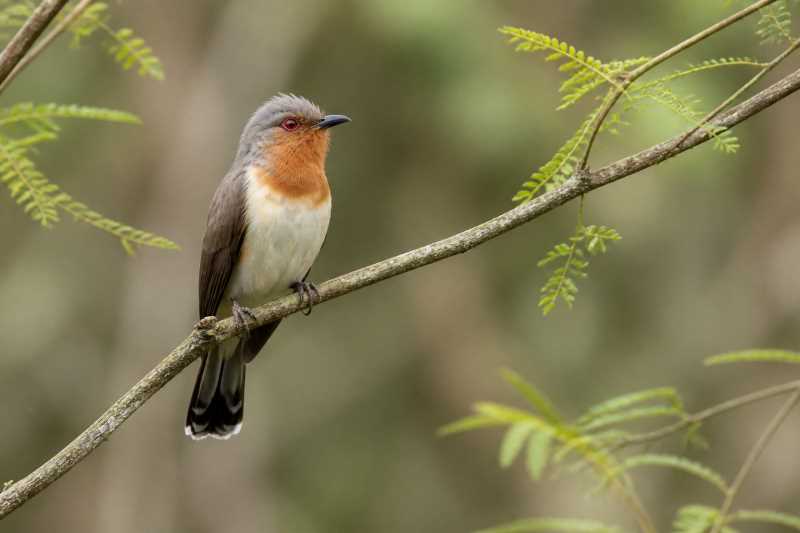
The Dwarf Cuckoo measures approximately 20–22 cm in length. Adults have greyish-brown upperparts, a rufous face, throat and upper breast, and pale creamy underparts. The wings and tail are darker, with contrasting pale markings on the tail feathers. The bill is dark, and the eye is reddish.
Males and females are generally similar in appearance. Juveniles are less clearly marked and may appear duller overall. Its compact body, relatively short wings and longish tail give it a different profile from the larger Squirrel Cuckoo.
Range and Habitat
The Dwarf Cuckoo occurs mainly in northern and western Colombia and northern Venezuela. Regional checklists also recognise records or marginal occurrence in eastern Panama and far northern Ecuador, although its distribution is much more concentrated in Colombia and Venezuela than the broad range suggested in some older accounts.
It uses tropical dry forest, gallery forest, riparian woodland, scrub, savanna with scattered trees, forest edges and secondary vegetation. It may also occur in heavily modified landscapes where patches of suitable woodland remain. Records are concentrated in lowlands and foothills, with local observations at higher elevations.
The species is generally considered resident rather than migratory. Geographic variation is limited because it is usually treated as a monotypic species, although local plumage and distributional differences may occur across its range.
Where to See This Species
Laguna de Sonso Nature Reserve, Valle del Cauca, Colombia
The Laguna de Sonso wetland complex and its surrounding woodland have documented records of Dwarf Cuckoo. The combination of gallery forest, scrub, wetlands and open country provides suitable habitat, although the species is usually unobtrusive and may be detected more readily by its call than by sight.
Nearby accommodation: Buga is the nearest practical base, with hotels, guest houses and rural accommodation available in and around the town.
Rio Claro, Antioquia, Colombia
Dwarf Cuckoo has been recorded in the Rio Claro area, where forest edges, riparian vegetation and secondary woodland create appropriate conditions. The species is not necessarily common, so careful observation of dense vegetation along trails and watercourses is advisable.
Nearby accommodation: The Rio Claro area provides lodge and cabin accommodation, with additional hotels and guest houses in Doradal.
Encanto de Guanapalo, Casanare, Colombia
The Encanto de Guanapalo conservation area contains savanna, wetlands and connected gallery forests, and the Dwarf Cuckoo is listed among its biome-restricted birds. The species is most likely to be encountered in gallery woodland and wooded edges rather than in open grassland.
Nearby accommodation: San Luis de Palenque is the nearest recognised town, with rural lodges, guest houses and community-based accommodation in the wider Llanos region.
Behaviour and Diet
The Dwarf Cuckoo is diurnal, shy and usually solitary. It often remains motionless within dense foliage, moving quietly through shrubs, woodland edges and low vegetation. When disturbed, it may make a short flight between nearby branches before disappearing into cover.
Its diet consists mainly of insects and other small invertebrates. It may glean prey from leaves and branches or make short sallies from a perch. Caterpillars and other soft-bodied insects are likely to be important food items, although detailed dietary studies are limited.
Its calls are described as soft, repetitive or grating notes, sometimes rendered as a short churr or a series of dry, rough syllables. Vocalisations can be useful for locating birds that remain hidden.
Detailed breeding information is limited. Unlike the familiar brood-parasitic cuckoos of the Old World, the Dwarf Cuckoo is not generally treated as an obligate brood parasite. Available regional accounts describe nest building and parental care by the species itself, but further field study is needed to clarify its nesting biology and breeding season across its range.
Identification Tips
- Look for a small, compact cuckoo with grey-brown upperparts, a rufous head and breast, and pale creamy underparts.
- A dark bill and reddish eye help separate it from some other small cuckoos.
- The bird often stays low in dense vegetation and may be easier to locate by its dry, repetitive call.
- The Dwarf Cuckoo is smaller than the Little Cuckoo (Coccycua minuta), which is usually more obviously associated with a yellow bill and red orbital skin.
- It is much smaller and less boldly patterned than the Squirrel Cuckoo (Piaya cayana), which has a longer tail and a more conspicuous overall appearance.
Conservation Status
The Dwarf Cuckoo is currently assessed as Least Concern. It has a broad distribution and is recorded in a range of natural, semi-natural and modified habitats. A reliable global population estimate and detailed population trend are not available.
The main potential threats are the continued loss and fragmentation of tropical dry forest, gallery woodland and riparian vegetation through agricultural expansion, grazing, development and the removal of woodland corridors. Protecting remaining dry-forest fragments, maintaining riparian vegetation and improving habitat connectivity are important conservation measures.
Frequently Asked Questions
Where is the Dwarf Cuckoo found?
It is found mainly in northern and western Colombia and northern Venezuela, with marginal or regional records in eastern Panama and far northern Ecuador.
What habitat does the Dwarf Cuckoo prefer?
It favours tropical dry forest, gallery forest, riparian woodland, scrub, forest edges and secondary vegetation, including some semi-open landscapes with scattered trees.
How large is the Dwarf Cuckoo?
The species is approximately 20–22 cm long, making it noticeably smaller than the Squirrel Cuckoo and slightly smaller than the Little Cuckoo.
What does the Dwarf Cuckoo eat?
It feeds mainly on insects and other small invertebrates, which it gleans from vegetation or catches during short flights from a perch.
Is the Dwarf Cuckoo a brood parasite?
It is not generally regarded as an obligate brood parasite. Regional accounts indicate that it builds its own nest and cares for its young, although its breeding biology remains poorly documented.
How can the Dwarf Cuckoo be identified in the field?
Look for a small, shy cuckoo with grey-brown upperparts, a rufous face and breast, creamy underparts, a dark bill and a reddish eye. Its rough, repetitive call may reveal its presence before the bird is seen.
References
- BirdLife International
- IOC World Bird List
- Key Biodiversity Areas Partnership
Related posts