The White-bellied Bustard: An Enigmatic Avian Marvel
The White-bellied Bustard (Eupodotis senegalensis) is an intriguing member of the bustard family, a group known for their elusive nature and distinctive appearance. These birds are native to the grasslands and savannas of sub-Saharan Africa, where they play a crucial role in the ecosystem. With their striking plumage and fascinating behavior, White-bellied Bustards are a subject of great interest to ornithologists and bird enthusiasts alike.
Habitat and Distribution
White-bellied Bustards are widely distributed across the African continent, inhabiting countries such as Senegal, Ethiopia, Kenya, and Tanzania. They prefer open landscapes like savannas, grasslands, and semi-arid regions, where they can blend seamlessly into their surroundings. These habitats provide the birds with ample food resources and nesting sites, crucial for their survival.
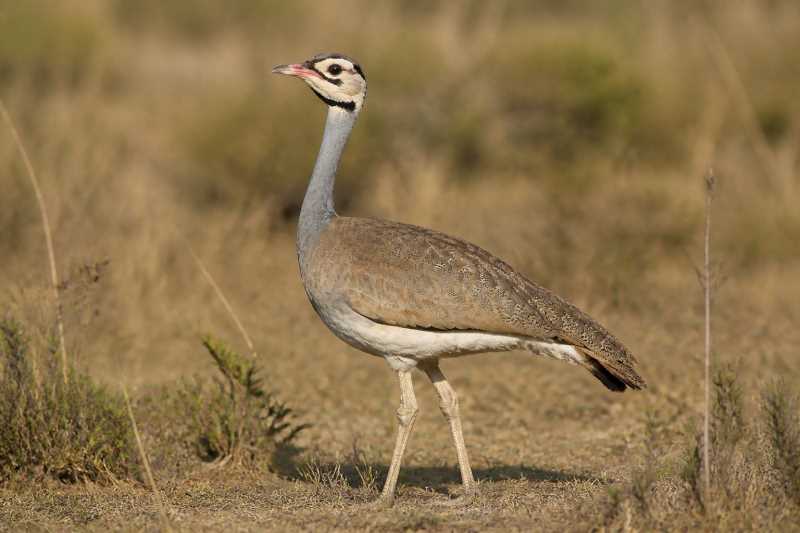
The adaptation of the White-bellied Bustard to these environments is remarkable. Their cryptic coloration, with mottled brown upperparts and a striking white belly, allows them to remain inconspicuous among the grasses. This camouflage is essential for avoiding predators and for successful nesting.
Physical Characteristics
The White-bellied Bustard is a medium-sized bird, measuring approximately 50 to 60 centimeters in length. Males are typically larger and more colorful than females, a common trait among bustards. The males boast a striking plumage with a white belly, dark brown back, and a distinctive black and white pattern on the head and neck. Females, on the other hand, display more subdued colors, which aid in nesting camouflage.
Their robust build and strong legs are suited for their terrestrial lifestyle, allowing them to walk long distances in search of food. Despite their size, White-bellied Bustards are capable of swift, low-level flight when necessary, although they prefer to rely on their legs for mobility.
Diet and Foraging Behavior
White-bellied Bustards are omnivorous, with a diet that includes a variety of plant matter, insects, and small vertebrates. Their feeding habits are opportunistic, often depending on the availability of food in their habitat. During the breeding season, they primarily consume insects, which provide the necessary protein for egg production and chick development.
These birds employ a foraging strategy known as "pecking," where they walk slowly through the grassland, pecking at food items on the ground. Their keen eyesight helps them spot prey from a distance, while their strong beaks are adept at handling a range of food types.
Breeding and Reproduction
The breeding season for White-bellied Bustards varies depending on their geographical location, but it generally coincides with the rainy season when food resources are abundant. Males are polygynous, meaning they mate with multiple females during a single breeding season.
Courtship displays are an integral part of their reproductive behavior. Males perform elaborate displays to attract females, involving puffing out their throats, raising their crests, and making booming calls that can be heard over long distances. Once a female is attracted, mating takes place, and the female assumes sole responsibility for nesting and chick-rearing.
Females lay one to three eggs in a simple ground nest, often a shallow scrape lined with bits of vegetation. The eggs are well-camouflaged, blending in with the surrounding environment to protect them from predators. Incubation lasts around 23 to 25 days, after which the chicks hatch and are cared for by the female until they are capable of fending for themselves.
Conservation Status and Threats
Currently, the White-bellied Bustard is classified as "Least Concern" by the International Union for Conservation of Nature (IUCN). However, like many grassland species, they face threats from habitat loss due to agricultural expansion, human encroachment, and climate change.
Conservation efforts are crucial to ensure the survival of these birds. Protecting their habitats and raising awareness about their ecological role are essential steps in preserving their populations. Additionally, more research is needed to fully understand their ecology and behavior, which will inform effective conservation strategies.
Conclusion
The White-bellied Bustard is a fascinating bird that embodies the beauty and complexity of Africa’s grasslands. Its unique adaptations, intriguing behaviors, and role in the ecosystem make it a vital species worthy of study and conservation. By safeguarding their habitats and promoting sustainable land use practices, we can help ensure that future generations will continue to marvel at the sight of the White-bellied Bustard striding gracefully across the African savanna.
Related posts