Introduction
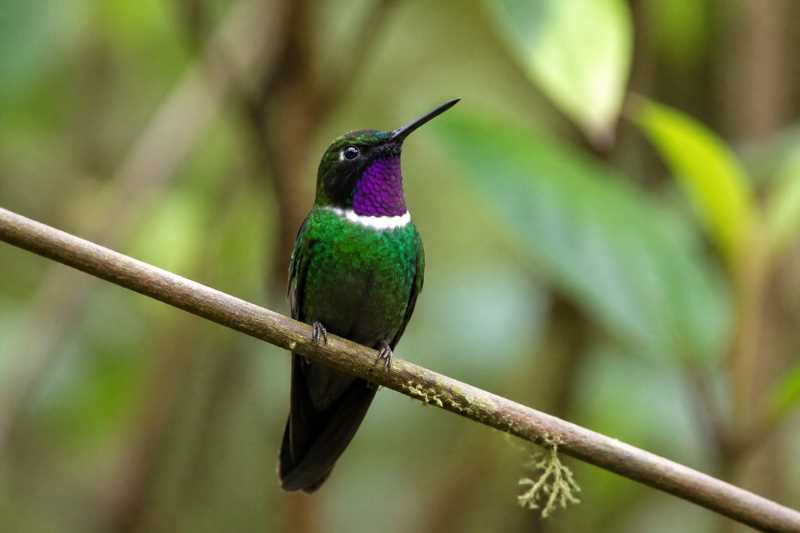
The Gorgeted Sunangel (Heliangelus strophianus) is a small, resident hummingbird of the western Andes. It occurs in south-western Colombia and north-western Ecuador, where it inhabits humid montane forest, forest edges and shrubby growth. The species is recognised for the male’s iridescent rosy-violet throat and contrasting white breast band. (birdguides.io)
Physical Description
The Gorgeted Sunangel is approximately 10–11 centimetres long. Both sexes have dark velvety-green upperparts, a small white spot behind the eye, dark wings and a dark steel-blue tail. The bill is short, straight and blackish. (en.wikipedia.org)
The adult male has a small glittering green frontlet above the bill, a dark chin and an iridescent rosy to violet gorget on the throat and upper breast. A clearly defined white band lies immediately below the gorget. The female is less brightly marked, with a dark grey-brown throat, pale feather edges and only a weak suggestion of the male’s throat colour and white band. Juveniles resemble females and generally show a narrower, less distinct breast band. (en.wikipedia.org)
The throat feathers are highly iridescent, so their colour can change noticeably with the angle of the light. This effect is produced by the structure of the feathers rather than by a change in pigment.
Range and Habitat
The Gorgeted Sunangel is restricted to the western Andes of south-western Colombia and north-western Ecuador. It is considered a resident species rather than a long-distance migrant. Its distribution is associated with humid premontane and montane forest, cloud forest margins, dense secondary vegetation and shrubby habitats at middle to high elevations.
Available records place it broadly within the Andean elevation zone of about 1,500–3,500 metres, although the exact altitude varies between localities. In Ecuador, it is regularly recorded in the Chocó-Andean cloud forests west and north-west of Quito. The species depends on flowering plants for nectar but may also use disturbed edges and gardens where suitable vegetation remains.
Where to See This Species
Bellavista Cloud Forest Reserve, Pichincha, Ecuador
Bellavista protects approximately 400 hectares of cloud forest in the Tandayapa Valley and has documented the Gorgeted Sunangel at its hummingbird feeders and within the surrounding forest. The reserve’s forested slopes, flowering plants and upper-elevation location make it a realistic place to search, although visitors should arrange access in advance. (bellavistacloudforest.com)
Nearby accommodation: Bellavista has on-site lodge accommodation, while Tandayapa and the wider Mindo area offer additional lodges, guest houses and small hotels.
Reserva Las Gralarias, Pichincha, Ecuador
Reserva Las Gralarias is a private cloud-forest reserve in the Mindo region with a documented list of hummingbirds that includes the Gorgeted Sunangel. Look around flowering plants, forest edges and hummingbird viewing areas, particularly in the reserve’s middle and upper-elevation habitats. Visits and accommodation should be arranged before arrival. (reservalasgralarias.org)
Nearby accommodation: The reserve provides visitor accommodation, and the nearby town of Mindo has lodges, guest houses and small hotels.
Mashpi Amagusa Reserve, Pichincha, Ecuador
Mashpi Amagusa is a privately managed reserve in the Chocó-Andean region that lists the Gorgeted Sunangel among its recorded birds. Its moist forest, flowering gardens and varied elevations provide suitable habitat. The reserve is accessible to visitors by prior arrangement and offers guided birdwatching and overnight stays. (mashpi-amagusa.com)
Nearby accommodation: Mashpi Amagusa offers lodge accommodation; other options are available in the wider Mashpi area and around Mindo.
Behaviour and Diet
Gorgeted Sunangels are usually encountered singly. Like many hummingbirds, they may defend productive feeding areas and chase other hummingbirds from favoured flowers or perches. Their flight is fast and highly manoeuvrable, but they often pause on exposed twigs or branches between feeding visits.
Nectar from flowering plants is the principal food, and the bird’s long tongue allows it to reach into tubular flowers. It also takes small insects and other arthropods, especially when additional protein is needed. By visiting flowers, it contributes to the pollination of Andean plants.
Detailed information about nesting dates, incubation and parental care is limited. The species is generally regarded as territorial during breeding, but local timing may vary with altitude, rainfall and flowering conditions.
Identification Tips
- Look for a small, dark-green hummingbird with a short blackish bill and a dark steel-blue tail.
- In good light, an adult male shows a bright rosy-violet throat bordered below by a conspicuous white breast band.
- The green frontlet above the male’s bill is a useful supporting feature, although it can be difficult to see in poor light.
- Females and juveniles are duller, with dark mottling on the throat and a less obvious white band.
- The combination of a rosy-violet gorget, white breast band, green body and dark tail helps separate it from other sunangels in the Ecuadorian Andes.
- Identification should be based on several features together, because iridescent throat colours can appear dull, purple, pink or nearly black depending on the viewing angle.
Conservation Status
The Gorgeted Sunangel is currently assessed as Least Concern on the global IUCN Red List. Its population size has not been reliably quantified, and available assessments indicate that the population is declining. The principal concern is the continuing loss and degradation of humid Andean forest through agricultural expansion, road development, settlement and other land-use changes.
Protection of cloud forest, restoration of degraded habitat and maintenance of flowering vegetation are important conservation measures. Well-managed private reserves and protected areas in the Chocó-Andean region help retain habitat, while responsible bird monitoring can improve knowledge of the species’ distribution and population trend. (en.wikipedia.org)
Frequently Asked Questions
Where can the Gorgeted Sunangel be found?
It occurs in south-western Colombia and north-western Ecuador, mainly in humid premontane and montane forest on the western Andes.
What does a male Gorgeted Sunangel look like?
The male is dark green with a small green frontlet, an iridescent rosy-violet throat and a contrasting white band across the upper breast.
How large is the Gorgeted Sunangel?
It is approximately 10–11 centimetres long, making it a small hummingbird.
What does the Gorgeted Sunangel eat?
It feeds mainly on nectar from flowering plants and also takes small insects and other arthropods.
Is the Gorgeted Sunangel migratory?
It is considered resident within its Andean range rather than a long-distance migrant, although local movements may occur in response to food availability and habitat conditions.
Is the Gorgeted Sunangel endangered?
It is currently listed as Least Concern, but habitat loss and degradation are believed to be contributing to a declining population trend.
References
- BirdLife International
- IUCN Red List of Threatened Species
- IOC World Bird List
Related posts