Introduction
Salvadori’s Teal (Salvadorina waigiuensis) is a secretive waterfowl species endemic to New Guinea. It belongs to the monotypic genus Salvadorina and is closely associated with mountain streams, rivers and highland lakes. Although it is difficult to observe, it remains an important specialist of New Guinea’s freshwater ecosystems.
Physical Description
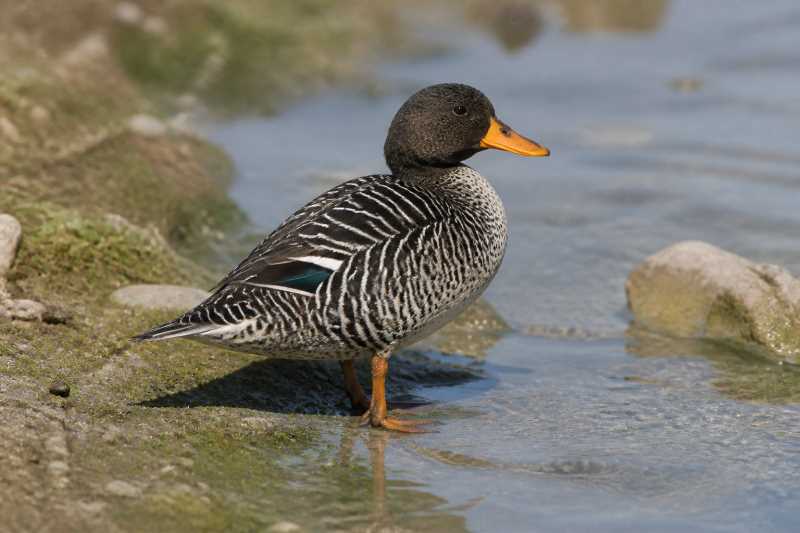
Salvadori’s Teal is a medium-sized duck measuring approximately 38–43 centimetres in length. It has a dark brown to blackish head and neck, a yellow bill, and yellowish-orange legs and feet. The upperparts are dark and often show pale edging, while the breast and flanks are whitish to buff with dark spotting that becomes heavier and more barred towards the sides and rear of the body.
The sexes are broadly similar, although males are generally slightly larger. Females may have a duller, greyer bill, while juveniles are less glossy and less strongly marked, with darker bills and paler greyish legs. In flight, the wings show dark flight feathers with pale edging and a contrasting pale wing bar.
Range and Habitat
Salvadori’s Teal is endemic to the island of New Guinea, occurring in both Papua New Guinea and the Indonesian provinces of Papua. It is generally associated with upland rivers, fast-flowing streams, rocky mountain torrents and alpine or subalpine lakes. Most records come from montane areas, but the species has also been recorded locally at much lower elevations, showing that it is not restricted to the highest mountains.
The species is resident rather than a long-distance migrant, although local movements may occur between streams, lakes and other suitable freshwater habitats. It favours clear, well-oxygenated water bordered by forest, dense riparian vegetation, grassland or wet mountain vegetation. Its distribution is difficult to define precisely because many parts of New Guinea are remote and the bird is shy and easily overlooked.
Where to See This Species
Salvadori’s Teal is not a straightforward bird to find. Visitors should use local guides, check access arrangements and concentrate on quiet streams, river margins and highland lakes within documented areas of occurrence.
Kokoda Track, Northern Province, Papua New Guinea
Salvadori’s Teal is included in published bird records from the Kokoda Track area, with observations around Isurava. Mountain streams and forested river corridors along the track provide suitable habitat, although sightings are likely to be infrequent and may require patient observation near quiet water.
Nearby accommodation: Kokoda and surrounding villages provide guest houses, village stays and trekking camps, while organised walking groups commonly use basic camps along the route.
Crater Mountain Wildlife Management Area, Eastern Highlands Province, Papua New Guinea
The species has been recorded in the Crater Mountain Wildlife Management Area, where field studies have also documented breeding activity. Forest streams, wet valleys and upland watercourses provide appropriate habitat, but access is generally through community-based visits and guided fieldwork rather than independent tourism.
Nearby accommodation: Kainantu and Goroka are the most practical regional accommodation centres, with hotels, guest houses and organised guiding services available before travelling to the wildlife management area.
Behaviour and Diet
Salvadori’s Teal is wary, elusive and usually encountered alone, in pairs or in small groups. It often keeps close to cover beside streams and may quickly disappear into vegetation when disturbed. The species is generally considered diurnal, although its secretive behaviour and remote habitat can make its activity patterns difficult to observe.
It forages in shallow water and along stream margins, taking a mixture of aquatic invertebrates, small aquatic organisms, seeds and other plant material. The precise composition of its diet is not well documented, and the importance of different food types may vary between fast-flowing streams, lakes and wet mountain habitats.
Breeding information remains limited. Nests are associated with freshwater habitats, and field observations indicate that breeding occurs in suitable mountain environments during the drier part of the year in at least some areas. Further study is needed to clarify nesting sites, clutch size, incubation and the roles of both adults.
Identification Tips
Look for a medium-sized, dark-headed duck beside a fast stream or highland lake. The combination of a yellow bill, yellowish-orange legs, dark upperparts, pale spotted underparts and bold flank barring is distinctive.
Salvadori’s Teal can be confused with other dark ducks when seen briefly or in poor light, but its strongly patterned sides and mountain-stream habitat are useful clues. The yellow bill and orange-toned legs also help separate it from the more uniformly coloured Pacific Black Duck, which is common in a wider range of lowland and wetland habitats.
Conservation Status
Salvadori’s Teal is currently classified as Least Concern on the IUCN Red List. This category does not mean that the species is free from risk. It is poorly known, locally uncommon and dependent on specialised freshwater habitats that can be affected by hunting, habitat degradation, forest clearance, road construction, altered stream flows and disturbance.
Introduced predators and other changes around mountain waterways may also create local pressure, but the extent of these threats is not well quantified. Conservation priorities include protecting montane forests and river corridors, maintaining natural stream flows, reducing unsustainable hunting, supporting community-managed protected areas and improving surveys of distribution, population trend and breeding ecology.
Frequently Asked Questions
Where is Salvadori’s Teal found?
It is endemic to New Guinea and occurs in suitable freshwater habitats in Papua New Guinea and Indonesian Papua. It is most often associated with mountain streams, rivers and highland lakes.
Is Salvadori’s Teal endangered?
The species is currently listed as Least Concern by the IUCN. However, it is secretive, poorly surveyed and vulnerable to local habitat degradation and hunting.
What does Salvadori’s Teal look like?
It is a medium-sized dark-headed duck with a yellow bill, yellowish-orange legs, pale spotted underparts and strong dark barring on the flanks and rear body.
What does Salvadori’s Teal eat?
Its diet includes aquatic invertebrates, other small aquatic organisms, seeds and plant material gathered from shallow water and stream margins.
Is Salvadori’s Teal migratory?
It is regarded as resident rather than a long-distance migrant. Local movements between streams, rivers and lakes may occur when conditions or food availability change.
Where can birdwatchers look for Salvadori’s Teal?
Documented areas include the Kokoda Track region and Crater Mountain Wildlife Management Area in Papua New Guinea. Both locations require careful planning, suitable local guidance and patience because sightings are uncommon.
References
- BirdLife International
- IUCN Red List of Threatened Species
- Bishop Museum, Distribution, Diversity and Conservation of Vertebrates in the Kokoda Track Area
Related posts