Introduction
The Black Langur, scientifically known as Trachypithecus ebenus, is a captivating and lesser-known primate species belonging to the family Cercopithecidae. These arboreal mammals are a fascinating subject for research and conservation efforts due to their unique behaviors and ecological significance. Primarily found in specific regions of Southeast Asia, the Black Langur plays a crucial role in its habitat’s ecological balance. This article delves into various aspects of the Black Langur, including its physical description, habitat, behavior, diet, identification tips, and conservation status.
Physical Description
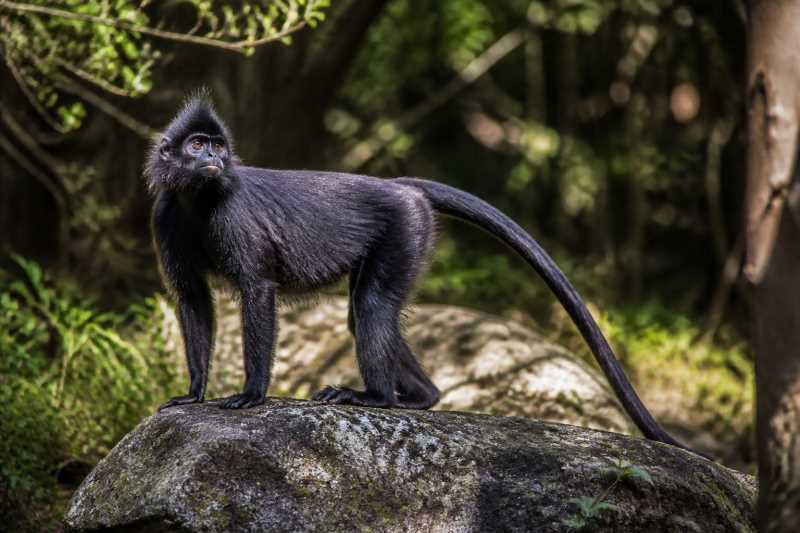
The Black Langur is renowned for its striking appearance, characterized by its glossy black coat, which provides excellent camouflage among the dense foliage of its forest habitat. Adult Black Langurs typically exhibit sexual dimorphism, with males being slightly larger than females. Males can weigh between 7 to 11 kilograms, while females typically weigh between 5 to 8 kilograms.
Their long, slender limbs and prehensile tail, which is often longer than their body, are perfectly adapted for an arboreal lifestyle. The Black Langur’s face is hairless and features a prominent brow ridge, giving it a distinctive profile. The species’ eyes are deep-set and expressive, providing excellent vision for navigating the forest canopy.
Range and Habitat
Black Langurs are native to the dense tropical and subtropical forests of Southeast Asia, specifically in regions of Vietnam and Laos. These primates prefer evergreen and semi-evergreen forests, where they can find abundant food sources and ample shelter.
Their habitat ranges from lowland forests to mountainous regions, up to elevations of 1,500 meters. The presence of rivers and streams is also a common characteristic of their habitat, as these water sources are crucial for their survival. Unfortunately, deforestation and habitat degradation pose significant threats to their natural environment, leading to fragmented populations.
Behavior and Diet
Black Langurs are social animals that live in groups, typically consisting of one dominant male, several females, and their offspring. These groups, often referred to as troops, are highly territorial and communicate through a series of vocalizations, facial expressions, and body postures.
Their diet primarily consists of leaves, fruits, flowers, and seeds, which they forage from the forest canopy. The Black Langur’s digestive system is specially adapted to process a high-fiber diet, allowing them to extract maximum nutrients from their food.
Feeding usually occurs in the early morning and late afternoon when temperatures are cooler. During the hottest parts of the day, Black Langurs engage in social grooming and resting to conserve energy.
Identification Tips (field recognition cues)
Identifying Black Langurs in their natural habitat can be challenging due to their elusive nature and the dense forest cover they inhabit. However, several field recognition cues can aid in spotting them:
- Glossy Black Coat: The Black Langur’s distinct glossy black fur is a primary identifying feature.
- Long Prehensile Tail: Watch for their long, agile tail used for balance and navigation through trees.
- Vocalizations: Listen for their distinct calls, often a series of hoots and grunts used for communication within the troop.
- Group Behavior: Look for groups of langurs moving together through the canopy, often led by a dominant male.
Conservation Status (with threats and protections)
The Black Langur is classified as Near Threatened by the International Union for Conservation of Nature (IUCN). The primary threats to their survival include habitat loss due to logging and agricultural expansion, as well as hunting for the illegal wildlife trade.
Conservation efforts are crucial to ensure the survival of this species. Protected areas such as national parks and nature reserves play a vital role in safeguarding their habitats. Additionally, conservation organizations are working to raise awareness about the importance of preserving the Black Langur and its ecosystem.
Frequently Asked Questions
What is the primary diet of the Black Langur?
The Black Langur primarily feeds on leaves, fruits, flowers, and seeds. Their digestive system is specially adapted to process high-fiber plant material.
Where can Black Langurs be found?
Black Langurs are native to Southeast Asia, specifically in the forests of Vietnam and Laos, preferring evergreen and semi-evergreen forest habitats.
How do Black Langurs communicate?
Black Langurs communicate through vocalizations, facial expressions, and body postures. Their calls include hoots and grunts that help maintain group cohesion and warn of potential threats.
What are the main threats to the Black Langur?
The primary threats include habitat loss due to deforestation, agricultural expansion, and hunting for the illegal wildlife trade. Conservation efforts are critical to their survival.
How can one identify a Black Langur in the wild?
Key identification cues include their glossy black coat, long prehensile tail, distinctive vocalizations, and group behavior often led by a dominant male.
Related posts