The Enigmatic White-tailed Trogon: A Closer Look at Trogon chionurus
The White-tailed Trogon, scientifically known as Trogon chionurus, is a captivating bird species belonging to the family Trogonidae. Renowned for its vibrant plumage and elusive nature, this bird inhabits the lush tropical forests of Central and South America. As an integral part of the ecosystem, the White-tailed Trogon plays a significant role in seed dispersal and maintaining the ecological balance of its habitat. This article delves into the fascinating world of the White-tailed Trogon, exploring its taxonomy, habitat, behavior, and conservation status.
Taxonomy and Classification
The White-tailed Trogon falls under the order Trogoniformes, which includes the family Trogonidae. The genus Trogon comprises several species, each with distinct characteristics and geographical distributions. The specific epithet ‘chionurus’ is derived from the Greek words ‘chion’ meaning snow and ‘oura’ meaning tail, referring to the bird’s distinctive white tail feathers. First described by John Gould in 1848, Trogon chionurus was initially considered a subspecies of the Violaceous Trogon (Trogon violaceus). However, subsequent studies, particularly those focusing on vocalizations and morphological distinctions, have led to its classification as a separate species.
Physical Description
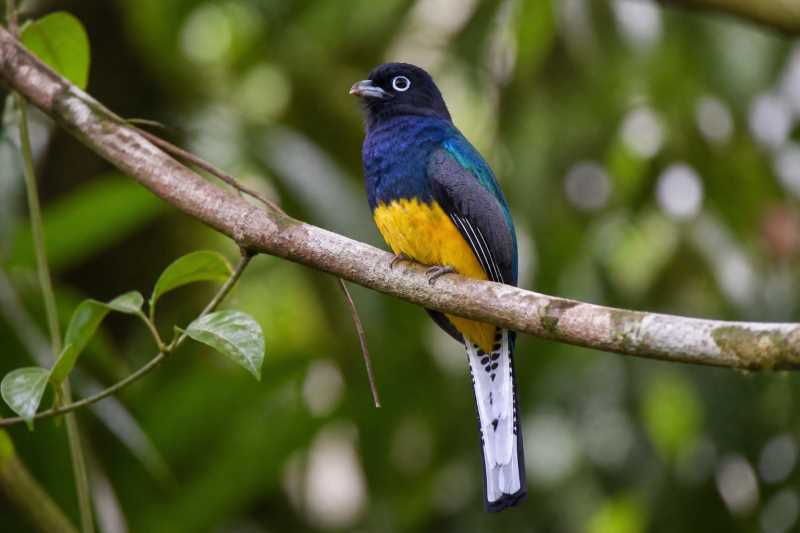
The White-tailed Trogon is a medium-sized bird, measuring between 25 to 28 centimeters in length. It exhibits sexual dimorphism, with males and females differing slightly in appearance. Males boast a striking combination of metallic green upperparts and a bright yellow belly. The head is adorned with a black face and throat, contrasting vividly with the iridescent blue-green crown. The tail, as implied by its name, is predominantly white with a black base. Females, on the other hand, display more muted tones, with a more subdued olive-green back and a brownish hue on the head.
One of the most distinctive features of the White-tailed Trogon is its tail, which serves various functions, from communication to courtship displays. The bird’s eyes are encircled by a bare, bright yellow eye-ring, adding to its striking appearance.
Habitat and Distribution
The White-tailed Trogon inhabits the tropical and subtropical rainforests of Central and South America. Its range extends from southern Honduras through Nicaragua, Costa Rica, and Panama, reaching into the Pacific lowlands of Colombia and Ecuador. Within these regions, the trogon favors dense, humid forests, often residing at elevations up to 1,200 meters.
These birds are typically found in the lower and mid-levels of the forest canopy, where they can easily access their primary food sources. While they prefer undisturbed primary forests, White-tailed Trogons can also adapt to secondary growth forests and edge habitats, provided there is adequate cover and food availability.
Diet and Feeding Behavior
White-tailed Trogons are primarily frugivorous, with fruits constituting the bulk of their diet. Their short, broad bills are well-suited for plucking fruits from branches and consuming them whole. Apart from fruits, these birds occasionally supplement their diet with insects, particularly during the breeding season when the demand for protein increases.
The trogon’s feeding behavior is characterized by a sit-and-wait strategy. They perch quietly on branches within the forest canopy, scanning for ripe fruits or unsuspecting insects. Once a suitable food source is identified, the trogon will swiftly fly to the target, snatch the food, and return to its perch to consume it.
Behavior and Social Structure
White-tailed Trogons are generally solitary or found in pairs, especially during the breeding season. They are known for their elusive nature, often remaining still and silent for extended periods. This behavior, combined with their ability to blend into the forest environment, makes them challenging to observe in the wild.
Vocalizations play a crucial role in the communication of White-tailed Trogons. Their calls are typically low-pitched, resonant notes, used primarily for territory defense and mate attraction. These vocalizations vary slightly between different populations, contributing to the understanding of their taxonomy and classification.
Breeding and Reproduction
The breeding season for White-tailed Trogons generally coincides with the onset of the rainy season, which varies geographically across their range. Courtship involves a series of vocal displays and aerial maneuvers, with males showcasing their vibrant plumage to attract females.
Nesting occurs in natural cavities, such as old woodpecker holes, or excavated nests in termite mounds. The female lays a clutch of two to three eggs, which both parents incubate. The incubation period lasts approximately 16 to 18 days, followed by a fledging period of about 25 days. During this time, both parents are actively involved in feeding and caring for the chicks, ensuring their survival in the competitive forest environment.
Conservation Status and Threats
The IUCN Red List currently classifies the White-tailed Trogon as a species of Least Concern. Despite this classification, the bird faces several threats that could impact its population in the future. Habitat destruction, primarily due to deforestation and agricultural expansion, poses the most significant threat to the species. As forests are cleared for timber and converted into farmland, the trogon’s habitat is fragmented, leading to population declines.
Conservation efforts for the White-tailed Trogon focus on habitat preservation and the establishment of protected areas. Initiatives aimed at promoting sustainable agricultural practices and reforestation projects are also crucial in ensuring the long-term survival of this species.
Conclusion
The White-tailed Trogon is a remarkable bird, captivating birdwatchers and researchers alike with its vibrant colors and elusive behavior. Understanding its ecological role and the challenges it faces is vital for developing effective conservation strategies. By preserving its natural habitat and promoting awareness, we can ensure that future generations continue to marvel at the beauty of the White-tailed Trogon.
As we strive to protect the biodiversity of our planet, the White-tailed Trogon serves as a reminder of the intricate connections that sustain life in tropical ecosystems. Through continued research and conservation efforts, we can safeguard this enigmatic species and its habitat, contributing to the overall health of our planet’s natural heritage.
Related posts