Forbes’s Forest Rail: The Enigmatic Bird of Papua New Guinea
Nestled within the lush, dense forests of Papua New Guinea, a small, elusive bird known as Forbes’s Forest Rail (Rallicula forbesi) makes its home. A member of the Rallidae family, this bird is a symbol of the region’s rich biodiversity and an indicator of the health of its forest ecosystems. Despite its elusive nature, the Forbes’s Forest Rail offers a fascinating glimpse into the avian diversity of New Guinea, a biodiversity hotspot.
Taxonomy and Description
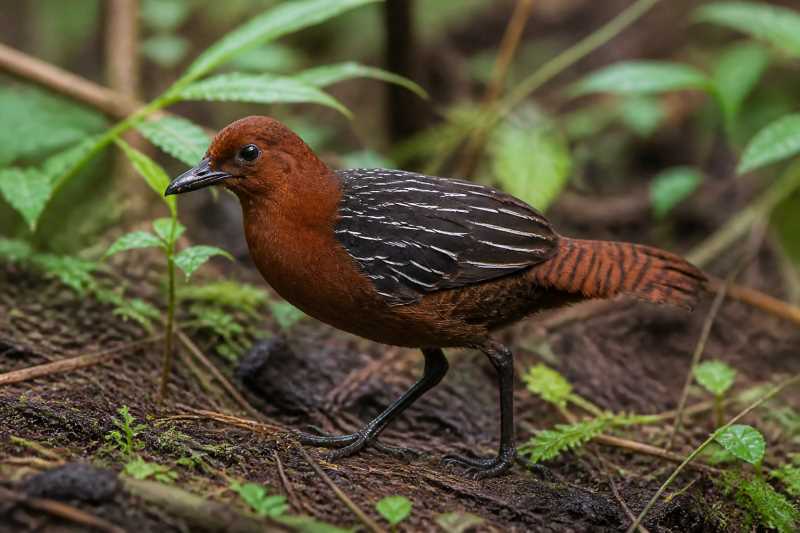
Forbes’s Forest Rail was named in honor of the British ornithologist Henry Ogg Forbes, who was instrumental in documenting the avian species of New Guinea. The Rallicula genus, to which this bird belongs, comprises several species of forest rails, all of which are endemic to the island of New Guinea. Forbes’s Forest Rail is a small, terrestrial bird, measuring about 20-25 cm in length. It features a striking plumage with dark olive-brown upperparts and chestnut underparts, complemented by a distinctive white throat and a hint of barring on its flanks.
The bird’s morphology is well-adapted to its forest floor habitat. Its strong legs and long toes are perfect for navigating through the dense undergrowth and leaf litter where it forages for food. The rail’s beak is slightly curved, aiding in the extraction of insects and other invertebrates from the forest floor.
Habitat and Distribution
Forbes’s Forest Rail is endemic to the montane and submontane rainforests of Papua New Guinea, typically found at elevations ranging from 1,000 to 2,500 meters. These forests, characterized by high humidity and dense vegetation, provide the ideal environment for the rail’s secretive lifestyle. The bird’s preference for remote, high-altitude forests has made it relatively insulated from human disturbances, although habitat loss due to logging and agricultural expansion poses a potential threat.
The distribution of Forbes’s Forest Rail is largely confined to the central and eastern parts of the island, where it occupies a niche within the complex ecosystem of the New Guinean montane forests. These areas are renowned for their high levels of endemism and biodiversity, hosting myriad plant and animal species found nowhere else on Earth.
Behavior and Ecology
Forbes’s Forest Rail is primarily terrestrial, spending most of its time on the forest floor, where it forages for insects, small invertebrates, and seeds. Its diet plays a crucial role in controlling insect populations within its habitat, thereby maintaining ecological balance. The bird is generally solitary or found in pairs and is known for its secretive nature, often remaining hidden within the dense undergrowth.
The rail’s vocalizations are one of the few ways it can be detected in its natural habitat. Its calls, a series of sharp whistles and trills, echo through the forest, particularly during the early morning and late afternoon. These vocalizations serve as both territorial markers and mating calls, playing a vital role in the bird’s social interactions.
Conservation Status and Challenges
The IUCN Red List currently categorizes Forbes’s Forest Rail as a species of "Least Concern." However, this status does not imply the absence of threats. The primary challenges facing Forbes’s Forest Rail are habitat loss and degradation. Expanding agricultural activities, logging, and infrastructure development pose significant threats to the montane forest ecosystems of Papua New Guinea.
Additionally, climate change may alter the delicate balance of these habitats, potentially impacting the availability of resources and suitable breeding sites for the rail. Conservation efforts must focus on preserving the integrity of these forest ecosystems through sustainable management practices and protection from deforestation.
Importance of Forbes’s Forest Rail
Forbes’s Forest Rail is a key species for understanding the ecological dynamics of New Guinea’s montane forests. As an indicator species, changes in its population can reflect broader environmental changes, making it an important subject for ecological research and conservation planning.
Moreover, the rail’s presence underscores the global significance of New Guinea as a center of avian diversity. Efforts to study and conserve this species contribute to broader initiatives aimed at preserving the unique biodiversity of the region.
Conclusion
Forbes’s Forest Rail stands as a testament to the rich, yet fragile biodiversity of Papua New Guinea’s montane forests. Protecting this elusive bird and its habitat is crucial not only for its survival but also for the preservation of the ecological balance within these forests. Through concerted conservation efforts and increased awareness, we can ensure that Forbes’s Forest Rail continues to thrive, serving as a symbol of the natural heritage of New Guinea for generations to come.
Related posts