Introduction
The Red-necked Spurfowl (Pternistis afer) is a ground-dwelling gamebird in the pheasant family, Phasianidae. It is also known in some sources as the Red-necked Francolin. The species is resident rather than migratory and occurs widely across suitable habitats in sub-Saharan Africa. Taxonomic authorities place it in the genus Pternistis, although older literature often used the name Francolinus afer. (itis.gov)
Physical Description
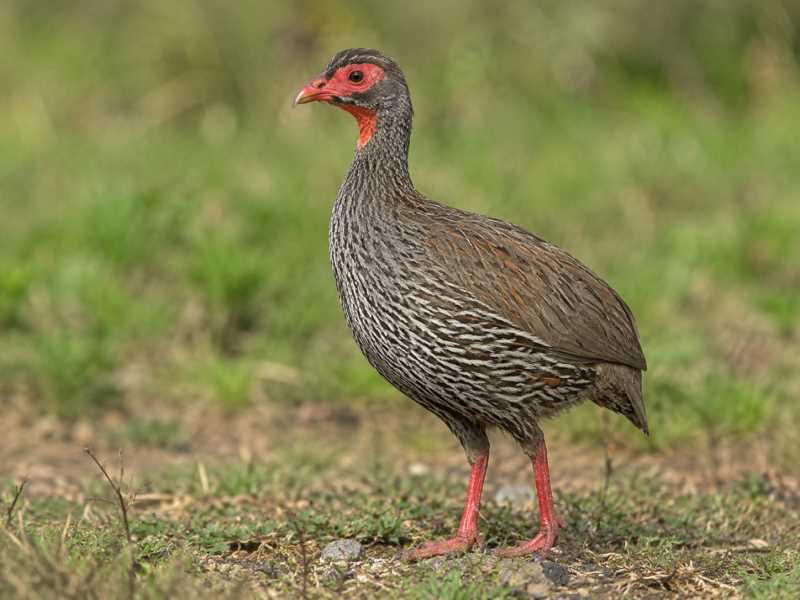
The Red-necked Spurfowl is a medium-sized, robust bird, generally measuring about 30–35 cm in length. Its body is mainly brown, grey-brown and finely patterned, providing effective camouflage in grass, leaf litter and scrub. The head, throat and facial skin show contrasting reddish colouring, although the intensity and extent of the red vary geographically.
Plumage differs between subspecies and regional populations. Males and females are broadly similar, with sexual differences generally less pronounced than in many other pheasants and gamebirds. Adult birds have stronger, more clearly defined markings than juveniles, while young birds are usually duller and more heavily camouflaged. The legs are sturdy and adapted for walking and scratching through ground cover. Spurs, where present, are associated mainly with males and are used in contests between rivals.
Range and Habitat
The species has a broad but uneven distribution across sub-Saharan Africa, including parts of West, Central, East and southern Africa. Its range is not continuous, and the precise distribution varies among recognised subspecies and taxonomic treatments. It is a resident species and does not undertake regular long-distance migration.
Red-necked Spurfowls occupy savannas, grasslands, open woodland, forest margins, scrub and areas of dense ground cover. They are most often associated with habitats that provide both feeding opportunities and concealment, including tall grass, thickets, woodland understorey and vegetated edges near cultivated land. In parts of southern Africa, the species can also persist in modified landscapes, including farmland, parks and some suburban areas where suitable cover remains. Research in South Africa has shown that indigenous vegetation patches and corridors can be important in built-up coastal environments. (tandfonline.com)
Behaviour and Diet
The Red-necked Spurfowl spends most of its time on the ground. It normally walks or runs through vegetation and leaf litter, but will fly when flushed or threatened, usually for a short distance before returning to cover. Birds may occur singly, in pairs or in small family groups. Their calls are loud and characteristic, helping maintain contact between birds and signalling alarm or territorial presence.
Foraging takes place mainly on the ground, often during the cooler parts of the day. The diet includes seeds, grains, fruits, roots, bulbs, tubers and other plant material, supplemented by invertebrates such as termites, ticks and molluscs. Plant material may form a larger proportion of the diet during dry periods, while invertebrates can become more important when they are abundant after rainfall. Birds scratch and probe the soil and leaf litter while searching for food. (biodiversityexplorer.info)
Breeding timing varies across the species’ extensive range and is closely associated with local rainfall and food availability. The nest is a shallow scrape on the ground, usually concealed in grass or beneath a shrub and lined with plant material and sometimes feathers. Clutches commonly contain about 3–9 eggs. The female undertakes incubation, which lasts approximately 23 days according to southern African field accounts. Chicks are precocial, leaving the nest soon after hatching and following the adults while developing their foraging and predator-avoidance skills. (biodiversityexplorer.info)
Identification Tips
Look for a sturdy, ground-dwelling bird with:
- Brown, grey-brown and finely patterned plumage.
- A contrasting reddish face and throat, with regional variation in colour.
- Strong legs and a relatively short, rounded-winged appearance.
- A preference for walking through cover rather than remaining in the open.
- A loud call, often heard before the bird is seen.
The combination of reddish facial and throat markings, heavily patterned brown plumage and terrestrial behaviour is usually more useful for identification than any single plumage feature. Care is needed because other Pternistis species may also have reddish or brightly coloured facial areas. Local field guides should be consulted when identifying birds in regions where Red-necked Spurfowl overlaps with related spurfowls.
Conservation Status
The Red-necked Spurfowl is classified as Least Concern on the IUCN Red List. The assessment recognises its extensive distribution and reports the species as generally common to abundant, although a precise global population estimate is not available. The overall population trend is not considered to indicate a sufficiently rapid decline for a threatened category. (car.birdmap.africa)
The species can nevertheless be affected locally by loss and fragmentation of vegetation, agricultural expansion, intensive land management and hunting. These pressures may be significant in areas where suitable ground cover has been removed or populations are isolated. Maintaining native grassland, scrub and woodland understorey, protecting habitat corridors and applying sustainable hunting regulations are important conservation measures. A Least Concern assessment does not mean that every local population is secure.
Frequently Asked Questions
Where does the Red-necked Spurfowl live?
It occurs across parts of sub-Saharan Africa, including regions of West, Central, East and southern Africa. It favours savannas, grasslands, open woodland, scrub and forest edges with dense ground cover.
Is the Red-necked Spurfowl migratory?
No. It is generally resident and remains within its home range throughout the year, although local movements may occur in response to rainfall, food availability or changes in habitat conditions.
What does the Red-necked Spurfowl eat?
Its diet includes seeds, grains, fruits, roots, bulbs, tubers and other plant material. It also eats invertebrates, including termites and other small ground-dwelling animals.
Where does it build its nest?
The nest is a shallow scrape on the ground, usually hidden in grass, leaf litter or beneath a shrub. The female commonly lays between three and nine eggs.
Can Red-necked Spurfowls fly?
Yes. Although they spend most of their time walking or running, they can make short, rapid flights when flushed or threatened.
Is the Red-necked Spurfowl endangered?
No. The species is currently assessed as Least Concern by the IUCN. Local populations may still face habitat loss, fragmentation and hunting pressure.
References
- BirdLife International. 2018. Pternistis afer. The IUCN Red List of Threatened Species 2018: e.T22678855A132050529. International Union for Conservation of Nature. https://doi.org/10.2305/IUCN.UK.2018-2.RLTS.T22678855A132050529.en. Accessed 8 September 2026.
- Gill, F., Donsker, D. and Rasmussen, P. (eds.). n.d. IOC World Bird List, version 15.2. International Ornithologists’ Union. https://www.worldbirdnames.org/ Accessed 8 September 2026.
- Mandiwana-Neudani, T. G., Little, R. M., Crowe, T. M. and Bowie, R. C. K. 2019. Taxonomy, phylogeny and biogeography of African spurfowls, Galliformes, Phasianidae, Phasianinae, Coturnicini: Pternistis spp. Ostrich: Journal of African Ornithology 90(2): 145–172. https://doi.org/10.2989/00306525.2019.1584925.
- van Niekerk, J. H. 2021. Population ecology of Red-necked Spurfowl Pternistis afer in the coastal towns of the Eastern Cape province, South Africa. Ostrich: Journal of African Ornithology 92(1): 32–40. https://doi.org/10.2989/00306525.2020.1794997.
- Hamish Robertson. n.d. Pternistis afer (Red-necked Spurfowl): species account. Biodiversity Explorer, University of Cape Town Animal Demography Unit. https://www.biodiversityexplorer.info/birds/phasianidae/pternistis_afer.htm Accessed 8 September 2026.
- Integrated Taxonomic Information System. n.d. Pternistis afer (P. L. S. Müller, 1776), Taxonomic Serial No. 553859. U.S. Department of Agriculture and partner agencies. https://www.itis.gov/servlet/SingleRpt/SingleRpt?search_topic=TSN&search_value=553859 Accessed 8 September 2026.
- BirdMap Africa. n.d. Red-necked Spurfowl (Pternistis afer). Coordinated Avifaunal Roadcounts. https://car.birdmap.africa/species/RNS Accessed 8 September 2026.
Related posts