Introduction
The Falkland Steamer Duck (Tachyeres brachypterus) is a large, flightless duck endemic to the Falkland Islands. It is a resident of the archipelago’s coastal waters, where territorial pairs occupy shorelines, sheltered bays and other inshore habitats. The species is also known locally as the Logger Duck. Its powerful wing-assisted swimming, which creates spray like a small paddle steamer, gives the group its distinctive common name.
Physical Description
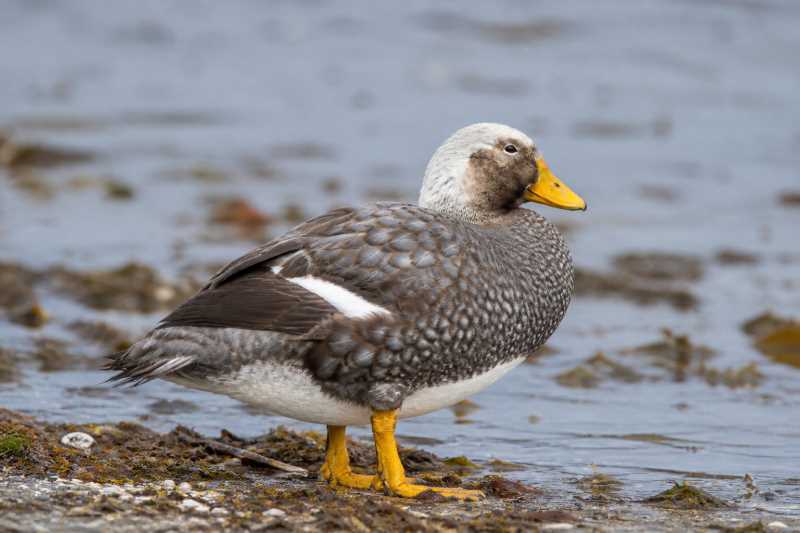
The Falkland Steamer Duck is a robust waterfowl measuring approximately 61–74 cm in length. It has a heavy body, short tail, broad bill, strong legs and greatly reduced wings that are unsuitable for flight.
Adult males generally have a paler grey head and neck, a darker body and a bright orange-yellow bill. Females are usually darker and browner on the head, with a duller olive-green bill. Both sexes show a pale line or ring around the eye, contrasting wing markings and yellowish to orange feet. Young birds are duller and less strongly marked than adults, gradually developing adult plumage during their first year.
The shortened wings are not useless. When moving rapidly across the water, the duck beats its wings while running and paddling with its feet, producing a characteristic churning movement. This adaptation provides fast movement through shallow coastal water but does not enable sustained flight.
Range and Habitat
The Falkland Steamer Duck occurs only in the Falkland Islands and is a non-migratory resident. It is widely distributed around the archipelago, particularly along rocky shores, sheltered bays, kelp beds, stony beaches and other productive inshore marine habitats. Pairs are less common along very exposed ocean coasts and some open sandy beaches.
The species may also use small freshwater bodies and shoreline vegetation, especially near nesting areas. Nests are concealed among rocks, tussac grass, fern beds or other dense vegetation close to the coast. Coastal territories are occupied throughout the year, and the birds generally remain near their established shoreline range.
Where to See This Species
Stanley Harbour and waterfront, East Falkland, Falkland Islands
The sheltered coastline around Stanley Harbour is one of the most practical places to look for Falkland Steamer Ducks. Birds are recorded along the harbour, nearby shoreline and surrounding coastal areas, where rocky edges, small beaches and inshore feeding grounds provide suitable habitat. A careful walk along the waterfront can produce close views, although birds should be watched without approaching nesting territories.
Nearby accommodation: Stanley is the main gateway settlement, with hotels, guest houses, self-catering accommodation and other visitor facilities.
Kidney Island Nature Reserve, East Falkland, Falkland Islands
Kidney Island supports tussac habitat and coastal bird communities, and recent surveys recorded Falkland Steamer Ducks there. Access is controlled and may require a visitor permit or organised visit, so arrangements should be confirmed before travelling. The island’s protected shoreline provides an appropriate setting for observing the species alongside other Falkland wildlife.
Nearby accommodation: Stanley is the practical accommodation base, with hotels, guest houses and self-catering options, followed by an organised boat visit where permitted.
Behaviour and Diet
Falkland Steamer Ducks are strongly territorial. Established pairs defend stretches of coastline and may behave aggressively towards rivals or other birds that enter their territory. They are usually seen resting on rocks, swimming close to shore, diving or feeding among kelp and shallow submerged habitat.
They feed mainly on marine invertebrates, including molluscs and crustaceans, together with other small aquatic prey. They obtain food by diving, dabbling and probing in shallow water. Their broad, powerful bills are suited to handling hard-shelled prey.
Breeding takes place during the austral spring and summer. Nest sites are usually concealed near the shoreline, and the female lays a clutch of several eggs. Ducklings are precocial, leaving the nest soon after hatching and following the adults to feeding areas. The male commonly remains involved in territorial defence and protection of the family group.
Identification Tips
- Look for a large, heavy-bodied duck with a short tail and noticeably small wings.
- The species is usually found close to rocky coasts, sheltered bays or kelp beds rather than on open inland water.
- Adult males are generally paler-headed with a brighter orange-yellow bill.
- Females and immature birds are browner and duller, with an olive-toned bill.
- The white or pale eye marking helps distinguish the species, but plumage can vary with age and sex.
- The most distinctive behaviour is rapid, noisy movement across the water using the wings and feet together.
- The similar Flying Steamer Duck, Tachyeres patachonicus, has been reported in the Falkland Islands, but its status and distinction from the island population have been the subject of taxonomic discussion. In the field, the Falkland Steamer Duck is generally identified by its stockier build, shorter wings and flightless behaviour.
Conservation Status
The Falkland Steamer Duck is currently assessed as Least Concern. It is locally common and widely distributed around the Falkland Islands, but its entire global range is restricted to the archipelago.
Potential threats include oil spills and other marine pollution, marine debris, disturbance at coastal territories, coastal development and degradation of shoreline habitat. Because the species cannot fly, pollution or changes affecting nearshore feeding grounds may have a particularly direct impact. Protection of coastal habitat, responsible wildlife tourism, biosecurity and continued monitoring of breeding territories are important conservation measures.
Frequently Asked Questions
Is the Falkland Steamer Duck flightless?
Yes. Its wings are too short to support flight, but they are used with the feet to propel the bird rapidly across the water.
Where does the Falkland Steamer Duck live?
It lives only in the Falkland Islands, mainly along rocky coasts, sheltered bays, kelp beds and other inshore marine habitats.
What does the Falkland Steamer Duck eat?
Its diet consists mainly of marine invertebrates such as molluscs and crustaceans, together with other small aquatic prey collected by diving and dabbling.
How can the sexes be distinguished?
Males are generally paler-headed and have a brighter orange-yellow bill. Females are usually browner, with a duller olive-green bill. Immature birds are less strongly marked.
When is the best time to see this species?
The species is present throughout the year because it is a resident rather than a long-distance migrant. Local conditions, weather and access determine viewing opportunities, but sheltered coastal areas can be productive in any season.
Why is it called a steamer duck?
When moving quickly, it beats its wings and paddles with its feet while running across the water. The resulting spray and churning motion resemble the action of an old paddle steamer.
References
- BirdLife International
- Falkland Islands Government
- Falklands Conservation
Related posts