Introduction
The African Emerald Cuckoo (Chrysococcyx cupreus) is a small, often elusive cuckoo of sub-Saharan Africa. It is best known for the male’s metallic green plumage, bright yellow underparts and distinctive whistled call. The species is usually encountered in forest, woodland and well-wooded riparian habitats, where it is often heard before it is seen.
Physical Description
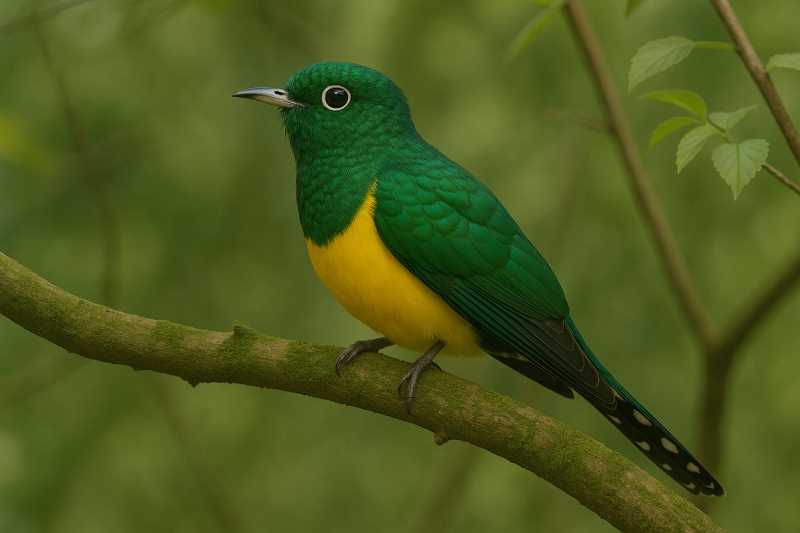
The African Emerald Cuckoo is about 20 centimetres long. Adult males have metallic green upperparts and upper breast, with bright yellow lower breast and belly. Their plumage can appear especially vivid in good light, although the bird often remains concealed in dense foliage.
Females are less brightly coloured. They are generally bronzy or greenish above, with strong barring on the underparts. Juveniles resemble females and are also barred. White markings on the outer tail feathers are visible in both sexes and can assist identification. The bill is slightly curved, and the legs and feet are typically slate-coloured.
The species shows marked sexual dimorphism, with the male’s vivid green and yellow plumage contrasting strongly with the more cryptic plumage of the female and young birds.
Range and Habitat
The African Emerald Cuckoo occurs widely across sub-Saharan Africa, from West Africa through Central and East Africa and southwards into southern Africa. Its distribution includes countries such as Senegal, Ghana, Cameroon, the Democratic Republic of the Congo, Uganda, Kenya, Tanzania, Zambia, Zimbabwe, Mozambique, South Africa and Eswatini.
It favours evergreen and semi-evergreen forest, forest galleries, riparian woodland, coastal forest, Afromontane forest and densely wooded, moist savanna. It may also use secondary woodland, forest edges and mature trees in cultivated or urban areas, provided that sufficient cover and insect prey are available.
The species is not confined to lowland rainforest. It occurs from low elevations to montane forest, although the precise elevation range varies across its broad distribution. Southern African birds are generally regarded as intra-African migrants, with numbers increasing during the warmer months. The extent of movement is uncertain, and some birds may remain resident in suitable habitat.
Where to See This Species
Kruger National Park, Limpopo and Mpumalanga, South Africa
The African Emerald Cuckoo is included on the official Kruger National Park bird checklist. It is an uncommon and often seasonal bird in the park, so the best opportunities are likely to be in wooded areas, riverine vegetation and forest-edge habitat, particularly during the warmer months. Listening for its clear, repeated whistle is often more productive than searching the canopy visually.
Nearby accommodation: SANParks camps and lodges are available within the park, with guesthouses, hotels and self-catering accommodation in gateway towns such as Phalaborwa and Hazyview.
Shongweni Dam and Nature Reserve, KwaZulu-Natal, South Africa
BirdLife South Africa identifies the African Emerald Cuckoo as a summer species at Shongweni Dam and Nature Reserve. The reserve’s forested gorge, dense bush and riverine vegetation provide suitable habitat, and the bird may be detected by its call before it is seen.
Nearby accommodation: The reserve provides camping and other accommodation options, while Durban and surrounding towns offer hotels, guesthouses and self-catering accommodation.
iSimangaliso Wetland Park, Eastern Shores, KwaZulu-Natal, South Africa
The African Emerald Cuckoo is recorded as a summer species in the forested areas of the Eastern Shores section of iSimangaliso Wetland Park. Coastal forest, forest edges and trails near the St Lucia area are appropriate places to listen for it, especially during the warmer breeding season.
Nearby accommodation: St Lucia is the main gateway settlement and provides a range of lodges, guesthouses, hotels, campsites and self-catering accommodation.
Behaviour and Diet
The African Emerald Cuckoo is generally solitary and spends much of its time in the middle and upper layers of trees. It is secretive in dense vegetation and is more frequently heard than seen. The male’s loud, four-note whistle is often rendered as “pretty Georgie” and is one of the most useful ways to locate the species.
Its diet consists mainly of insects, especially caterpillars and other foliage-dwelling prey. Beetles, ants and additional invertebrates may also be taken. Small amounts of fruit or other plant material may supplement the diet, but the species is primarily insectivorous.
The African Emerald Cuckoo is an obligate brood parasite. The female lays her eggs in the nests of other small insectivorous birds rather than building a nest or raising a brood herself. Confirmed or well-supported hosts in southern Africa include Bleating Camaroptera, Starred Robin and Blue-grey Flycatcher. The full range of hosts across Africa remains incompletely documented.
Breeding activity in southern Africa is concentrated mainly in the warmer months. As with other brood-parasitic cuckoos, the young cuckoo receives food and care from its foster parents, although the details of competition between the cuckoo chick and host young can vary between host species.
Identification Tips
- Look for a small cuckoo with a long tail and a habit of remaining high in leafy trees.
- The male is distinctive, with metallic green upperparts and bright yellow lower underparts.
- The female and juvenile are bronzy or greenish above and strongly barred below.
- White markings on the outer tail feathers can be useful when the bird flies or shifts position.
- The four-note, whistled “pretty Georgie” call is often easier to detect than the bird itself.
- In southern Africa, take care not to confuse it with Klaas’s Cuckoo or Diederik Cuckoo. The African Emerald Cuckoo is generally more strongly associated with forest and dense woodland, while females and young birds require close attention to pattern and call.
Conservation Status
The African Emerald Cuckoo is currently classified as Least Concern on the IUCN Red List. It has a broad geographic range and is not regarded as globally threatened. However, forest clearance, agricultural expansion, degradation of riparian vegetation and fragmentation of wooded habitat may affect local populations.
Maintaining native forest, riverine woodland and habitat corridors is important for the species and for the small insectivorous birds that serve as its hosts. Monitoring seasonal movements and breeding interactions would also improve understanding of regional population changes.
Frequently Asked Questions
Where is the African Emerald Cuckoo found?
It is found across much of sub-Saharan Africa, from West Africa through Central and East Africa to southern Africa. It mainly occupies forest, woodland, riverine vegetation and other well-wooded habitats.
What does the African Emerald Cuckoo look like?
The male has metallic green upperparts and bright yellow lower underparts. Females and juveniles are more subdued, with bronzy or greenish upperparts and barred underparts.
What does the African Emerald Cuckoo sound like?
Its call is a clear, repeated four-note whistle commonly remembered by the phrase “pretty Georgie”. The call often reveals the bird’s presence before it can be seen.
What does the African Emerald Cuckoo eat?
It feeds mainly on insects, particularly caterpillars and other invertebrates found in foliage. Beetles, ants and occasional fruit may also be taken.
Is the African Emerald Cuckoo a brood parasite?
Yes. The female lays her eggs in the nests of other small insectivorous birds, which incubate the egg and raise the cuckoo chick. Known hosts in southern Africa include Bleating Camaroptera, Starred Robin and Blue-grey Flycatcher.
Is the African Emerald Cuckoo endangered?
No. It is currently listed as Least Concern, although habitat loss and degradation may create local pressures, particularly where forests, riparian vegetation and woodland corridors are being cleared.
References
- BirdLife International
- IUCN Red List of Threatened Species
- IOC World Bird List
Related posts