Introduction
The Sooty Ant Tanager (Driophlox gutturalis) is an enchanting yet elusive bird that has captured the interest of ornithologists and bird watchers alike. Found primarily in the dense tropical forests of northern Colombia, this species is a member of the Thraupidae family, known for its vibrant plumage and unique vocalizations. Despite its intriguing characteristics, the Sooty Ant Tanager remains relatively understudied, with much still to be discovered about its behaviors, habitat preferences, and ecological role. This article delves into the various aspects of this fascinating bird, from its physical characteristics and habitat to its behavior and conservation status.
Physical Characteristics
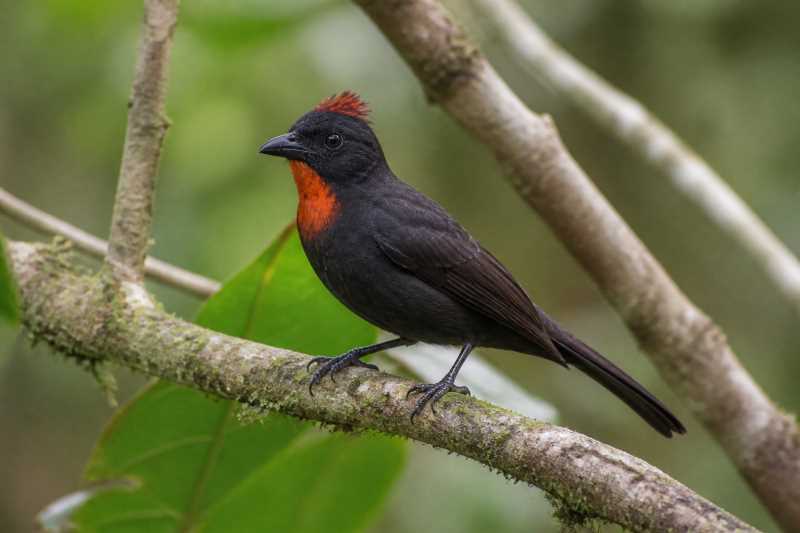
The Sooty Ant Tanager is a medium-sized bird, measuring approximately 17 to 18 centimeters in length. True to its name, its plumage is predominantly sooty black, with subtle hints of blue iridescence that shimmer under the right lighting conditions. One of its most distinguishing features is the bright, fiery red throat patch that contrasts starkly with its darker body, making it a striking sight for those fortunate enough to observe it in its natural habitat.
The bird’s bill is relatively short and robust, adapted for its diet which primarily consists of insects and other small invertebrates. Its legs are strong and adapted for foraging through leaf litter, a behavior that is typical for ant tanagers. The Sooty Ant Tanager’s eyes are dark, adding to its enigmatic appearance.
Habitat and Distribution
The Sooty Ant Tanager is endemic to Colombia, where it inhabits the lowland and foothill forests of the Magdalena Valley and adjacent regions. Its range is limited to elevations between 100 and 1,200 meters above sea level. The species favors dense, humid forests with a rich understory, often near water sources.
These birds tend to avoid heavily disturbed areas, preferring pristine habitats or regions with minimal human interference. The deforestation and habitat fragmentation in Colombia pose significant threats to their preferred habitats, making conservation efforts crucial for their survival.
Behavior and Ecology
Sooty Ant Tanagers are social birds, often found in small groups or pairs. They are known for their energetic foraging habits, frequently seen hopping through the undergrowth in search of insects, spiders, and other small prey. Their feeding strategy often involves flipping over leaves and probing into crevices to extract hidden food items.
Vocal communication is an essential aspect of their behavior, with a repertoire of calls used for maintaining group cohesion and deterring intruders. Their vocalizations are described as sharp, metallic notes that can carry through the dense forest cover.
Breeding behaviors of the Sooty Ant Tanager are not well-documented, but it is assumed that they exhibit similar nesting habits to other tanagers. Typically, they construct cup-shaped nests using twigs and leaves, camouflaged within the dense foliage.
Conservation Status
The International Union for Conservation of Nature (IUCN) currently classifies the Sooty Ant Tanager as Near Threatened. The primary threats to the species are habitat loss and degradation due to agricultural expansion, logging, and mining activities in Colombia. Conservation efforts are essential to protect the remaining forest habitats that these birds rely upon.
Various organizations are working towards preserving the forests of northern Colombia, recognizing the ecological importance of this region. Establishing protected areas and promoting sustainable land-use practices are critical strategies for ensuring the long-term survival of the Sooty Ant Tanager.
Conclusion
The Sooty Ant Tanager is a remarkable species that embodies the rich biodiversity of Colombia’s forests. Although relatively understudied, it plays a vital role in the ecosystem, contributing to insect population control and seed dispersal. Understanding its biology and ecology better is essential for developing effective conservation strategies.
Future research should focus on detailed studies of its breeding habits, population dynamics, and interactions with the ecosystem. Additionally, raising awareness about the importance of preserving its habitat can aid in garnering support for conservation initiatives.
In summary, the Sooty Ant Tanager is not just a bird of striking beauty but also a symbol of the delicate balance within tropical ecosystems. Protecting this species is crucial not only for its survival but also for the health of the forests it inhabits.
Related posts