Introduction
Sclater’s Monkey, scientifically known as Cercopithecus sclateri, is a fascinating primate species that captivates the attention of wildlife enthusiasts and researchers alike. Endemic to Nigeria, these monkeys belong to the Old World monkey family and are a part of the guenon group, known for their striking facial markings and lively behaviors. Despite their unique characteristics, Sclater’s Monkeys are not widely known outside of their native region, making them a subject of interest for both conservationists and primate lovers.
Physical Description
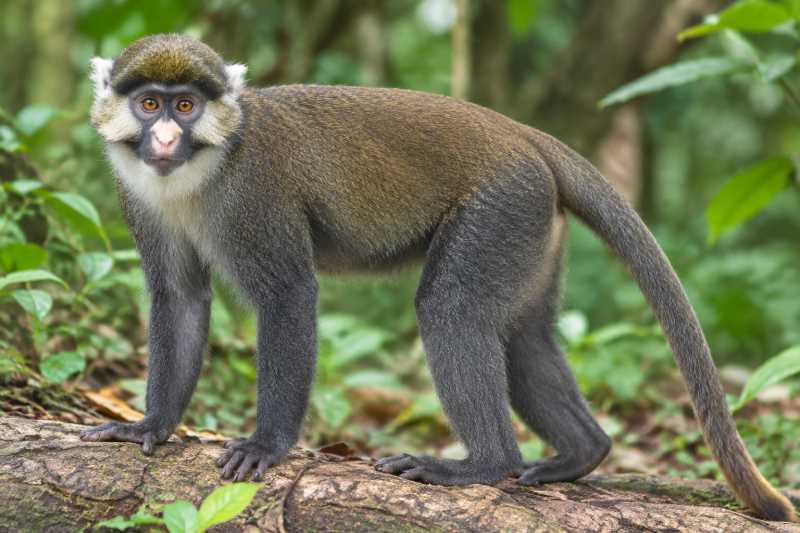
Sclater’s Monkeys are medium-sized primates, with adult males typically larger than females. They exhibit a sleek body covered with a dense, glossy coat of fur. The coloration of their fur is predominantly blackish-grey, with a distinctive white marking around the throat and chest area, giving them a somewhat regal appearance.
Their faces are particularly striking, featuring a combination of black and white markings that highlight their expressive eyes and prominent brows. The white fur extends from the cheeks to the sides of the neck, creating a contrast that enhances their visual appeal. The muzzle is black, and their large eyes are surrounded by a lighter hue, adding to their distinct look.
Sclater’s Monkeys have long limbs and a non-prehensile tail, which aids in balance rather than gripping. The tail is often tipped with a lighter shade, often white or light grey, which can be a useful identification mark in the field.
Range and Habitat
Sclater’s Monkeys are endemic to a restricted range within southern Nigeria. Their habitat primarily consists of lowland and montane forests, where they thrive in the dense canopy cover that provides both food and protection from predators.
These monkeys are most commonly found in primary and secondary forests, as well as swamp forests, which offer a rich diversity of flora and fauna. They are arboreal by nature, spending most of their time in the trees, which provide them with a safe refuge and a vantage point for foraging.
The geographical range of Sclater’s Monkeys is limited, making them a species of concern when it comes to conservation efforts. Their presence is largely recorded in areas such as the Cross River and the Niger Delta regions, where conservation initiatives are crucial to their survival.
Behavior and Diet
Sclater’s Monkeys are social animals, typically forming groups of 10 to 35 individuals. These groups are usually composed of multiple females and their young, with one or more males. Social interactions are complex and involve grooming, vocalizations, and playful activities, which help maintain group cohesion and establish social hierarchies.
Their diet is primarily frugivorous, consisting of a wide variety of fruits supplemented with leaves, seeds, and insects. The availability of food resources plays a significant role in their daily activities and movement patterns. During the dry season, when fruits are less abundant, they may rely more heavily on leaves and other vegetation.
Sclater’s Monkeys are diurnal, meaning they are active during the day. They spend the majority of their time foraging, resting, and engaging in social activities. Vocal communication is a key aspect of their behavior, with a range of calls used to convey information about food sources, predators, and social dynamics.
Identification Tips
Field recognition of Sclater’s Monkeys can be challenging due to their elusive nature and the dense habitats they occupy. However, several key features can aid in their identification:
- Distinctive Facial Markings: Look for the characteristic black and white facial pattern, with a white throat and cheek markings.
- Tail Characteristics: Observe the long tail with a lighter tip, often used for balance.
- Vocalizations: Listen for their unique calls, which can help locate them in dense foliage.
- Group Behavior: Spotting a group of these monkeys can be easier than finding a solitary individual, as they are often seen in small troops.
- Habitat Preference: Focus on areas of dense canopy cover within their known range in southern Nigeria.
Conservation Status
The conservation status of Sclater’s Monkey is currently classified as Endangered by the International Union for Conservation of Nature (IUCN). This status is due to a combination of factors that threaten their survival, including habitat loss, hunting, and human encroachment.
Threats:
- Habitat Destruction: Deforestation for agriculture, logging, and infrastructure development has significantly reduced their natural habitat.
- Hunting: Sclater’s Monkeys are hunted for bushmeat, a practice that poses a significant threat to their populations.
- Human Encroachment: Expanding human settlements and agricultural activities encroach on their habitats, leading to habitat fragmentation.
Protections:
Efforts to protect Sclater’s Monkeys are underway, with several initiatives focused on habitat preservation and reducing hunting pressures. Protected areas such as national parks and wildlife sanctuaries are crucial for their conservation. Additionally, community awareness programs aim to reduce hunting and promote sustainable practices.
Frequently Asked Questions
Q1: Where can Sclater’s Monkeys be found in the wild?
A: Sclater’s Monkeys are found exclusively in southern Nigeria, primarily in the Cross River and Niger Delta regions. They inhabit lowland and montane forests, favoring dense canopy areas.
Q2: What do Sclater’s Monkeys eat?
A: Their diet is mainly frugivorous, consisting of fruits, but they also eat leaves, seeds, and insects, especially when fruit is scarce.
Q3: How do Sclater’s Monkeys communicate?
A: These monkeys use a variety of vocalizations to communicate, conveying information about food sources, social interactions, and predator warnings.
Q4: What are the main threats to Sclater’s Monkeys?
A: The primary threats include habitat destruction, hunting for bushmeat, and human encroachment, all contributing to their endangered status.
Q5: Are there conservation efforts to protect Sclater’s Monkeys?
A: Yes, conservation efforts include habitat protection, anti-poaching initiatives, and community education programs to promote sustainable practices.
Related posts