Introduction
The Angolan colobus, scientifically known as Colobus angolensis, is a captivating primate species belonging to the family Cercopithecidae. Renowned for its striking black and white pelage, this Old World monkey inhabits various regions across Central and East Africa. Its unique appearance, combined with its arboreal lifestyle, makes the Angolan colobus a fascinating subject of study for primatologists and wildlife enthusiasts alike. This article delves into the physical characteristics, habitat preferences, behavioral patterns, and conservation status of this remarkable mammal.
Physical Description
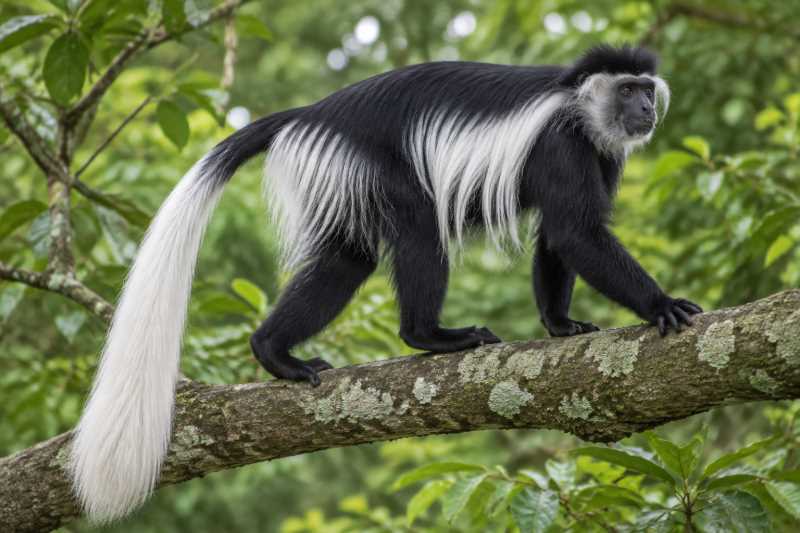
The Angolan colobus boasts a distinctive appearance, characterized by its contrasting black and white coloration. Adult individuals typically exhibit a glossy black coat with white accents along the shoulders, back, and tail. The long, flowing white mantle, which drapes elegantly over their bodies, is one of their most striking features. This species also has a white face framed by a halo of white hair, creating a sharp contrast against their dark facial skin.
On average, adult Angolan colobuses measure between 50 to 70 centimeters in body length, with an impressive tail length ranging from 70 to 100 centimeters. This elongated tail not only aids in balance but also serves as a visual signal in the dense forests they inhabit. Sexual dimorphism is present in this species, with males typically weighing between 9 to 20 kilograms, while females are slightly smaller, weighing 7 to 15 kilograms.
Their slender bodies and long limbs are adapted for an arboreal lifestyle, allowing them to navigate the treetops with agility. Unlike many other primates, the Angolan colobus lacks a thumb, a trait that aids in their ability to move swiftly through the forest canopy.
Range and Habitat
The Angolan colobus is widely distributed across Central and East Africa, with its range extending from Angola, the Democratic Republic of the Congo, and Zambia, to parts of Tanzania, Kenya, and Uganda. These primates predominantly inhabit tropical rainforests, where they occupy the upper canopy layers. Their preference for dense, moist forests ensures they remain well-camouflaged and protected from potential predators.
In addition to primary rainforests, Angolan colobuses can also thrive in secondary forests, montane forests, and gallery forests. These adaptable primates are occasionally found in swamp forests and riverine woodlands, demonstrating their ability to exploit a variety of forested environments.
Behavior and Diet
Angolan colobuses are highly social animals, typically forming groups ranging from 5 to 20 individuals. These groups are usually composed of a dominant male, several females, and their offspring. Social bonds within the group are reinforced through grooming, a critical activity that helps maintain hygiene and strengthens alliances.
The species is diurnal, spending the majority of daylight hours foraging, grooming, and resting. As folivores, Angolan colobuses primarily feed on leaves, which constitute the bulk of their diet. They also consume seeds, flowers, and fruits, depending on seasonal availability. Their specialized stomachs, which contain complex bacteria, enable them to digest cellulose-rich leaves efficiently.
Communication within groups is facilitated through a combination of vocalizations, facial expressions, and body postures. Alarm calls are particularly crucial for alerting group members to the presence of predators, such as leopards and large birds of prey.
Identification Tips (Field Recognition Cues)
Identifying the Angolan colobus in the field can be an exhilarating experience for wildlife observers. Here are some key identification tips:
- Coloration: Look for the striking black coat with a long, flowing white mantle. The contrast between the black body and white highlights is a signature characteristic.
- Size and Shape: Note the medium-sized, slender body with long limbs and an elongated tail, which aids in their arboreal locomotion.
- Facial Features: Observe the white face surrounded by a halo of white hair, which distinguishes them from other colobus species.
- Behavior: Watch for groups moving gracefully through the upper canopy, often leaping from tree to tree.
- Vocalizations: Listen for their distinct vocal calls, which are used for communication within the group.
Conservation Status (With Threats and Protections)
As of the latest assessments, the Angolan colobus is classified as a species of "Least Concern" on the IUCN Red List. However, this status does not imply that the species is free from threats. Habitat destruction, primarily due to deforestation and agricultural expansion, poses a significant threat to their populations. Additionally, hunting for bushmeat and the illegal pet trade further exacerbate their vulnerability.
Conservation efforts are crucial to ensuring the long-term survival of the Angolan colobus. Protected areas, such as national parks and wildlife reserves, play a vital role in safeguarding their habitats. Furthermore, community-based conservation initiatives that involve local populations in protecting forest ecosystems have shown promise in mitigating threats.
Frequently Asked Questions
Why is this species unique?
The Angolan colobus is unique due to its striking black and white coloration and its lack of a thumb, an adaptation that aids in its arboreal lifestyle. This combination of physical and behavioral traits distinguishes it from other primates.
What do Angolan colobuses eat?
Angolan colobuses primarily consume leaves, which are abundant in their forest habitats. Their specialized stomachs allow them to digest cellulose efficiently, making them well-adapted folivores.
Where can I see Angolan colobuses in the wild?
You can observe Angolan colobuses in various national parks and reserves across Central and East Africa, where they inhabit dense tropical rainforests. Parks in Tanzania, Kenya, and Uganda are popular destinations for wildlife enthusiasts seeking to see these primates.
How do Angolan colobuses communicate?
Communication within Angolan colobus groups is facilitated through vocalizations, facial expressions, and body postures. Alarm calls are particularly important for alerting group members to potential dangers.
What are the main threats to the Angolan colobus?
The primary threats to the Angolan colobus include habitat destruction due to deforestation and agricultural expansion, as well as hunting for bushmeat and the illegal pet trade. Conservation efforts are essential to mitigate these threats.
Related posts