Mackinnon’s Shrike: A Fascinating Avian Predator of Africa’s Forests
Mackinnon’s Shrike (Lanius mackinnoni) is a captivating bird species that inhabits the dense forests of Central Africa. Known for its distinctive hunting habits and striking appearance, this avian predator plays a unique role in its ecosystem. In this article, we will explore the physical characteristics, habitat, behavior, and conservation status of Mackinnon’s Shrike, shedding light on why this bird is an important subject of study for ornithologists and bird enthusiasts alike.
Physical Characteristics
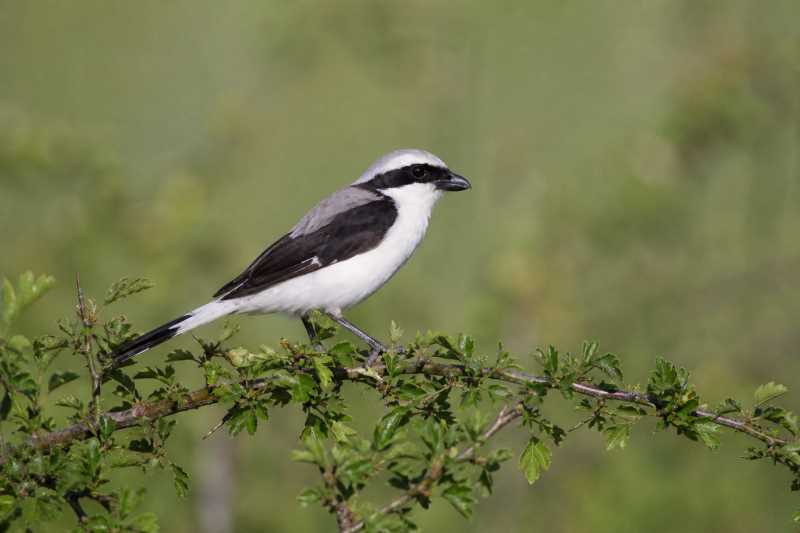
Mackinnon’s Shrike is a medium-sized bird, measuring approximately 20 to 23 centimeters in length with a wingspan of about 30 centimeters. It is characterized by its robust body, hooked bill, and strong legs. The plumage of Mackinnon’s Shrike is predominantly gray, with a distinctive black mask that extends from the forehead to the nape, enhancing its charismatic appearance. The wings are dark with white patches that become visible during flight, and the tail is relatively long, adding to its sleek profile.
One of the most striking features of Mackinnon’s Shrike is its sharp, hooked beak, which is perfectly adapted for its predatory lifestyle. This feature allows it to catch and kill prey with precision, making it a formidable hunter in the avian world.
Habitat and Distribution
Mackinnon’s Shrike is primarily found in the montane and submontane forests of Central Africa, including countries such as Uganda, Rwanda, Burundi, and parts of the Democratic Republic of the Congo. It prefers the edges of forests and areas with scattered trees, where it can easily spot and ambush prey.
The bird’s distribution is closely linked to its preferred habitat, which includes dense forests and woodland areas at elevations ranging from 1,000 to 3,000 meters. This preference for higher altitudes sets Mackinnon’s Shrike apart from many other shrike species, which are often associated with open habitats.
Behavior and Diet
Mackinnon’s Shrike is known for its solitary and territorial behavior. It is an adept hunter, preying on a variety of insects, small mammals, and birds. The bird employs a "sit-and-wait" hunting strategy, perching conspicuously on tree branches to scan the surroundings for potential prey. Once it spots a target, it swoops down with remarkable speed and precision, using its hooked beak to capture and kill its prey.
In addition to its hunting prowess, Mackinnon’s Shrike is also known for its unique behavior of impaling its prey on thorns or barbed wire. This behavior, common among shrikes, serves multiple purposes: it allows the bird to store food for later consumption, helps in tearing apart larger prey, and may even serve as a display to attract mates or deter competitors.
Breeding and Reproduction
The breeding season of Mackinnon’s Shrike typically occurs during the rainy months, when food is abundant. The bird constructs a cup-shaped nest using twigs, grass, and other plant materials, often placing it in a tree or shrub at a considerable height to protect it from predators.
Both the male and female participate in nest building and caring for the young. The female lays a clutch of three to five eggs, which she incubates for about two weeks. After hatching, the chicks are fed by both parents and fledge approximately three weeks later. The cooperative breeding behavior of Mackinnon’s Shrike is crucial for the survival and development of the offspring, ensuring that they receive adequate nourishment and protection.
Conservation Status
Mackinnon’s Shrike is currently listed as a species of Least Concern by the International Union for Conservation of Nature (IUCN). However, like many forest-dependent species, it faces threats from habitat loss due to deforestation and land conversion for agriculture.
Conservation efforts aimed at preserving forest habitats are essential for the long-term survival of Mackinnon’s Shrike. Protecting the bird’s natural habitat not only benefits the shrike but also supports a wide range of other species that rely on the same ecosystem.
Conclusion
Mackinnon’s Shrike is a remarkable bird that exemplifies the intricate relationships between predators and their ecosystems. Its unique adaptations, hunting strategies, and behavioral traits make it a fascinating subject for study and conservation. As we continue to explore the rich biodiversity of Central Africa, Mackinnon’s Shrike serves as a reminder of the importance of preserving our natural world for future generations.
By understanding and appreciating the role of species like Mackinnon’s Shrike, we can work towards a more sustainable future where both wildlife and humans coexist harmoniously.
References
- BirdLife International (2023). "Lanius mackinnoni: Mackinnon’s Shrike". The IUCN Red List of Threatened Species.
- Fry, C. H., et al. (2000). "The Birds of Africa: Volume VI". Academic Press.
- Urban, E. K., et al. (1997). "The Birds of Africa: Volume V". Academic Press.
Related posts