The Enigmatic Barred Hawk: A Guardian of the Canopy
The Barred Hawk (Morphnarchus princeps) is a captivating bird of prey that resides in the lush, verdant landscapes of Central and South America. Known for its striking appearance and elusive behavior, this species is a subject of fascination for ornithologists and birdwatchers alike. This article delves into the intriguing world of the Barred Hawk, exploring its habitat, behavior, diet, and conservation status, while highlighting its significance in the avian world.
Habitat and Distribution
The Barred Hawk is predominantly found in the tropical rainforests of Central and South America, with its range extending from Costa Rica and Panama down to Colombia, Ecuador, and Peru. This bird thrives in montane and lowland forests, preferring regions with high humidity and dense canopy cover. It is typically found at elevations ranging from 500 to 2,500 meters, although sightings at higher altitudes are not uncommon.
The hawk’s preference for dense forested areas with ample tree cover provides it with the necessary resources for hunting and nesting. These habitats offer a rich biodiversity that supports a variety of prey species, contributing to the hawk’s survival and reproductive success.
Physical Characteristics
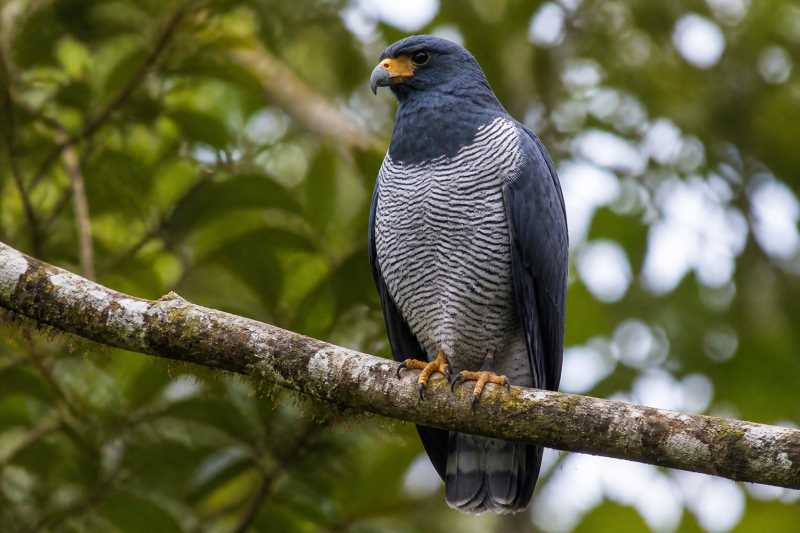
The Barred Hawk is a medium-sized raptor, measuring approximately 46 to 55 centimeters in length, with a wingspan ranging from 85 to 95 centimeters. Its plumage is predominantly black, with distinctive white barring across its chest and underparts, which gives the bird its name. The contrast between the dark upperparts and the barred underparts is striking and aids in identification.
Another notable feature of the Barred Hawk is its broad, rounded wings and short tail, which allow it to maneuver effectively through the dense forest canopy. Its sharp, hooked beak and powerful talons are well-adapted for capturing and subduing prey.
Behavior and Hunting Techniques
Barred Hawks are solitary and territorial birds, often seen perched silently on a high branch, scanning the forest floor for potential prey. They primarily feed on small mammals, birds, and reptiles, using their keen eyesight to detect movement below.
Hunting is typically carried out from a perch, where the hawk will wait patiently before swooping down with precision to capture its prey. This sit-and-wait strategy is highly effective in the dense forest environment, where speed and stealth are crucial for success.
Reproduction and Lifespan
The breeding season for Barred Hawks usually coincides with the rainy season, when prey availability is at its peak. During this time, males engage in elaborate courtship displays, involving aerial acrobatics and vocalizations, to attract a mate.
Once a pair has formed, they work together to build a nest, typically situated high in the canopy of a large tree. The female lays a single egg, which both parents incubate. After hatching, the chick is cared for by both parents until it fledges, which occurs approximately six to eight weeks after hatching.
Barred Hawks have a relatively long lifespan, with individuals living up to 20 years in the wild, provided they can avoid natural predators and human-induced threats.
Conservation Status and Threats
Currently, the Barred Hawk is classified as a species of Least Concern by the International Union for Conservation of Nature (IUCN). However, like many forest-dwelling species, it faces threats from habitat destruction and fragmentation due to deforestation and agricultural expansion.
Conservation efforts aimed at preserving tropical rainforests are essential for the continued survival of the Barred Hawk and other forest-dependent species. Initiatives that promote sustainable land-use practices and the establishment of protected areas are crucial in mitigating habitat loss and ensuring the long-term viability of these ecosystems.
The Significance of the Barred Hawk
The Barred Hawk plays a vital role in maintaining the ecological balance of its habitat. As a top predator, it helps regulate populations of small mammals, birds, and reptiles, thus contributing to the overall health and stability of the ecosystem.
Moreover, the presence of Barred Hawks can serve as an indicator of forest health, as these birds require large, contiguous tracts of forest to thrive. Their presence signifies a well-functioning ecosystem capable of supporting diverse wildlife.
Conclusion
The Barred Hawk, with its striking appearance and elusive nature, continues to captivate those who venture into its forested realm. Understanding and protecting this remarkable raptor is crucial, not only for its own survival but also for the health of the tropical ecosystems it inhabits. Through continued research and conservation efforts, we can ensure that the Barred Hawk remains a guardian of the canopy for generations to come.
Related posts