Introduction
The Cameroon Olive Pigeon, Columba sjostedti, is a large, range-restricted pigeon of the Cameroon Highlands and adjacent parts of Nigeria and Bioko Island in Equatorial Guinea. It is associated mainly with humid montane and submontane forests, where its dark plumage and quiet behaviour can make it difficult to detect.
Physical Description
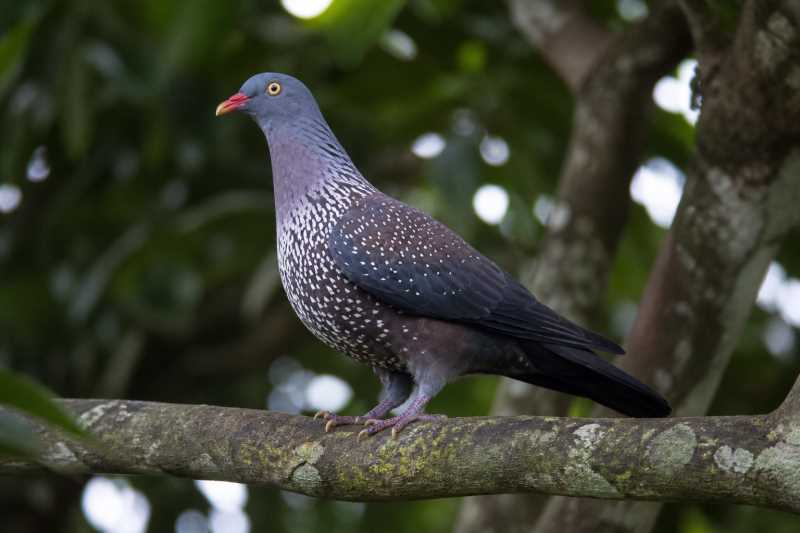
The Cameroon Olive Pigeon is a large pigeon, measuring approximately 36–40 cm in length. Adults have a dark blue-grey head, vinous-maroon upperparts and underparts, and conspicuous pale or white spotting across the mantle, breast, belly and some wing-coverts. The tail is dark blue-black.
The bill is yellow with a reddish base, while the feet are dark purple to reddish-purple. The eyes are surrounded by a noticeable yellow area. Juveniles are duller than adults and lack the strong adult spotting, with pale greyish or rufous feather edges instead.
Range and Habitat
The species occurs along the Cameroon Volcanic Line, including western Cameroon, eastern Nigeria and Bioko Island in Equatorial Guinea. It is a resident forest bird rather than a long-distance migrant, although local movements may occur in response to food availability.
It is most closely associated with humid montane forest, submontane forest and forested gullies. Records commonly come from roughly 1,000 to 2,500 metres above sea level, although the species may occur at lower elevations in suitable forest. It can also use some disturbed or open areas close to forest, but its distribution remains closely linked to remaining highland woodland.
Where to See This Species
Mount Cameroon National Park, Southwest Region, Cameroon
Mount Cameroon supports suitable montane forest habitat for the species, and the Cameroon Olive Pigeon has been recorded in the Mount Cameroon and Mokoko-Onge Key Biodiversity Area. Forested slopes and higher-elevation trails, particularly where mature fruiting trees remain, offer the most realistic opportunities. The species is unobtrusive and is often detected by its calls or by a bird flying between forest trees rather than sitting in the open.
Nearby accommodation: Buea and Limbe provide the most practical bases, with hotels, guest houses, lodges and other visitor accommodation.
Ngel Nyaki Forest Reserve, Taraba State, Nigeria
Ngel Nyaki lies on the Mambilla Plateau within the Cameroon Highlands and has documented records of the Cameroon Olive Pigeon. The reserve’s remaining montane forest and forest edges provide appropriate habitat. Access should be arranged locally, as this is a conservation reserve rather than a conventional open-access national park.
Nearby accommodation: Gembu and other settlements on the Mambilla Plateau offer basic guest houses, small hotels and locally arranged accommodation.
Basilé Peak National Park, Bioko Norte, Equatorial Guinea
Basilé Peak protects montane habitats on Bioko Island, where the Cameroon Olive Pigeon is included among the recorded birds of conservation importance. Forested slopes and upper-elevation woodland are the most suitable areas to search, although sightings may be difficult because the species is quiet and usually remains in trees.
Nearby accommodation: Malabo is the main practical base, with hotels, guest houses and lodges suitable for arranging visits to the mountain.
Behaviour and Diet
The Cameroon Olive Pigeon is generally shy and unobtrusive. It often remains high in the forest canopy or in the middle levels of mature trees, where it searches for food among foliage and branches. Its soft, hesitant calls followed by a short series of coos may be easier to detect than the bird itself.
Its diet consists mainly of fruit and seeds, including the fruits of forest trees such as figs and yellowwoods. It may also take other fleshy fruits and hard seeds. By swallowing fruit and later passing viable seeds, the species may contribute to seed dispersal and forest regeneration.
Breeding information is limited. A documented nest was a loose platform of sticks placed in a forest tree, and the record contained a single white egg. A May nesting record suggests that breeding may coincide with periods of suitable food availability in at least part of the range, but the species’ breeding season is not fully established.
Identification Tips
- Look for a large, dark forest pigeon with a blue-grey head and rich vinous-maroon body.
- The pale spotting on the mantle, breast and belly is a useful feature on perched adults.
- Note the yellow bill with a reddish base, the yellow eye area and the dark purplish feet.
- The bird is often detected by its soft, repeated cooing rather than by movement in the canopy.
- Juveniles are duller and less heavily spotted than adults.
- Do not confuse it with smaller forest pigeons or doves. Its large size, dark plumage, maroon tones and extensive pale spotting are distinctive within its range.
Conservation Status
The Cameroon Olive Pigeon is currently assessed as Least Concern. Nevertheless, its restricted distribution and dependence on montane and submontane forest make it vulnerable to the continuing loss and fragmentation of suitable habitat.
Major pressures include logging, agricultural expansion, infrastructure development, woodland clearance and the degradation of forest edges. Conservation priorities include protecting remaining highland forests, maintaining connections between forest blocks, supporting locally managed reserves and improving monitoring of populations and habitat condition. A Least Concern assessment should not be interpreted as evidence that local populations are secure everywhere within the species’ range.
Frequently Asked Questions
Where does the Cameroon Olive Pigeon live?
It occurs in montane and submontane forests along the Cameroon Volcanic Line, including western Cameroon, eastern Nigeria and Bioko Island in Equatorial Guinea.
What does the Cameroon Olive Pigeon look like?
It is a large, dark pigeon with a blue-grey head, vinous-maroon body, pale spotting on the breast and upperparts, a yellow and red-based bill, and dark purplish feet.
How large is the Cameroon Olive Pigeon?
Adults are approximately 36–40 cm long, making this a noticeably large forest pigeon.
What does the Cameroon Olive Pigeon eat?
It feeds mainly on forest fruits and seeds, including fruits from trees such as figs and yellowwoods.
Is the Cameroon Olive Pigeon endangered?
The species is currently classified as Least Concern, but habitat loss and fragmentation remain important local threats, especially in highland forests.
Where can birdwatchers look for this species?
Documented wildlife sites include Mount Cameroon National Park in Cameroon, Ngel Nyaki Forest Reserve in Nigeria and Basilé Peak National Park on Bioko Island. Local access arrangements and experienced guides are recommended.
References
- BirdLife International
- IOC World Bird List
- Key Biodiversity Areas Partnership
Related posts