Introduction
The Cape Shoveler, Spatula smithii, is a medium-sized dabbling duck of southern Africa. It is named for its broad, spatula-shaped bill, which is adapted for filtering and taking small aquatic prey. The species is concentrated in South Africa, with smaller or irregular populations elsewhere in the region.
Physical Description
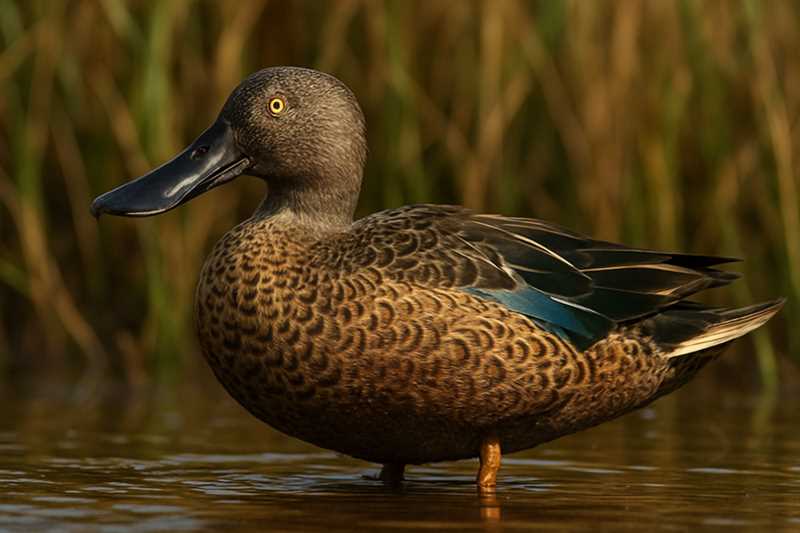
The Cape Shoveler is about 51–53 centimetres long. Both sexes have mottled grey-brown plumage and a long, broad bill, but they differ in several useful field characters.
Adult males have a paler greyish head and neck, a black bill, pale yellow eyes and yellow legs and feet that may become orange during the breeding period. Their wings show a conspicuous pale blue forewing, a white wing bar and an iridescent green speculum. The body is generally darker and more strongly marked than the head.
Females are more uniformly coloured and usually paler overall. They have a dark grey bill, brownish eyes and brownish-olive legs and feet. Juveniles resemble females but are generally duller. The species has only one recognised subspecies.
Range and Habitat
The Cape Shoveler occurs mainly in southern Africa, with its largest population in South Africa. It is most abundant in the lowlands of the Western Cape and also occurs in suitable wetlands across the Free State Highveld, Gauteng, North West, Mpumalanga, the Eastern Cape and KwaZulu-Natal. Its range extends marginally into southern Angola, while records from Namibia, Botswana and Zimbabwe are patchy or irregular. It is an occasional visitor to parts of Lesotho, Eswatini and Mozambique.
It favours shallow, plankton-rich wetlands, farm dams, pans and the shallow margins of lakes and reservoirs. It also uses tidal estuaries, saltpans, saline lagoons and shallow bays. Wetlands with abundant food, open water and emergent vegetation are particularly important. The species is not a strict long-distance migrant, but its movements are incompletely understood and may include local, nomadic and partly migratory movements in response to rainfall and water conditions.
Behaviour and Diet
Cape Shovelers feed mainly in shallow water. They may dabble at the surface, tip forward to reach submerged food, or sweep the broad bill from side to side while filtering water. The bill is lined with fine lamellae that help retain small food items.
The diet is predominantly animal-based and includes insects, crustaceans, molluscs, tadpoles and other planktonic invertebrates. Plant material and seeds are eaten only occasionally, rather than forming the main part of the diet.
Breeding has been recorded throughout the year, although the timing varies between regions and provinces. The female builds a shallow ground scrape close to water and lines it with grass and down. A typical clutch contains 5–12 eggs. The female incubates the eggs alone for about 27–31 days, beginning after the clutch is complete. She also leads and protects the ducklings, which remain dependent for approximately eight weeks before fledging. The species generally raises one brood per breeding season.
Identification Tips
- Look first for the very broad, spatula-shaped bill and elongated duck profile.
- In flight, the pale blue forewing, white wing bar and green speculum are strong identification features.
- An adult male usually has a paler head, yellow eye and black bill, while the female has a darker eye and grey bill.
- The Cape Shoveler is generally darker and less rufous than a female Northern Shoveler, Spatula clypeata.
- The Cape Shoveler’s bill is more uniformly dark. A female Northern Shoveler usually has paler yellowish or orange-brown edges to the bill and may show whiter-edged tail feathers when swimming.
- Northern Shovelers are rare vagrants in southern Africa, so most shovelers encountered in the region will be Cape Shovelers.
Conservation Status
The Cape Shoveler is classified globally as Least Concern by the IUCN and BirdLife International. However, the 2025 regional assessment for South Africa, Lesotho and Eswatini lists it as Near Threatened, reflecting evidence of regional declines and uncertainty about local population trends.
Important threats include the loss or degradation of wetlands, disturbance at moulting sites, poorly managed hunting and possible hybridisation with introduced Mallards. Like other waterbirds, the species may also be affected by disease outbreaks such as avian botulism. Some important wetlands are protected through nature reserves and Ramsar-site designation, while continued waterbird monitoring, wetland protection and carefully managed hunting regulations are recommended conservation measures.
Frequently Asked Questions
What is the scientific name of the Cape Shoveler?
The accepted scientific name is Spatula smithii. It belongs to the duck family Anatidae and the dabbling-duck genus Spatula.
Where does the Cape Shoveler live?
It lives mainly in southern Africa, especially South Africa. It uses shallow freshwater wetlands, dams, pans, estuaries, saltpans, saline lagoons and the margins of larger water bodies.
What does the Cape Shoveler eat?
Its diet consists mainly of insects, crustaceans, molluscs, tadpoles and other planktonic invertebrates. Plant material and seeds are eaten less frequently.
How can a Cape Shoveler be identified?
The broad spatula-shaped bill is the most obvious feature. Adult males also show a paler head, yellow eye, black bill and brighter wing pattern, while females are more uniformly brown-grey with darker eyes and a grey bill.
When does the Cape Shoveler breed?
Breeding can occur throughout the year, but the timing varies geographically. The female lays 5–12 eggs and incubates them alone for approximately 27–31 days.
Is the Cape Shoveler endangered?
Globally, it is classified as Least Concern. It is assessed as Near Threatened regionally in South Africa, Lesotho and Eswatini because several analyses indicate declines and the available population data remain uncertain.
References
- BirdLife South Africa. 2025. “Cape Shoveler.” In The 2025 Red Data Book of Birds of South Africa, Lesotho and Eswatini. BirdLife South Africa. Available at: https://www.birdlife.org.za/red-data-book/red-list/cape-shoveler/ (accessed 8 September 2026).
- BirdLife International. 2024. “Species factsheet: Cape Shoveler Spatula smithii.” BirdLife International Data Zone. Available at: https://datazone.birdlife.org/species/factsheet/cape-shoveler-spatula-smithii (accessed 8 September 2026).
- Gill, F., and D. Donsker, eds. 2025. IOC World Bird List, version 15.2. International Ornithologists’ Union. Available at: https://www.worldbirdnames.org/ (accessed 8 September 2026).
- Siegfried, W. R. 1965. “The Cape Shoveler Anas smithii (Hartert) in southern Africa.” Ostrich 36(4): 155–198.
- Little, R. M., K. C. Vester, and T. M. Crowe. 1995. “Temporal and spatial patterns of breeding activity of 12 duck species (Anatidae) in the Cape provinces, South Africa, and their implications for hunting seasons.” South African Journal of Wildlife Research 25(1): 17–22.
- Maclean, G. L. 1997. “Cape Shoveler.” In J. A. Harrison, D. G. Allan, L. G. Underhill, M. Herremans, A. J. Tree, V. Parker and C. J. Brown, eds, The Atlas of Southern African Birds, volume 1, pp. 136–137. Johannesburg: BirdLife South Africa.
- Madge, S., and H. Burn. 1988. Wildfowl: An Identification Guide to the Ducks, Geese and Swans of the World. London: Christopher Helm.
Related posts