Introduction
The Brown Nightjar, Veles binotatus, is a poorly known nocturnal bird of the Guinean and Central African rainforests. It is the only species in the genus Veles and is often encountered by its call rather than seen. Earlier sources placed it in the genus Caprimulgus, so older records may use the name Caprimulgus binotatus.
Physical Description
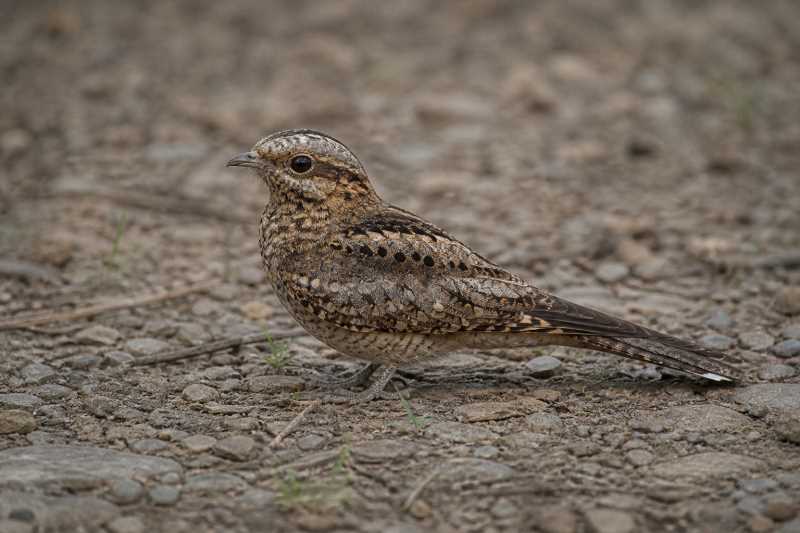
The Brown Nightjar is a small to medium-sized, dark forest nightjar. Its plumage is predominantly deep brown, with dense tawny and chestnut mottling that provides effective camouflage among shaded branches, vines and leaf litter. It has a dark chocolate-brown appearance, a relatively short-looking tail and small pale or whitish markings on the sides of the neck.
The species lacks the obvious pale collar shown by some other forest nightjars. It also lacks conspicuous white panels in the wings or tail, making it particularly easy to overlook in flight. Reliable published measurements are not readily available, and the species is sexually monomorphic or shows little obvious sexual difference in the field. Age-related plumage differences are also poorly documented.
Range and Habitat
The Brown Nightjar occurs in West and Central Africa. Its documented range extends from Liberia and southern Côte d’Ivoire through Ghana, southern and western Cameroon, Gabon, the Republic of the Congo, the Central African Republic and the Democratic Republic of the Congo.
It is associated mainly with humid lowland rainforest, especially mature forest with a relatively open canopy and dense undergrowth. Records are concentrated in remaining blocks of Upper Guinean and Congo Basin forest. The species is regarded as sedentary, and there is no well-established evidence of regular long-distance migration.
The original article’s reference to Southeast Asia and Indonesia is incorrect. Veles binotatus is an African species, not a Southeast Asian nightjar.
Where to See This Species
The Brown Nightjar is difficult to locate, and most observations involve birds calling briefly at dusk or after dark. The following Ghanaian sites have documented records and suitable forest habitat.
Kakum National Park, Central Region, Ghana
Brown Nightjars have been recorded at Kakum, including around the canopy walkway and in the surrounding rainforest. The species may call in the late afternoon or around dusk before becoming quiet, so listening from forest trails and established viewing areas is more productive than searching for a perched bird. Night access should follow park rules and be arranged with authorised guides.
Nearby accommodation: Cape Coast is the main practical gateway, with hotels, guest houses and other visitor accommodation. Some accommodation is also available in communities near the park.
Bobiri Forest and Butterfly Sanctuary, Ashanti Region, Ghana
Bobiri’s mature forest and accessible trails have produced repeated Brown Nightjar records, including birds seen or heard shortly after dusk. The forest edge, clearings and less densely vegetated trail sections may offer the best chances of detecting a calling bird, although sightings remain unpredictable.
Nearby accommodation: Kumasi is the principal accommodation base, with hotels and guest houses. Local visitor accommodation may also be available near the sanctuary.
Atewa Forest Range, Eastern Region, Ghana
Brown Nightjar is included in bird records for the Atewa Forest Range, a large block of upland and lowland forest supporting a rich West African rainforest avifauna. The species is most realistically sought with an experienced local guide during evening listening sessions, subject to access and conservation restrictions.
Nearby accommodation: Koforidua is the main practical gateway, with hotels, guest houses and other accommodation suitable for forest visits.
Behaviour and Diet
The Brown Nightjar is primarily crepuscular and nocturnal. It is usually quiet and inactive during daylight, when it may roost above the ground on a low branch, vine loop or other concealed perch. Its dark, mottled plumage makes it extremely difficult to detect at close range.
Like other nightjars, it is expected to feed mainly on flying insects caught during short aerial sallies. The broad mouth and specialised rictal bristles are adaptations associated with this feeding method, but the precise diet of the Brown Nightjar has not been studied in detail.
Its call has been described as a soft, metallic, repeated note, sometimes rendered as “kliou”. Calls may be delivered at roughly regular intervals and are important for locating the species in dense forest. Available information on courtship, territory size and social behaviour remains limited.
Identification Tips
- Listen at dusk and during the first part of the night, especially in mature rainforest.
- Look for a very dark, chocolate-brown nightjar with dense tawny or chestnut mottling.
- Note the small pale spots on the sides of the neck and the absence of a strong pale hind-neck collar.
- In flight, expect an unmarked dark silhouette without obvious white wing or tail patches.
- Treat any identification based only on a brief call with care, particularly where Long-tailed Nightjar, Standard-winged Nightjar or other local nightjars occur.
- A response to playback is not proof of presence unless the call and habitat are consistent. Playback should be avoided or used only under responsible local birding guidelines, especially during the breeding season.
Conservation Status
The Brown Nightjar is currently assessed as Least Concern on the IUCN Red List. This category does not mean that the species is common or well studied. Its population size and trend are poorly known, partly because the bird is difficult to detect and may be under-recorded.
The principal potential threat is the continuing loss and degradation of humid forest through logging, agricultural expansion, mining, roads and other land conversion. Protecting remaining rainforest, maintaining connected forest blocks and improving nocturnal survey work are important conservation measures. More field research is needed to clarify its distribution, abundance, breeding biology and population trend.
Frequently Asked Questions
Where is the Brown Nightjar found?
The Brown Nightjar is found in West and Central Africa, from Liberia and Ghana eastwards through Côte d’Ivoire, Cameroon, Gabon, the Congo region, the Central African Republic and the Democratic Republic of the Congo.
Is the Brown Nightjar found in Southeast Asia?
No. The Brown Nightjar is an African species. Earlier descriptions that placed it in Indonesia, the Malay Peninsula or Southeast Asia were incorrect.
What habitat does the Brown Nightjar use?
It is associated mainly with humid rainforest, including mature lowland forest with dense undergrowth and a relatively open canopy. It may also occur in protected forest reserves and other remaining large blocks of rainforest.
When is the best time to look for a Brown Nightjar?
The best time is around dusk and during the early part of the night, when the bird may call or make short flights to catch insects. It is usually much harder to find during daylight.
What does the Brown Nightjar eat?
It is believed to feed mainly on flying insects captured in the air. The details of its diet have not been studied extensively.
Is the Brown Nightjar endangered?
The species is currently assessed as Least Concern, but its population is poorly known and its rainforest habitat continues to face pressure from logging and land conversion.
References
- BirdLife International
- IOC World Bird List
- Bulletin of the African Bird Club
Related posts