Introduction
The Jungle Nightjar, Caprimulgus indicus, is a cryptically coloured nocturnal bird of the Indian subcontinent. It belongs to the nightjar family, Caprimulgidae, and is most often detected by its calls at dusk or dawn rather than by sight. Current treatments recognise the species in India and Sri Lanka, while several formerly associated Asian populations are treated separately.
Physical Description
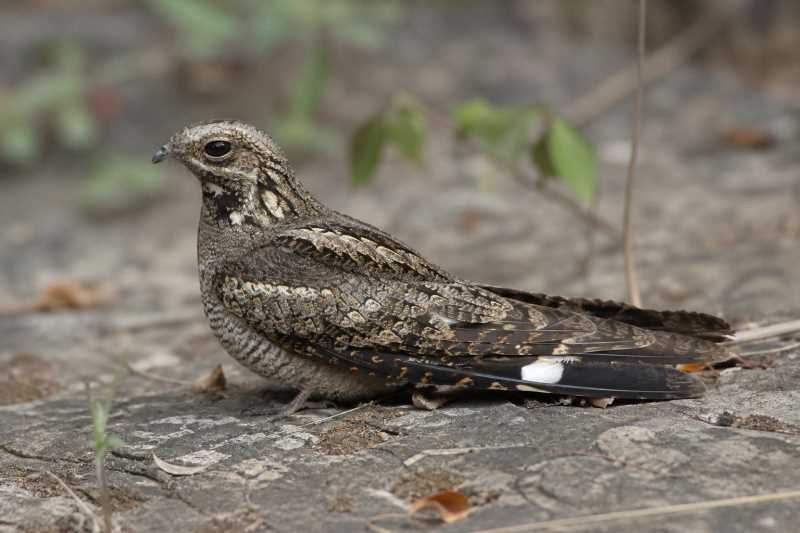
The Jungle Nightjar is a medium-sized nightjar measuring approximately 21–24 cm in length. Its plumage is predominantly greyish brown, with fine black, brown and buff streaking that provides excellent camouflage among dry leaves, rocks, soil and shaded branches.
The bird has long, pointed wings, a relatively long tail, large dark eyes and a very wide gape fringed with sensory bristles. A small bill is largely concealed when the mouth is closed. The wings show rufous and pale markings, although these are not usually obvious when the bird is perched.
Males and females are broadly similar in appearance. Males may show more distinct white markings on the outer tail feathers, while females generally have duller, buff-toned markings. Juveniles are less well documented in the field but are expected to be more muted and softly marked than adults.
Range and Habitat
The Jungle Nightjar occurs in India and Sri Lanka. In India, it is associated especially with peninsular and central regions, although records extend farther north in suitable woodland and scrub habitats. The Sri Lankan population is sometimes treated as the subspecies Caprimulgus indicus kelaarti.
It uses open and lightly wooded habitats, including forest edges, dry deciduous woodland, scrub, clearings, rocky slopes, grassland with scattered trees, plantations and some cultivated landscapes. It may occur from lowland areas to montane habitats, where open ground is available for foraging and resting.
The species is generally resident, but local movements and seasonal changes in distribution may occur. Its cryptic plumage, nocturnal habits and tendency to remain motionless during the day make its abundance difficult to assess.
Where to See This Species
Sariska Tiger Reserve, Rajasthan, India
Jungle Nightjars have been documented in Sariska Tiger Reserve, where they use dry scrub forest, woodland edges and open areas. They are most likely to be detected by their calls during the breeding period and around dusk, particularly from March to May, although sightings are not guaranteed.
Nearby accommodation: Alwar is the main practical accommodation centre, with hotels, guest houses and lodge-style accommodation serving visitors to the reserve.
Kuno National Park, Madhya Pradesh, India
Kuno National Park supports dry deciduous forest, savanna woodland and grassland, habitats in which the Jungle Nightjar has been recorded. Quiet tracks and open forest edges may be worth checking after sunset, especially during the park’s cooler visiting season.
Nearby accommodation: Sheopur is the principal gateway town, with guest houses, hotels and forest-related accommodation available in the wider Kuno area.
Bhagwan Mahavir National Park, Goa, India
The official management plan for Bhagwan Mahavir National Park lists the Jungle Nightjar as a resident species. The park’s forest margins, clearings and open areas within the Western Ghats provide suitable habitat, and evening listening is more productive than daytime searching.
Nearby accommodation: Ponda and the wider eastern Goa region provide hotels, guest houses, self-catering accommodation and nature-oriented stays.
Behaviour and Diet
The Jungle Nightjar is mainly nocturnal, with activity beginning around sunset and continuing through the night. It may also be active shortly before sunrise. During the day, it rests on the ground, rocks or horizontal branches, where its mottled plumage makes it extremely difficult to detect.
It commonly hunts from a low perch or from the ground, making short, agile flights to capture insects in the air. Its diet includes moths, beetles, flying ants, cicadas, grasshoppers, locusts and other flying insects. It may forage along tracks, forest edges and clearings where insect activity is concentrated.
Breeding varies geographically but generally occurs during the warmer months. The female lays one or two eggs directly on bare ground, leaf litter, ash, stones or sparsely vegetated soil rather than constructing a conventional nest. Both adults may remain close to the breeding site, and the well-camouflaged young can move away from the laying site soon after hatching. Adults may use distraction displays or remain motionless when predators approach.
Identification Tips
- Listen at dusk and dawn for a repetitive, distinctive nightjar call from woodland edges or open forest.
- Look for a compact, grey-brown bird sitting lengthwise on a branch, rock or track, often remaining still even when approached.
- Note the long wings, large eyes, broad gape and finely streaked plumage.
- In flight, the bird appears long-winged and agile, with rufous and pale wing markings that may flash briefly.
- Do not confuse it with the smaller Indian Nightjar, Caprimulgus asiaticus, which is generally associated with more open, drier country and has different plumage patterning and vocalisations.
- The Grey Nightjar, Caprimulgus jotaka, was formerly included in broader treatments of the Jungle Nightjar but is now recognised as a separate species. It is more relevant to identification in northern and eastern Asian regions than in the core range of C. indicus.
Conservation Status
The Jungle Nightjar is currently assessed as Least Concern on the IUCN Red List. It has a broad distribution and uses a range of woodland, scrub and open habitats. A precise global population estimate is not provided here, and the species’ regional abundance is difficult to determine because it is nocturnal and easily overlooked.
Potential local pressures include the clearance and fragmentation of scrub and open woodland, disturbance at breeding sites, road traffic on frequently used night-time tracks and reductions in flying-insect prey caused by intensive land management. Maintaining habitat mosaics with woodland, scrub, leaf litter and open ground can benefit the species.
Frequently Asked Questions
Where is the Jungle Nightjar found?
The species is found in India and Sri Lanka, mainly in open woodland, dry forest, scrub, forest edges, plantations and other habitats with both cover and open ground.
Is the Jungle Nightjar nocturnal?
Yes. It is most active after sunset and before sunrise, although it may occasionally move or call during daylight, particularly when disturbed.
What does the Jungle Nightjar eat?
It feeds mainly on flying insects, including moths, beetles, flying ants, cicadas, grasshoppers and other insects captured during short aerial flights.
Where does the Jungle Nightjar nest?
It does not build a conventional nest. One or two eggs are laid directly on bare ground, leaf litter, stones, ash or sparsely vegetated soil.
How can the Jungle Nightjar be identified?
The most reliable clues are its grey-brown, heavily camouflaged plumage, long wings, large eyes, broad gape and distinctive dusk or dawn call. It is usually easier to hear than to see.
Is the Jungle Nightjar migratory?
It is generally regarded as resident, although local movements and seasonal changes in occurrence may take place in parts of its range.
References
- IOC World Bird List
- BirdLife International
- IUCN Red List of Threatened Species
Related posts