The Smooth-billed Ani: An Intriguing Avian Resident of the Americas
The Smooth-billed Ani (Crotophaga ani) is a fascinating bird species belonging to the cuckoo family, Cuculidae. Known for its distinctive appearance and unique social behavior, this bird has captured the interest of ornithologists and bird enthusiasts alike. Found primarily in the Americas, the Smooth-billed Ani exhibits a plethora of intriguing characteristics that make it a subject worthy of study and admiration.
Distribution and Habitat
The Smooth-billed Ani is predominantly found in the Caribbean, Central America, and the northern parts of South America, extending to southern Florida in the United States. It thrives in a variety of habitats, including grasslands, savannas, agricultural fields, and suburban areas. This adaptability to diverse environments has contributed to its wide distribution across the region.
One of the key factors enabling the Smooth-billed Ani’s success in various habitats is its ability to exploit different food resources. This bird is predominantly insectivorous, feeding on a diet that includes grasshoppers, crickets, and other small invertebrates. However, it is also known to consume fruits and seeds, showcasing its opportunistic feeding behavior.
Physical Characteristics and Identification
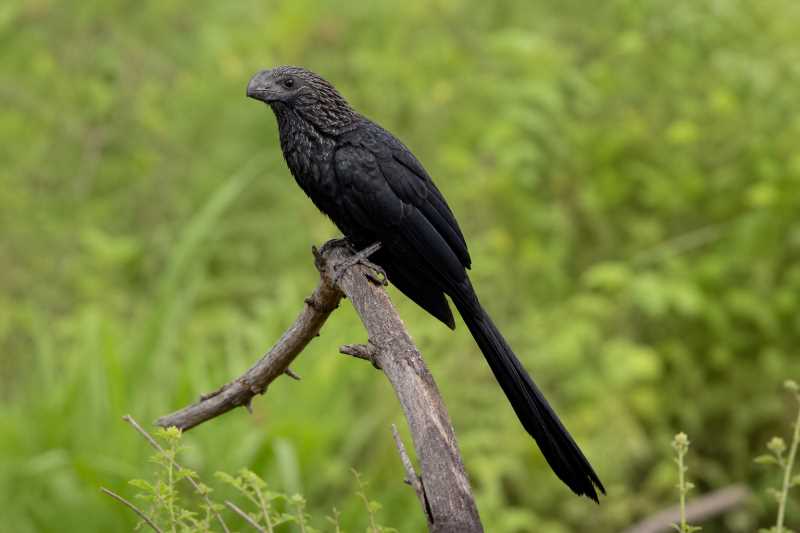
The Smooth-billed Ani is easily recognizable due to its unique physical features. It is a medium-sized bird, measuring approximately 33 to 36 centimeters in length, with a weight ranging from 70 to 100 grams. The bird possesses a glossy black plumage, which may appear slightly iridescent under sunlight. Its most distinctive characteristic is its large, curved bill, which is smooth and lacks the serrated edges seen in some related species.
In addition to its striking bill, the Smooth-billed Ani has a long tail that it often flicks and fans. This behavior is thought to play a role in communication, particularly during social interactions within the group. Males and females are similar in appearance, making it difficult to distinguish between the sexes based solely on visual characteristics.
Social Behavior and Communication
One of the most remarkable aspects of the Smooth-billed Ani is its highly social nature. These birds are known to live in cooperative breeding groups, typically consisting of two to five pairs. The group dynamics are complex, with members engaging in mutual grooming, feeding, and other communal activities.
Cooperative breeding is a prominent feature of the Smooth-billed Ani’s social structure. Within a group, several females may lay eggs in a single nest, which is then incubated collectively by all members. This shared responsibility extends to raising the young, with both males and females participating in feeding and protecting the chicks. This cooperative approach to parenting increases the chances of survival for the offspring, particularly in environments where food resources may be limited.
Communication within the group is facilitated through a range of vocalizations and visual signals. The Smooth-billed Ani produces a variety of calls, including whistles, grunts, and clicks, each serving different functions such as alerting the group to potential threats or coordinating activities. Visual signals, such as tail flicking and wing displays, complement vocal communication and reinforce social bonds within the group.
Conservation Status and Threats
The International Union for Conservation of Nature (IUCN) currently classifies the Smooth-billed Ani as a species of Least Concern. Despite this relatively secure status, the bird faces threats from habitat loss and degradation, particularly due to agricultural expansion and urban development. In some regions, pesticide use and climate change also pose challenges to its populations.
Conservation efforts for the Smooth-billed Ani primarily focus on preserving its natural habitats and promoting sustainable land-use practices. By maintaining healthy ecosystems, the ecological balance that supports this and other species can be sustained.
Conclusion
The Smooth-billed Ani is a remarkable bird that exemplifies the beauty and complexity of avian life in the Americas. Its distinctive appearance, social behavior, and adaptability to different environments make it a valuable subject for scientific study and conservation efforts. As we continue to learn more about this intriguing bird, it serves as a reminder of the importance of preserving our natural world and the diverse species that inhabit it.
By understanding and appreciating the Smooth-billed Ani, we can better appreciate the intricate web of life that sustains our planet, encouraging further efforts to protect and conserve biodiversity for future generations.
Related posts