Introduction
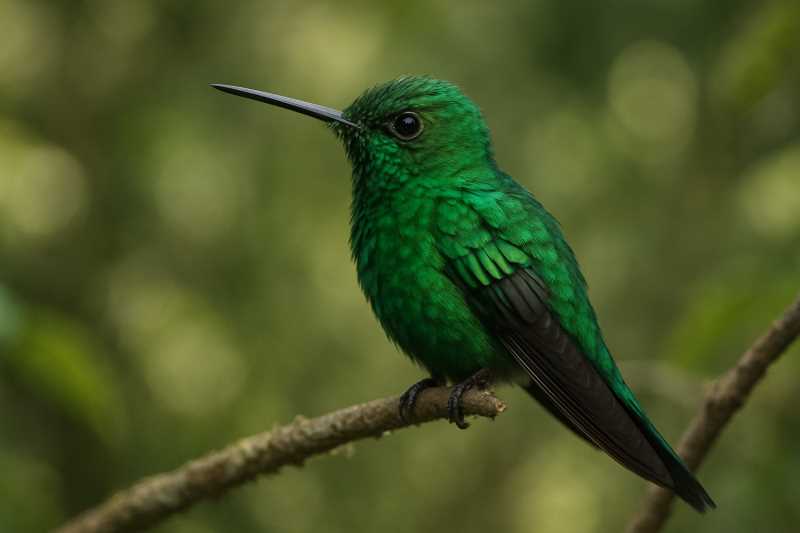
The Western Emerald (Chlorostilbon melanorhynchus) is a small hummingbird of the northern Andes. It occurs mainly in western Colombia and Ecuador, where it uses forest edges, secondary vegetation, scrub, gardens and other semi-open habitats. The species is known for its brilliant green plumage, short black bill and rapid, agile flight.
Physical Description
The Western Emerald measures about 10.9 to 11.4 centimetres in length and weighs approximately 2.6 grams. Both sexes have a short, straight, entirely black bill.
Adult males are predominantly iridescent green, with a brighter, often golden-green crown and a glittering green throat and breast. The back may show bronzy tones, while the tail is dark and metallic, often appearing steel-blue and shallowly forked. Small white feather tufts may be visible on the thighs.
Females are less brightly coloured. They have green to bronzy-green upperparts, a darker face, a pale mark behind the eye, paler greyish underparts and a dark tail with pale tips on the outer feathers. Juveniles are generally duller than adults and may lack the full intensity of the adult male’s iridescence.
Range and Habitat
The Western Emerald is distributed in western Colombia and Ecuador, including parts of the western and central Andes. It is generally resident rather than migratory, although local movements may occur in response to flowering conditions and habitat availability.
Records span roughly 600 to 2,700 metres above sea level, with some Colombian records extending into lower foothills and semi-arid areas. The nominate form is associated mainly with higher subtropical and temperate Andean habitats, while the form pumilus is associated with lower, warmer and drier areas of western Colombia and Ecuador.
Unlike hummingbirds that depend heavily on undisturbed forest interior, the Western Emerald often uses forest margins, clearings, secondary growth, shrubby vegetation, plantations, cultivated land and gardens. It is also recorded in humid montane forest and in dry or semi-dry inter-Andean valleys where flowering plants are available.
Where to See This Species
Tatamá National Natural Park, Risaralda and Chocó, Colombia
The Western Emerald has been recorded in the Tatamá region, where montane forest edges, clearings and flowering vegetation provide suitable habitat. Birdwatchers should look around forest margins and flowering shrubs, particularly at middle and lower elevations accessible from the park’s western approaches.
Nearby accommodation: Pueblo Rico and the Montezuma area provide practical bases with lodges, guest houses and other birdwatching accommodation.
Reserva Orquideológica Pahuma, Pichincha, Ecuador
The Western Emerald is documented from Pahuma, a publicly accessible reserve in the Andean foothills west of Quito. Its forest edges, gardens, clearings and flowering plants offer appropriate habitat for this species, especially along trails and around open areas.
Nearby accommodation: Nono and the outskirts of Quito provide guest houses, small lodges and hotels, with additional nature-lodge accommodation available in the wider Mindo and western Pichincha region.
Reserva Maquipucuna, Pichincha, Ecuador
Records from Maquipucuna confirm the species’ presence in this protected Andean forest landscape. Look along forest edges, secondary vegetation, garden areas and flowering plants at suitable elevations rather than concentrating only on dense forest interior.
Nearby accommodation: Maquipucuna and the nearby settlements of Nanegalito and Nanegal offer reserve lodges, guest houses and small rural accommodation.
Behaviour and Diet
The Western Emerald is active during daylight hours and can hover in place while feeding. Its short bill is suited to visiting a variety of flowers, and its rapid flight allows it to move efficiently through dense vegetation and along forest edges.
Nectar forms the main part of its diet. The bird also takes small insects and other arthropods, either by making short aerial sallies or by picking prey from vegetation and spider webs. These animal foods are particularly important when additional protein is needed.
Individuals are often seen alone. Males may defend productive flowering plants or feeding areas from other hummingbirds and can make rapid chases through the vegetation. The species is not known for long-distance migration.
Breeding information remains limited. The female builds and attends the nest, using plant fibres, moss and spider web to form a small cup attached to a branch. A documented nest contained two white eggs. The female alone incubates the eggs and cares for the young, but the exact breeding season and nesting success of the species are not well established.
Identification Tips
- Look for a small hummingbird with a short, straight, all-black bill.
- Adult males are brilliant green overall, with a brighter crown and a dark, metallic blue-green tail.
- Females are duller, with greyish underparts, a dark face and pale markings around the eye and outer tail feathers.
- The tail is shorter and less deeply forked than that of some closely related emeralds.
- In western Colombia and Ecuador, compare it carefully with the Red-billed Emerald (Chlorostilbon gibsoni). The Western Emerald has an entirely black bill, whereas the Red-billed Emerald shows red on the lower mandible.
- Plumage colour can change noticeably with light and viewing angle, so bill colour, tail shape, size and location are useful supporting characters.
Conservation Status
The Western Emerald is generally treated as Least Concern under taxonomic treatments that recognise it as a full species. The IUCN assessment framework has also treated the taxon within the broader Blue-tailed Emerald complex, reflecting continuing differences among global bird taxonomies.
A precise global population estimate is not available. The species appears able to use some disturbed and human-modified habitats, which may reduce the effects of forest loss in parts of its range. Nevertheless, deforestation, agricultural expansion, urban development, the removal of flowering vegetation and changes to local rainfall and flowering patterns may reduce habitat quality.
Maintaining forest edges, secondary vegetation, native flowering plants, hedgerows and habitat corridors can benefit the Western Emerald. Protected areas and community-based conservation are particularly important in the Andean landscapes where suitable habitat is fragmented.
Frequently Asked Questions
Where can the Western Emerald be found?
It is found in western Colombia and Ecuador, mainly in the northern Andes and adjacent foothills. Its range includes forest edges, scrub, gardens, plantations, clearings and semi-open habitats.
What does the Western Emerald look like?
It is a very small, mainly green hummingbird with a short black bill. Males are brighter and more strongly iridescent, while females have greyish underparts, a darker face and pale markings near the eye and tail.
What does the Western Emerald eat?
It feeds mainly on nectar from flowering plants and supplements this diet with small insects and other arthropods.
Is the Western Emerald migratory?
It is generally considered resident rather than migratory. Local movements may occur when birds follow flowering plants or respond to changes in food availability.
How does the Western Emerald nest?
The female builds a small cup-shaped nest from plant fibres, moss and spider web. A documented clutch contained two white eggs, but detailed information about incubation and fledging remains limited.
Is the Western Emerald endangered?
It is generally treated as Least Concern, although taxonomy differs between authorities. Habitat loss and the degradation of flowering vegetation remain important local concerns.
References
- Cornell Lab of Ornithology, Birds of the World
- South American Classification Committee, American Ornithological Society
- Revista Ecuatoriana de Ornitología
Related posts