Introduction
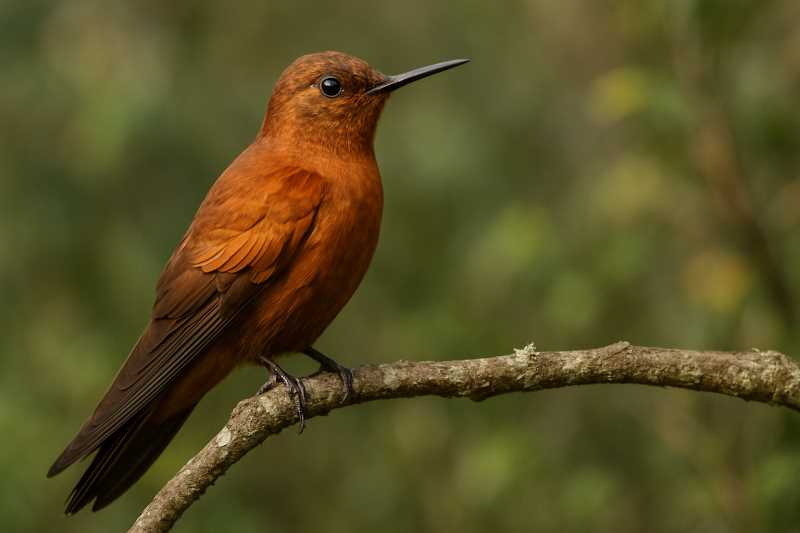
The Shining Sunbeam, Aglaeactis cupripennis, is a high-elevation hummingbird of the tropical Andes. It occurs from Colombia through Ecuador to Peru, where it inhabits montane forest, elfin forest, forest edges and open subpáramo and páramo vegetation. Its coppery rump and back can flash brightly in suitable light, giving the species its distinctive appearance.
Physical Description
The Shining Sunbeam is a relatively large hummingbird, measuring about 11.4 centimetres in length and weighing approximately 6.4 to 8.1 grams. Its overall plumage is warm rufous to brown. The wings and back are dark bronze-brown, while the crown and eye stripe are darker.
The most diagnostic feature is the iridescent patch across the lower back and rump. This area may show pink, yellow, green or copper tones depending on the angle of the light. The patch is generally more extensive and brighter in males. The bill is relatively straight, and the bird has the compact, powerful shape typical of a high-altitude hummingbird.
Reliable information on age-related plumage differences is limited, so immature birds should not be identified solely by assuming that their plumage follows a fixed juvenile pattern.
Range and Habitat
The Shining Sunbeam is a resident Andean species found in Colombia, Ecuador and Peru. Its distribution extends through the high Andes, with records from roughly 2,500 to 4,300 metres above sea level, although local elevations vary.
It uses a broad range of highland habitats, including upper montane forest, elfin forest, forest edges, disturbed woodland, shrubby slopes, high-altitude grassland, subpáramo and páramo with scattered trees and shrubs. In Colombia, it is recorded in parts of the Central and Eastern Andes. In Ecuador and Peru, it occurs on both forested and more open highland slopes.
The species is not considered migratory in the usual long-distance sense. Individuals may move locally in response to flowering conditions, territory quality and seasonal changes in food availability.
Where to See This Species
Chingaza National Natural Park, Cundinamarca and Meta, Colombia
The Shining Sunbeam is documented in Chingaza National Natural Park, where it occurs in subpáramo and páramo habitats, including areas with scattered shrubs and flowering plants. It is described as uncommon locally, and males may be easier to detect during territorial displays or periods of strong flowering, including flowering of Puya species.
Nearby accommodation: The practical bases are the towns and rural accommodation areas around La Calera, Guasca and Fómeque, with guest houses, lodges and small hotels available outside the park.
Yanacocha Biological Reserve, Pichincha, Ecuador
Yanacocha protects high-elevation Andean forest and páramo west of Quito. Biological records document the Shining Sunbeam at approximately 3,500 to 3,800 metres, making the reserve’s trails and upper-elevation habitats realistic places to look for the species. Early morning observation is most productive, particularly around flowering shrubs and forest edges.
Nearby accommodation: Quito is the main accommodation base, with hotels, guest houses and self-catering options. Rural lodging is also available in the Nono area.
Behaviour and Diet
The Shining Sunbeam is generally solitary and territorial. It often perches for extended periods before making short, rapid flights to feed or drive away intruders. Research in Ecuador and Peru found that tracked birds spent more time perched than actively foraging, with aggressive interactions forming a smaller part of their daily activity.
Nectar forms the main part of its diet. In detailed observations, flowers of Oreocallis grandiflora supplied most recorded nectar-feeding events, while flowers of Brachyotum, Centropogon, Fuchsia, Gaultheria, Macleania and other plants were also used. Small insects supplement the diet and provide additional protein.
Territorial disputes commonly involve other hummingbirds and nectar-feeding birds such as flowerpiercers. Males are reported to perform aerial displays, although detailed information about courtship, nesting and parental care remains limited.
As a flower visitor, the Shining Sunbeam can contribute to pollination in high-Andean plant communities. Its feeding behaviour also places it in direct competition with other nectar-feeding birds where flowering resources are concentrated.
Identification Tips
- Look for a medium-sized, relatively robust hummingbird in high Andean habitats.
- Focus on the dark bronze-brown wings and back, rufous body tones and especially the brilliant iridescent rump.
- The iridescence may appear copper, pink, yellow or green as the bird changes position.
- The bill is relatively straight and the bird often perches conspicuously before making a short feeding flight.
- Males usually show the more extensive and brighter rump patch.
- Do not rely on colour alone. In dull light, the bird may appear mostly brown or rufous, so habitat, size, posture and the reflective rump are useful together.
- In areas where other sunbeams occur, compare the complete pattern carefully, especially the rump, back, head and any contrasting tail or flank markings.
Conservation Status
The Shining Sunbeam is currently assessed as Least Concern. It has a broad distribution and is described in ornithological research as relatively common in suitable high-elevation habitat.
The species nevertheless depends on the continued availability of flowering plants and native Andean vegetation. Local threats include conversion of montane habitat for agriculture, burning, grazing, road development and other forms of habitat degradation. Climate-driven changes in temperature, rainfall and flowering periods could also affect food availability, although the species-specific effects are not yet well quantified.
Protection of high-Andean forest, subpáramo and páramo, together with habitat restoration and careful management of fire and grazing, remains important. Maintaining networks of native vegetation is particularly valuable because territorial hummingbirds may depend on reliable concentrations of flowering plants.
Frequently Asked Questions
Where does the Shining Sunbeam live?
It lives in the high Andes of Colombia, Ecuador and Peru. Its habitats include montane and elfin forest, forest edges, shrubby slopes, high-altitude grassland, subpáramo and páramo.
Is the Shining Sunbeam found in Bolivia?
The currently recognised range is Colombia, Ecuador and Peru. Bolivia is not included in the standard modern range accounts for Aglaeactis cupripennis.
What does the Shining Sunbeam eat?
It feeds mainly on nectar, especially from high-Andean flowering plants such as Oreocallis grandiflora. It also catches small insects, which provide supplementary protein.
Is the Shining Sunbeam endangered?
No. It is currently assessed as Least Concern, although local populations may be affected by habitat loss, burning, grazing and changes to flowering resources.
How can the Shining Sunbeam be identified?
Look for a medium-sized hummingbird with dark bronze-brown wings and back, warm rufous tones and a highly reflective rump that may appear copper, pink, yellow or green in the light.
References
- BirdLife International
- Cespedes et al., The Wilson Journal of Ornithology
- Instituto Nacional de Biodiversidad, Ecuador
Related posts