Introduction
Erckel’s Spurfowl (Pternistis erckelii), also known as Erckel’s Francolin, is a large, ground-dwelling gamebird of the northern Ethiopian Highlands, Eritrea and north-eastern Sudan. It is adapted to steep upland terrain, rocky slopes, scrub and grassy habitats, where it usually relies on cover and running ability rather than sustained flight.
Physical Description
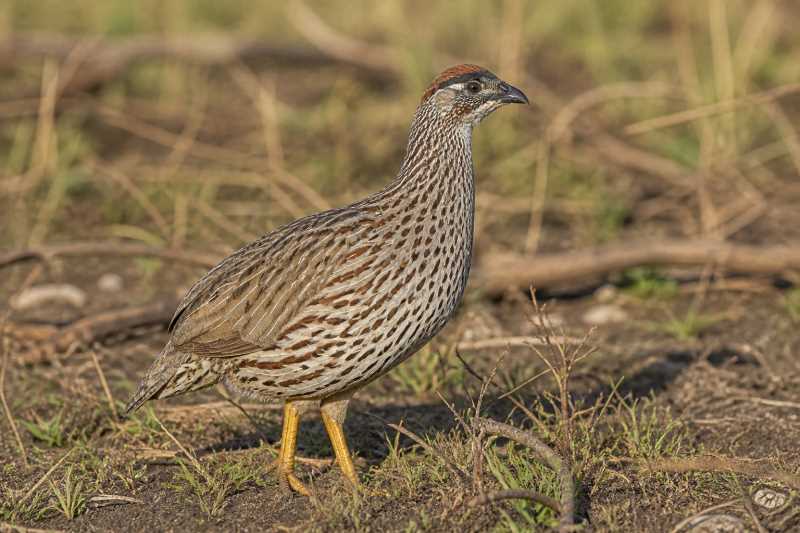
Erckel’s Spurfowl is a pheasant-sized bird measuring approximately 38–43 centimetres in length. It has a heavy, hooked bill, thick yellow legs and a full-bodied shape. The crown is chestnut, the throat is white, and the face includes a dark stripe behind the eye. The upperparts are greyish-brown with chestnut, maroon and white markings, while the underparts are pale with bold chestnut and black teardrop-shaped markings.
The sexes are broadly similar in plumage, although males are larger than females. Adult males have two spurs on the back of each leg, which are a useful feature when the bird is seen clearly. Juveniles are generally duller and less sharply marked than adults.
Range and Habitat
The species is native to the highlands of northern Ethiopia and Eritrea, extending into north-eastern Sudan. In its African range, it is most often associated with steep, rocky slopes covered by shrubs and grasses, dense vegetation along streams, forest edges, gullies and upland cultivated areas.
It usually occurs between about 2,000 and 3,500 metres above sea level, although it can occur at lower elevations in suitable habitat. Erckel’s Spurfowl is a resident rather than a regular long-distance migrant.
The species has also been introduced to Hawai‘i, where it occupies upland grasslands, shrublands, open woodland, forest edges and streamside habitats. It was introduced there as a gamebird in 1957 and is now established on several islands.
Where to See This Species
Simien Mountains National Park, Amhara Region, Ethiopia
Erckel’s Spurfowl is recorded in the Simien Mountains National Park bird checklist. The park’s high, rugged escarpments, rocky slopes, grassland and patches of shrub cover provide suitable habitat. Look and listen around upland tracks, cliff edges and areas of dense vegetation, particularly during the cooler morning hours.
Nearby accommodation: Debark is the main gateway settlement, with guest houses, hotels and basic lodges serving visitors to the park.
Awash National Park, Afar Region, Ethiopia
Erckel’s Spurfowl is included among the target birds recorded for Awash National Park. The park contains a mixture of upland slopes, grassland, scrub and wooded areas, and birds may be encountered where rocky terrain meets thicker vegetation. Early morning is generally the most productive period for detecting this wary species.
Nearby accommodation: Awash town is the practical base, with hotels, guest houses and lodge-style accommodation available for park visitors.
Kaloko-Honokōhau National Historical Park, Hawai‘i Island, United States
Hawai‘i Birding Trails lists Kaloko-Honokōhau National Historical Park as a hotspot for introduced Erckel’s Spurfowl. The bird may occur in grassy, shrubby and open woodland areas, although it is easily concealed and often runs away before it can be seen. Listening for its loud, laughing call can be more effective than searching dense cover.
Nearby accommodation: Kailua-Kona is the nearest major visitor centre, with hotels, holiday apartments, guest houses and self-catering accommodation.
Behaviour and Diet
Erckel’s Spurfowl is wary and usually remains in dense vegetation during the day. It often runs uphill when disturbed and may make only short flights, especially along cliff edges. The species is social and can occur in coveys of up to about 20 birds, although individuals or pairs may also be encountered.
Its loud call is a series of laughing notes that commonly descends in pitch towards the end. Calling is most frequent around dawn and dusk, and birds may call from rocks, cliff edges or other elevated positions.
The diet is omnivorous. Seeds and insects are important foods, supplemented by buds, flowers, leaves, shoots, fruits, berries, rhizomes and tubers. The bird forages mainly on the ground, scratching or digging with its bill and feet in shrubby areas, forest edges, cultivated fields and grassland.
The nest is a shallow scrape on the ground, usually concealed beneath dense vegetation. A clutch contains about 4–10 eggs. Chicks are mobile soon after hatching, and both parents are involved in caring for the young and directing them towards food.
Identification Tips
- Look for a large, heavy-bodied spurfowl with a chestnut crown, white throat and dark facial markings.
- The underparts are pale but strongly patterned with chestnut and black teardrop-shaped markings.
- The upperparts appear greyish-brown, with contrasting maroon, chestnut and white streaking.
- Thick yellow legs and the male’s two leg spurs are useful close-range features.
- The species is usually detected by its loud, laughing call or by the sound of a bird running through cover.
- It is smaller than a Ring-necked Pheasant but more heavily marked than many similarly sized gamebirds.
- In Ethiopia, habitat and range help separate it from other spurfowls, but careful attention is needed where it overlaps with Chestnut-naped and other highland spurfowls.
Conservation Status
Erckel’s Spurfowl is classified as Least Concern on the IUCN Red List. Its population size has not been reliably quantified, but its broad range and apparently stable overall population do not currently meet the criteria for a threatened category.
The species may nevertheless be affected locally by habitat conversion, degradation of upland vegetation, expanding cultivation and hunting pressure. Maintaining native scrub, grassland, streamside cover and other upland habitats, together with sustainable land use and effective management of protected areas, will help conserve populations across its range.
Frequently Asked Questions
Where is Erckel’s Spurfowl found?
It is native to northern Ethiopia, Eritrea and north-eastern Sudan. It has also been introduced and established in Hawai‘i.
What habitat does Erckel’s Spurfowl prefer?
It favours steep, rocky slopes with shrubs and grasses, as well as gullies, streamside vegetation, forest edges, open woodland and upland cultivated areas.
How large is Erckel’s Spurfowl?
Adults are approximately 38–43 centimetres long. Males are generally larger than females.
What does Erckel’s Spurfowl eat?
Its diet includes seeds, insects, buds, flowers, leaves, shoots, fruits, berries, rhizomes and tubers. Most feeding takes place on the ground.
Can Erckel’s Spurfowl fly?
Yes, but it usually prefers to run, often uphill, when disturbed. It makes short flights when necessary, particularly around steep slopes and cliff edges.
What is the conservation status of Erckel’s Spurfowl?
The species is listed as Least Concern. Its total population is not known, and local habitat loss or hunting may still create pressures in some parts of its range.
References
- BirdLife International
- Cornell Lab of Ornithology
- Hawai‘i Birding Trails
Related posts