Introduction
The Common Warthog (Phacochoerus africanus) is a fascinating wild member of the pig family, Suidae. Renowned for its distinctive appearance and adaptability, the Common Warthog is a resilient species thriving in various African landscapes. This article delves into the intriguing world of these remarkable mammals, exploring their physical characteristics, natural habitats, behaviors, and conservation status.
Physical Description
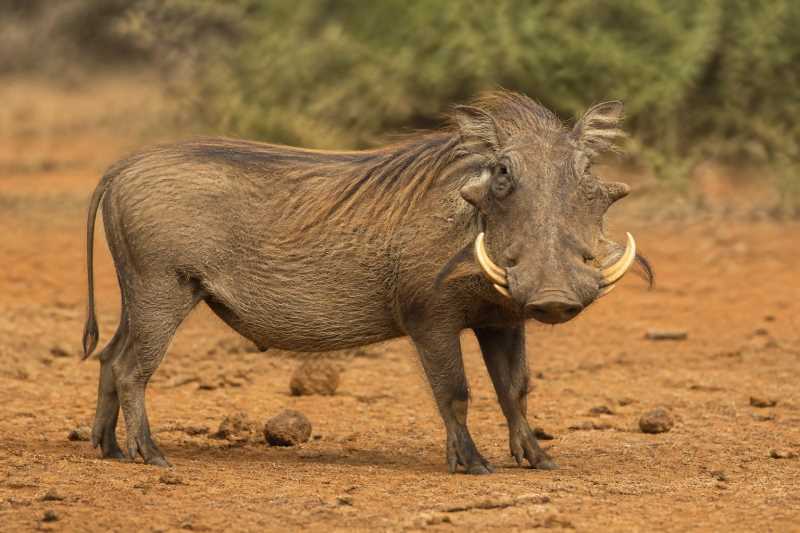
The Common Warthog is easily recognizable by its unique facial features and robust body. Adult warthogs typically weigh between 50 to 150 kilograms and can stand up to 85 centimeters at the shoulder. Their bodies are covered with sparse hair, and they have a mane of longer bristles running down their spine. One of the most striking features of the warthog is its large head adorned with warts, which are actually protective bumps that shield their face during fights.
Warthogs possess impressive tusks that curve upwards from their mouths. These tusks are elongated canine teeth that can grow up to 25 centimeters in boars, serving as formidable tools for defense and foraging. Their skin is a tough, grayish-brown color, providing camouflage in their natural environment.
Range and Habitat
The Common Warthog is widely distributed across sub-Saharan Africa, with its range extending from Mauritania and Senegal in the west to Ethiopia and Somalia in the east, and down to South Africa. These adaptable animals thrive in a variety of habitats, including savannas, grasslands, and open woodlands. They tend to avoid dense forests and arid deserts but can be found near water sources, which are crucial for their survival.
Warthogs are also known to inhabit agricultural areas and can sometimes be seen grazing alongside domestic livestock. Their ability to adapt to various environments has played a significant role in their wide distribution across the African continent.
Behavior and Diet
Common Warthogs are diurnal creatures, primarily active during the cooler parts of the day, such as early morning and late afternoon. They are social animals that live in groups called sounders, typically composed of females and their young. Adult males, or boars, are generally solitary, joining groups only during the mating season.
Warthogs are omnivorous, with a diet consisting mainly of grasses, roots, tubers, and bark. They have specialized padded snouts that allow them to dig for food with ease. Though they primarily feed on vegetation, warthogs will occasionally eat insects, eggs, and small animals when available.
Identification Tips
When trying to identify a Common Warthog in the field, look for the following characteristics:
- Facial Warts: The prominent warts on their face are a key identification feature.
- Curved Tusks: The upward-curving tusks are visible even from a distance.
- Sparse Hair with a Mane: The long bristles along their back distinguish them from other pig species.
- Behavior: Observing their social behavior can also be a clue, as they often graze in groups.
Conservation Status
The Common Warthog is currently classified as Least Concern by the International Union for Conservation of Nature (IUCN). This classification reflects their widespread distribution and stable population numbers. However, warthogs face several threats, including habitat loss due to agricultural expansion and human encroachment.
Hunting poses another significant threat, as warthogs are often targeted for their meat and tusks. Despite these challenges, the species benefits from protective measures in several national parks and reserves across Africa, where hunting is regulated or prohibited.
Frequently Asked Questions
What do warthogs eat in the wild? Common Warthogs primarily feed on grasses, roots, tubers, and bark, but they also consume insects, eggs, and small animals when available.
How do warthogs protect themselves from predators? Warthogs rely on their speed and agility to escape predators. Their tusks serve as defensive weapons, and they often retreat to burrows for safety.
Are warthogs dangerous to humans? While warthogs are generally not aggressive towards humans, they can defend themselves with their sharp tusks if threatened.
How long do warthogs live? In the wild, warthogs can live up to 15 years, although their lifespan is often shorter due to predation and environmental factors.
Where can you find warthogs in Africa? Warthogs are found throughout sub-Saharan Africa, inhabiting savannas, grasslands, and open woodlands, often near water sources.
Related posts