Introduction
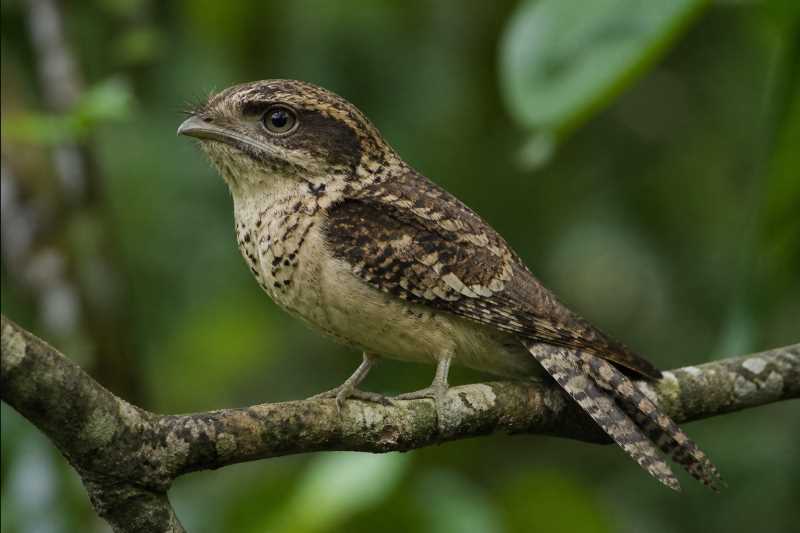
The Sumatran Frogmouth (Batrachostomus poliolophus), also known as the Short-tailed Frogmouth, is a nocturnal member of the frogmouth family, Podargidae. It is endemic to Sumatra, Indonesia, where it is associated mainly with forest in the Barisan mountain range. Its sombre plumage, short tail and habit of remaining motionless on a branch make it difficult to find, even where it is known to occur.
Physical Description
The Sumatran Frogmouth is a compact, medium-sized frogmouth with a broad, strongly arched bill and prominent bristles around the forehead, gape and ear coverts. Its plumage is dominated by brown, grey-brown and buff tones, with fine mottling and barring that closely resembles broken bark, lichen and shaded foliage.
The species is particularly notable for its short tail, which is distinctly shorter than the wing. The upperparts are generally darker and more heavily marked than the underparts, while the throat, breast and belly may show pale buff or whitish areas with darker barring or mottling. Sexual differences have been reported in plumage, although the available descriptions are based on relatively few specimens and observations. Young birds may show paler or less sharply defined markings than adults.
Range and Habitat
The Sumatran Frogmouth is endemic to Sumatra and is not naturally found elsewhere. Its known distribution is concentrated in the Barisan mountain system, although records include both foothill and montane forest. Reported elevations are broadly in the range of about 600 to 1,200 metres, but the species may occur outside this band locally.
It uses humid evergreen forest, including primary forest, mature secondary forest and forest edges where suitable trees and dense vegetation remain. The species is resident rather than migratory. Because it is nocturnal, well camouflaged and often detected by its call rather than by sight, its distribution may be more extensive than the small number of published records suggests.
Where to See This Species
The Sumatran Frogmouth is a difficult bird to locate. Night surveys with an experienced local guide offer the best chance, while quiet daytime searches may reveal a roosting bird sitting lengthwise along a branch.
Kerinci Seblat National Park, Jambi and West Sumatra, Indonesia
The park protects extensive foothill and montane forest in the Barisan Range, and the Sumatran Frogmouth has been recorded during birding surveys and night-birding visits around the Gunung Kerinci area. Forest tracks and quieter roadside sections are the most realistic places to search, especially after locating a calling bird.
Nearby accommodation: Kersik Tuo is the principal gateway settlement, with homestays, guest houses and small hotels serving visitors to the Gunung Kerinci area.
Way Kambas National Park, Lampung, Indonesia
The Sumatran Frogmouth is included in bird checklists for Way Kambas National Park, where remaining forest, woodland and other wooded habitats support a varied nocturnal bird community. It is likely to require targeted night searching, and sightings should not be expected on every visit.
Nearby accommodation: The park is accessed through settlements around Way Jepara and Labuhan Ratu, where guest houses, small hotels and lodge-style accommodation are available.
Behaviour and Diet
The Sumatran Frogmouth is nocturnal. During daylight it usually rests motionless on a branch, relying on its cryptic plumage and elongated posture to resemble a broken limb or patch of bark. It becomes more active after dusk and may forage from a perch or make short flights to capture prey.
Its diet consists mainly of insects and other small invertebrates, including beetles, moths, crickets and similar nocturnal prey. The broad bill is well suited to taking prey from the air or vegetation.
The species is usually encountered singly or in pairs. Its vocalisations include repeated whistles and wavering, descending notes, but calls can be difficult to locate in dense forest. Breeding information is limited. Available accounts describe a very small nest on a branch and a clutch of one white egg, with parental care shared by the adults. The timing of breeding may vary with local rainfall and food availability, but a consistently defined breeding season is not well established.
Identification Tips
- Look for a compact frogmouth with a very broad, pale brown to straw-coloured bill.
- The short tail is a useful diagnostic feature because it is noticeably shorter than the wing.
- Search for mottled brown and grey-brown plumage, pale underparts and a bark-like outline.
- Long bristles around the bill and ear coverts may be visible at close range.
- During the day, check horizontal or slightly sloping branches in shaded forest, especially where a bird can blend with bark and lichen.
- At night, listen for soft, wavering whistles and use the call to guide a careful search rather than relying on movement.
- Do not confuse it with other frogmouths recorded on Sumatra. The Sumatran Frogmouth is generally recognised by its short tail and pale, heavily bristled face, but identification can be difficult in poor light and should be confirmed with range, call and plumage together.
Conservation Status
The Sumatran Frogmouth is currently assessed as Least Concern on the IUCN Red List. This status does not mean that the species is unaffected by habitat change. Forest clearance, logging, agricultural expansion, plantation development and fragmentation continue to reduce and degrade suitable habitat in Sumatra, particularly in lower-elevation forests.
Its apparent scarcity is also influenced by its nocturnal behaviour, camouflage and limited survey coverage. Protecting remaining forest in the Barisan mountain range, maintaining habitat connections between protected areas and improving nocturnal bird surveys are important conservation measures.
Frequently Asked Questions
Where is the Sumatran Frogmouth found?
It is endemic to Sumatra, Indonesia, with its known range centred on the Barisan mountain range. It is mainly associated with humid foothill and montane forest.
Is the Sumatran Frogmouth nocturnal?
Yes. It rests during the day and becomes active after dusk, when it searches for insects and other small invertebrates.
What does the Sumatran Frogmouth eat?
Its diet is composed mainly of nocturnal insects and other small invertebrates, including beetles, moths and crickets.
How can the species be identified?
The most useful features are its broad bill, strongly camouflaged brown plumage, prominent facial bristles and tail that is distinctly shorter than the wing.
Where is the best place to look for this species?
Kerinci Seblat National Park is one of the more realistic places to search because it protects extensive Barisan mountain forest and the species has been recorded around the Gunung Kerinci area. Way Kambas National Park is another documented location, although sightings remain unpredictable.
Is the Sumatran Frogmouth threatened?
It is currently classified as Least Concern, but habitat loss and forest degradation remain important concerns. The species is difficult to monitor, so further field surveys are needed to clarify its distribution and population trend.
References
- BirdLife International and IUCN Red List of Threatened Species
- IOC World Bird List
- Cornell Lab of Ornithology, Birds of the World
Related posts