Introduction
Goeldi’s Monkey, scientifically known as Callimico goeldii, is a unique and fascinating member of the New World monkeys. Named after the Swiss-Brazilian naturalist Emil August Goeldi, this primate is one of the lesser-known species of South America’s rich biodiversity. These small, arboreal creatures inhabit the dense, humid rainforests of the Amazon Basin, where they play a crucial role in the ecosystem. Despite their elusive nature, Goeldi’s Monkeys are of great interest to primatologists and conservationists alike, as they exhibit a range of distinctive characteristics and behaviors that set them apart from other primates.
In this comprehensive article, we will delve into the various aspects of Goeldi’s Monkey, including their physical description, range and habitat, behavior and diet, identification tips, conservation status, and more. By the end, readers will have a better understanding of this remarkable species and the importance of preserving its habitat.
Physical Description
Goeldi’s Monkeys are small primates, typically weighing between 400 to 700 grams (0.88 to 1.54 pounds) and measuring about 20 to 30 centimeters (7.9 to 11.8 inches) in body length, excluding their tail. Their tails are slightly longer than their bodies, averaging 25 to 40 centimeters (9.8 to 15.7 inches) in length, and are non-prehensile.
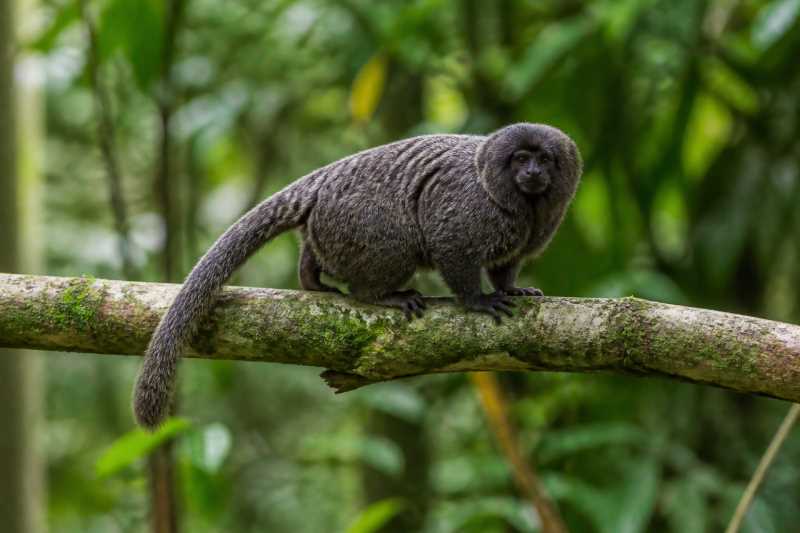
These monkeys are characterized by their soft, black to dark brown fur, which provides excellent camouflage in their dense forest habitats. Their fur is often described as having a slight sheen, adding to their distinctive appearance. Unlike many other primates, Goeldi’s Monkeys lack the bright color variations seen in tamarins and marmosets, to which they are closely related.
One of the most striking features of Goeldi’s Monkeys is their expressive faces, with large, round eyes that are adapted for their crepuscular lifestyle. Their short, rounded ears are often obscured by their dense fur, and they possess a short, blunt snout that gives them a somewhat muzzled appearance.
Range and Habitat
Goeldi’s Monkeys are native to the western Amazon Basin, with their range spanning across several South American countries, including Brazil, Peru, Bolivia, and Colombia. They are typically found in humid, lowland rainforests, particularly in regions with dense understory vegetation, which provides them with ample cover and food resources.
These primates prefer areas with a high density of bamboo and other understory plants, where they can easily find food and shelter. Their habitats are generally characterized by high humidity levels, consistent temperatures, and a rich diversity of plant and animal life. Goeldi’s Monkeys are often found at elevations ranging from sea level up to 1,200 meters (3,937 feet), although they are most commonly observed in lowland areas.
Behavior and Diet
Goeldi’s Monkeys are arboreal and primarily diurnal, although they exhibit some crepuscular activity, being most active during the early morning and late afternoon. They are social animals, typically living in small groups of up to ten individuals, which usually consist of an adult pair and their offspring.
These monkeys communicate through a variety of vocalizations, facial expressions, and body postures. Their calls include high-pitched whistles, trills, and chirps, which are used to maintain group cohesion and alert others to potential threats.
The diet of Goeldi’s Monkeys is diverse and predominantly frugivorous, consisting mainly of fruits, seeds, and insects. They also consume small vertebrates, bird eggs, and various plant materials such as flowers and leaves when fruits are scarce. Their ability to exploit a wide range of food resources is a key factor in their survival in the diverse and competitive rainforest environment.
Identification Tips (Field Recognition Cues)
Identifying Goeldi’s Monkeys in the wild can be challenging due to their elusive nature and the dense habitats they occupy. However, there are several key characteristics to look out for:
- Fur Color: Look for their dark, black to brown fur, which can appear shiny in certain lighting conditions.
- Size: Note their small size, with a body length of 20 to 30 centimeters, excluding the tail.
- Tail: Their non-prehensile tail is longer than their body and is often held out straight or slightly curved.
- Facial Features: Observe their large, round eyes and short, rounded ears that are partially hidden by fur.
- Vocalizations: Listen for their distinctive high-pitched calls, which can help locate them in dense foliage.
Conservation Status (With Threats and Protections)
As of the latest assessments by the International Union for Conservation of Nature (IUCN), Goeldi’s Monkey is classified as Near Threatened. The primary threats to their survival include habitat destruction, fragmentation due to logging, agriculture, and development, as well as potential hunting pressures.
Conservation efforts for Goeldi’s Monkeys focus on protecting their natural habitats through the establishment and management of protected areas within their range. International and local organizations are working to promote sustainable land-use practices and raise awareness about the importance of conserving these primates and their ecosystems.
Additionally, research initiatives aimed at understanding the ecology, behavior, and population dynamics of Goeldi’s Monkeys are crucial in informing conservation strategies and ensuring the long-term survival of the species.
Frequently Asked Questions
What is the scientific name of Goeldi’s Monkey?
The scientific name of Goeldi’s Monkey is Callimico goeldii. They are also commonly referred to as Goeldi’s marmosets, although they are distinct from true marmosets.
Where can Goeldi’s Monkeys be found?
Goeldi’s Monkeys are found in the western Amazon Basin, spanning countries like Brazil, Peru, Bolivia, and Colombia. They inhabit humid, lowland rainforests with dense understory vegetation.
What do Goeldi’s Monkeys eat?
Their diet primarily consists of fruits, seeds, insects, and small vertebrates. They also consume bird eggs and various plant materials when fruits are scarce, showcasing their dietary adaptability.
How do Goeldi’s Monkeys communicate?
They communicate using a range of vocalizations, including high-pitched whistles, trills, and chirps, as well as through facial expressions and body postures to maintain group cohesion and alert others of threats.
Are Goeldi’s Monkeys endangered?
Goeldi’s Monkeys are currently classified as Near Threatened by the IUCN. Their primary threats include habitat destruction and fragmentation due to logging, agriculture, and development.
Related posts