Introduction
Hartlaub’s Spurfowl (Pternistis hartlaubi), also known as Hartlaub’s Francolin, is a small, range-restricted member of the pheasant family, Phasianidae. It is endemic to rocky escarpments and outcrops in Namibia and south-western Angola. The species was named after the German physician and ornithologist Gustav Hartlaub. Current major bird lists place it in the genus Pternistis. (ww.worldbirdnames.org)
Physical Description
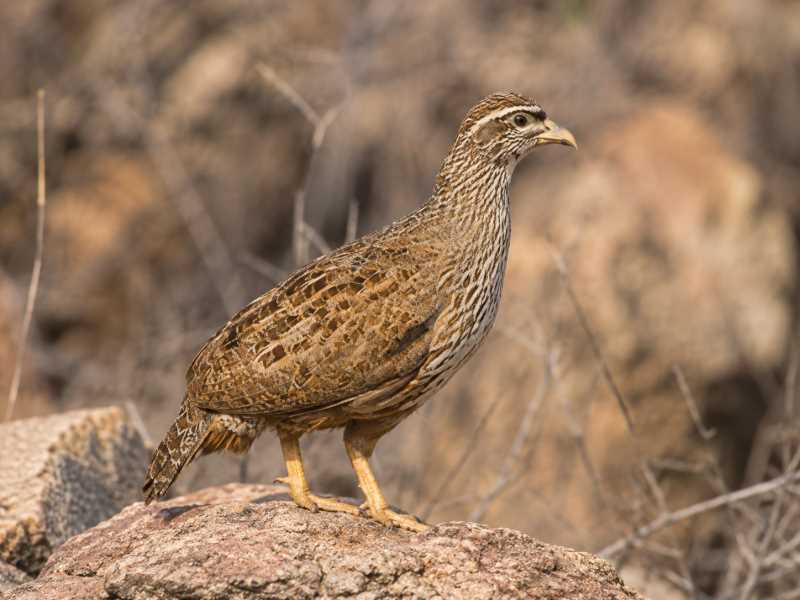
Hartlaub’s Spurfowl is one of the smallest African spurfowls. Males average about 28 cm in length and weigh approximately 245–290 g, while females are smaller, at about 25 cm and 210–240 g. The sexes are strongly dimorphic in both size and plumage.
The male has a dark brown forehead, a conspicuous white supercilium, rufous ear-coverts, brown-grey upperparts with darker barring and streaking, and pale underparts marked with dark streaks. The bill is large and distinctive, with a brownish upper mandible and yellow lower mandible. The legs are yellow and bear flattened spurs.
Females have similar upperparts but are generally duller below, with a cinnamon or rufous head, neck and underparts that lack the male’s extensive dark streaking. Juveniles are less sharply marked. Young males resemble adult males but usually have finer, less strongly developed streaking, while young females are similar to adult females. (birdforum.net)
Range and Habitat
Hartlaub’s Spurfowl is endemic to south-western Africa. Its range extends through north-central and north-western Namibia, with a smaller distribution in south-western Angola. It is not a migratory species.
The species is associated with medium-altitude arid and semi-arid country, generally between about 800 and 1,600 m above sea level. It favours rocky granite and sandstone outcrops, boulder-strewn hillsides and escarpments surrounded by semi-desert steppe. Dense grass and shrub cover around the rocks provides food, nest sites and shelter.
The species may occur near Red-billed Spurfowl (Pternistis adspersus) and Orange River Francolin (Scleroptila gutturalis), but the three birds generally use different parts of the landscape. Red-billed Spurfowl is more closely associated with bush near watercourses, while Orange River Francolin commonly occupies slopes leading towards the rocky habitats used by Hartlaub’s Spurfowl. (researchgate.net)
Behaviour and Diet
Hartlaub’s Spurfowl is mainly terrestrial and is usually encountered in pairs or small family groups. It is secretive and often remains concealed between boulders or in dense grass and shrubs. When flushed, it may fly rapidly and utter a short, chattering call, but it is more often detected by its vocalisations than by direct observation.
Pairs are territorial, and calling sites are used for repeated bouts of antiphonal calling. The species has a notably complex vocal behaviour, with paired birds contributing to duets that help maintain contact and defend territory. Calling is particularly useful for locating birds in rugged terrain where visual detection is difficult.
The diet includes plant material and invertebrates. Recorded food items include corms, seeds and insects. Feeding behaviour differs between the sexes: females are particularly associated with digging for underground corms, including those of Cyperus species, while males use a wider range of foraging methods and consume a broader selection of insects and seeds.
Breeding information remains limited. The nest is a shallow ground scrape, usually placed among grass, shrubs or rocks and lined with plant material. Clutches of several eggs have been recorded, including five-egg clutches. The chicks are precocial and leave the nest soon after hatching, remaining with the adults while they develop. (en.wikipedia.org)
Identification Tips
Look for the following combination of features:
- A small, compact spurfowl associated with rocky hills and isolated granite or sandstone outcrops.
- A conspicuously large bill and yellow legs.
- In males, a dark forehead, long white supercilium, rufous ear-coverts and strongly streaked pale underparts.
- In females, plainer cinnamon-rufous underparts and a less contrasting head pattern.
- A tendency to remain concealed among boulders and vegetation rather than flush readily.
- Loud, complex paired calling from rocky slopes, often providing the first indication that birds are present.
In parts of its range, Red-billed Spurfowl and Orange River Francolin may occur nearby. Habitat is a useful first clue: Hartlaub’s Spurfowl is most closely associated with rocky outcrops and boulder-strewn higher ground, rather than watercourse thickets or more open surrounding slopes.
Conservation Status
Hartlaub’s Spurfowl is currently assessed as Least Concern on the IUCN Red List. This status does not mean that every local population is secure. The species has a restricted distribution and depends on specialised rocky habitat, while its population size and detailed population trend are not well documented.
Granite quarrying and other forms of disturbance to rocky outcrops are recognised as potential local threats. Habitat degradation, poorly planned development and the removal of dense grass and shrub cover could also reduce the availability of shelter, food and nesting sites. Conservation measures should prioritise the protection of rocky escarpments and outcrops, maintain surrounding vegetation, and improve monitoring in both Namibia and Angola. (worldbirdnames.com)
Frequently Asked Questions
Where does Hartlaub’s Spurfowl live?
It occurs in north-central and north-western Namibia and in a smaller area of south-western Angola. Its range is centred on rocky escarpments, hills and isolated granite or sandstone outcrops.
Is Hartlaub’s Spurfowl found in South Africa?
The recognised range is in Namibia and south-western Angola. South Africa is not generally included in the current distribution of the species.
What does Hartlaub’s Spurfowl eat?
Its diet includes corms, seeds and insects. Females are particularly associated with digging for underground corms, while males use a wider range of feeding techniques.
How can Hartlaub’s Spurfowl be identified?
It is a small spurfowl with a large bill, yellow legs and a strong association with rocky outcrops. Males have a dark forehead, white supercilium and streaked pale underparts, while females are more uniformly cinnamon-rufous below.
Is Hartlaub’s Spurfowl endangered?
No. The species is currently assessed as Least Concern, although its restricted range and dependence on specialised rocky habitat make local habitat protection important.
Does Hartlaub’s Spurfowl migrate?
No. It is regarded as a resident species rather than a regular migrant, occupying suitable rocky habitat throughout the year.
References
- BirdLife International. 2016. Species factsheet: Hartlaub’s Spurfowl, Pternistis hartlaubi. BirdLife DataZone. Available at: https://datazone.birdlife.org/species/factsheet/hartlaubs-spurfowl-pternistis-hartlaubi. Accessed 8 September 2026.
- International Union for Conservation of Nature. 2024. The IUCN Red List of Threatened Species, version 2024-2. IUCN, Gland, Switzerland. Available at: https://www.iucnredlist.org/. Accessed 8 September 2026.
- Gill, F., Donsker, D. and Rasmussen, P. (eds.). 2026. IOC World Bird List, version 15.2. International Ornithologists’ Union. Available at: https://www.worldbirdnames.org/. Accessed 8 September 2026.
- Komen, J. 1987. Preliminary observations of the social pattern, behaviour and vocalization of Hartlaub’s Francolin. South African Journal of Wildlife Research, Supplement 1, 82–86.
- Mandiwana-Neudani, T. G., Little, R. M., Crowe, T. M. and Bowie, R. C. K. 2019. Taxonomy, phylogeny and biogeography of African spurfowls, Galliformes, Phasianidae, Phasianinae, Coturnicini: Pternistis spp. Ostrich, 90(2), 129–137. Available at: https://doi.org/10.2989/00306525.2019.1606690.
- Atlas of Namibia. n.d. Terrestrial wildlife endemism. Namibia Nature Foundation and partners. Available at: https://atlasofnamibia.online/chapter-7/terrestrial-wildlife/endemism. Accessed 8 September 2026.
- Brown, C. J., et al. 2015. Breeding data on the birds of Namibia. Ornithological Observations, Volume 6, 92–196. Available at: https://the-eis.com/elibrary/sites/default/files/downloads/literature/Breeding%20data%20on%20the%20birds%20of%20Namibia_2015.pdf.
Related posts