Introduction
Philby’s Partridge (Alectoris philbyi) is a resident ground-dwelling bird of the mountainous Arabian Peninsula. It occurs mainly in south-western Saudi Arabia and northern Yemen, where it inhabits dry, rocky slopes and other open highland habitats. The species was described by P. R. Lowe in 1934 and named after the British explorer and Arabist Harry St John Philby.
Physical Description
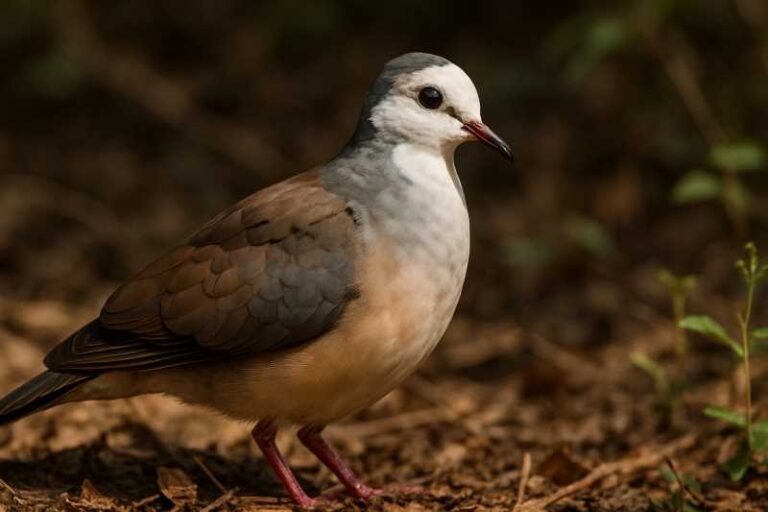
Philby’s Partridge is a medium-sized partridge, measuring approximately 33–36 cm in length. Its general plumage is greyish-brown to bluish-grey, with boldly barred flanks in black and pale buff. The most distinctive feature is the black throat and cheeks, separated from the paler head and nape by a narrow white line.
The bill, eye-ring and legs are pink to rose-red. Males and females are broadly similar in appearance, although males are usually slightly larger and may have more prominent tarsal spurs. Reliable information on age-related plumage differences is limited.
Range and Habitat
Philby’s Partridge has a restricted range in south-western Saudi Arabia and northern Yemen. It is not considered a migratory species, and available accounts describe it as largely sedentary.
The species occupies arid and semi-arid mountain environments, including rocky slopes, ravines and sparsely vegetated highlands. It may also use cultivated terraces and other agricultural areas where suitable cover remains. Recorded elevations vary geographically, approximately from 1,280 to 3,600 metres above sea level, with many records from high mountain terrain.
The species is associated with open ground containing rocks, grasses and low shrubs. In some areas it occurs in habitat similar to that of Arabian Partridge, but it is reported to favour steeper slopes with greater bush cover.
Behaviour and Diet
Philby’s Partridge is primarily diurnal and terrestrial. It usually forages on the ground and may occur in small coveys, generally numbering fewer than 15 birds. Its movements are poorly documented, but there is no evidence of regular long-distance migration.
Detailed studies of its diet are limited. Available observations indicate that plant material forms the main part of the diet, including seeds, leaves, grasses, shoots, buds and cultivated grains. Small invertebrates may also be eaten, particularly when available. Most food is obtained from the ground or low vegetation, although individuals may occasionally climb into bushes to feed.
The breeding biology of the species is not well known in the wild. Pairs have been recorded from spring into summer, and nests have been reported in shallow ground scrapes sheltered by rocks or shrubs. Published accounts commonly give clutch sizes of five to eight eggs. The original article’s estimate of eight to twelve eggs is therefore replaced with the more consistently reported range of five to eight. Some aspects of nesting behaviour, including the extent of male participation in incubation, remain uncertain.
Identification Tips
- Look for a medium-sized, compact partridge on rocky mountain slopes or among scattered shrubs.
- The black cheeks and throat are the key field mark.
- A narrow white line separates the black facial and throat pattern from the greyish-blue head and nape.
- The flanks show strong black-and-pale barring, while the bill and legs are pink or rose-red.
- It can resemble Chukar and other Alectoris partridges, but the combination of a wholly black throat and cheeks, pale head, and narrow white facial border is especially useful for identification.
- Birds are often detected by movement or calls before they are seen clearly, because their colouring blends well with rocks and dry vegetation.
Conservation Status
Philby’s Partridge is currently assessed as Least Concern on the IUCN Red List. This status does not mean that local populations are secure. The species has a geographically restricted range, and available regional assessments have identified concerns about population declines in parts of its distribution.
Potential and documented pressures include habitat degradation, agricultural and residential development, overgrazing, disturbance and hunting. Conditions in Yemen also make field monitoring and conservation assessment difficult. Important conservation measures include protecting mountain habitats, maintaining suitable vegetation and rocky cover, regulating hunting, and improving population monitoring across both range countries.
Frequently Asked Questions
Where does Philby’s Partridge live?
Philby’s Partridge occurs mainly in south-western Saudi Arabia and northern Yemen. It lives in dry, rocky mountain habitats, often at elevations above 1,000 metres.
What does Philby’s Partridge look like?
It is a greyish-brown to bluish-grey partridge with boldly barred flanks, pink or rose-red legs and bill, and a distinctive black throat and cheek area separated from the pale head by a thin white line.
What does Philby’s Partridge eat?
Its diet consists mainly of seeds and other plant material, including leaves, grasses, shoots, buds and grains. Small invertebrates may also be eaten.
Is Philby’s Partridge migratory?
It is generally regarded as resident and largely sedentary. Regular long-distance migration has not been documented.
How many eggs does it lay?
Published accounts generally report clutches of five to eight eggs. The species nests on the ground, usually in a shallow scrape protected by rocks or low vegetation.
Is Philby’s Partridge endangered?
The species is currently assessed as Least Concern, but it faces local risks from habitat degradation, overgrazing, development, disturbance and hunting. Its restricted range and limited field data justify continued monitoring.
References
- BirdLife International. 2026. Philby’s Partridge Alectoris philbyi Species Factsheet. BirdLife DataZone. Accessed 8 September 2026. https://datazone.birdlife.org/species/factsheet/philbys-partridge-alectoris-philbyi
- Gill, F., Donsker, D. and Rasmussen, P. (eds.). 2026. IOC World Bird List, version 15.2. International Ornithologists’ Union. Accessed 8 September 2026. https://www.worldbirdnames.org/
- IUCN. 2025. The IUCN Red List of Threatened Species: Arabian Region assessment materials. International Union for Conservation of Nature. Accessed 8 September 2026. https://portals.iucn.org/library/sites/library/files/documents/RL-53-004.pdf
- Ornithological Society of the Middle East, the Caucasus and Central Asia. 2023. The Birds of Saudi Arabia, Volume 2: Pheasants, Partridges, Turkeys, Grouse (Phasianidae). OSME. https://osme.org/wp-content/uploads/2023/06/The-Birds-of-Saudi-Arabia-Volume-2-2.pdf
- Saudi Aramco. 2019. The Life of Birds, Volume 1. Saudi Aramco. https://www.aramco.com/-/media/publications/books/volume-1-life-of-birds.pdf
- Lowe, P. R. 1934. Alectoris philby. Bulletin of the British Ornithologists’ Club 55: 8. Biodiversity Heritage Library. https://www.biodiversitylibrary.org/item/125291#page/46/mode/1up
- World Bird Names. n.d. Philby’s Partridge / Alectoris philbyi. Accessed 8 September 2026. https://www.worldbirdnames.com/bird/philby-s-partridge/1253.html
Related posts