Introduction
The Tambourine Dove, Turtur tympanistria, is a small, mainly resident dove of sub-Saharan Africa. It is associated with forest, woodland and other dense vegetation, where its repeated call may reveal its presence before the shy bird is seen. The species is generally found alone or in pairs and often feeds on the ground beneath cover.
Physical Description
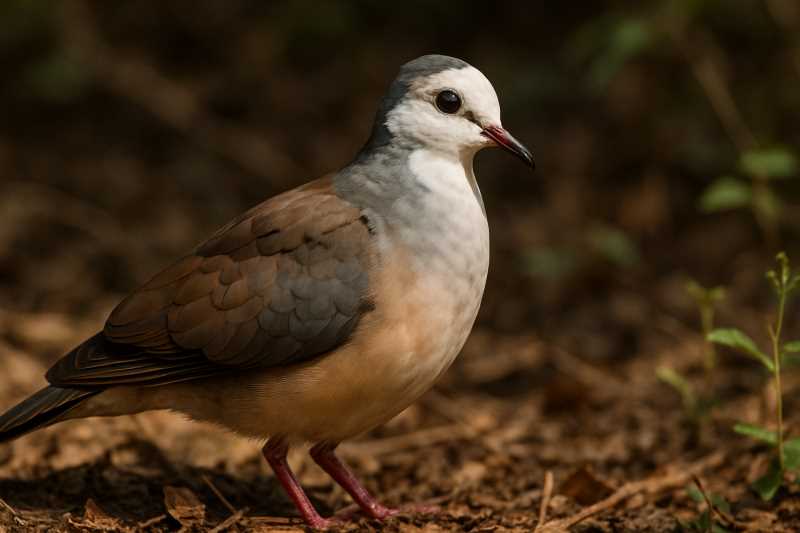
The Tambourine Dove is a compact dove measuring about 22–23 centimetres in length. The adult male has a white face and underparts, a grey crown, and pale grey-brown upperparts. A dark spot behind the eye, purple or violet wing patches, a purple-red eye-ring and reddish-purple legs are useful identification features. The bill is also purplish, often with a darker tip.
Females are duller than males. The face, breast and crown are more grey-brown, while the belly remains white. Juveniles resemble females but usually show chestnut fringes on the feathers of the back, breast and flanks. The species is not strongly sexually dimorphic in size, but the difference in facial and breast colour is often noticeable.
Range and Habitat
The Tambourine Dove is widely distributed across sub-Saharan Africa. Its range extends broadly from Senegal and Guinea eastwards through central and eastern Africa to Ethiopia and Kenya, then southwards through parts of Angola, Zambia, Zimbabwe, Mozambique and South Africa. It is absent from much of the driest south-western region and also occurs on Bioko and the Comoros Islands.
It is a resident breeding species rather than a long-distance migrant. The dove favours evergreen and semi-evergreen forest, riverine woodland, forest edges, dense thickets and secondary growth. It may also use well-vegetated gardens and plantations, including areas with cocoa, rubber or castor-oil plants. In southern Africa, it is especially associated with moist woodland and forest habitats, often close to rivers or other dense cover.
Where to See This Species
Kruger National Park, Limpopo and Mpumalanga, South Africa
The Tambourine Dove is included on the official Kruger National Park bird checklist. SANParks describes it as a rare and localised resident of suitable riverine habitat, so birders should concentrate on moist wooded areas, river margins and dense vegetation rather than open savanna. The northern parts of the park, including riverine habitats around the Levuvhu area, offer particularly appropriate conditions.
Nearby accommodation: Visitors can use SANParks rest camps and campsites within the park, or choose guest houses, lodges and hotels in gateway areas such as Phalaborwa, Hoedspruit or Thohoyandou.
Behaviour and Diet
The Tambourine Dove is secretive and predominantly terrestrial. It usually walks quietly on the forest floor or beneath thick vegetation while searching for food. When flushed, it typically makes a fast, low flight through cover before settling again.
Its diet consists mainly of seeds and small fruits, supplemented by invertebrates such as insects, termites and small molluscs. Castor-oil seeds are among the recorded food items. The bird is usually solitary, although pairs, family groups and occasional associations with other forest doves may occur.
The call is a persistent, repetitive series often rendered as “du-du-du-du-du”. It is commonly heard from dense vegetation and may be the first indication that a Tambourine Dove is nearby.
Breeding can occur at different times in different parts of Africa. The species builds a fragile platform of twigs and plant material in a low bush, tree or tangle of creepers, often near dense vegetation or a watercourse. Usually two cream-coloured eggs are laid. Both parents participate in nest care, although the female may perform most of the incubation. The chicks are fed regurgitated food and generally leave the nest after roughly two weeks, remaining dependent on the adults for a short time afterwards.
Identification Tips
- Look for a small, compact dove moving on the ground beneath thick woodland or forest cover.
- Adult males show a striking white face and underparts, grey crown and dark spot behind the eye.
- Purple or violet patches on the folded wings are often visible when the bird is perched or moving through shade.
- Females are duller, with a grey-brown face, breast and crown, but retain a white belly.
- The purple-red eye-ring, purplish bill and reddish-purple legs can help confirm identification at close range.
- The repeated “du-du-du-du-du” call is often easier to detect than the bird itself.
- The Tambourine Dove is generally paler below than several other small African doves. Its preference for dense, moist vegetation also helps distinguish it from more open-country species such as the Emerald-spotted Wood-Dove.
Conservation Status
The Tambourine Dove is currently assessed as Least Concern. It remains widespread and occurs in a range of wooded habitats, including some secondary vegetation and plantations. Nevertheless, local populations may be affected by deforestation, agricultural expansion, degradation of riverine forest and other forms of habitat loss. Hunting may also affect the species in parts of its range, although it is not regarded as a uniform threat across the whole distribution.
Maintaining forest corridors, riverine woodland, dense secondary growth and other suitable cover is important for the species. Continued monitoring is also useful because a broad global assessment can conceal local declines where habitat is being lost rapidly.
Frequently Asked Questions
Where can the Tambourine Dove be found?
It occurs widely across sub-Saharan Africa, from West Africa through central and eastern Africa to parts of southern Africa. It also occurs on Bioko and the Comoros Islands.
Is the Tambourine Dove migratory?
No. It is generally a resident species, although local movements may occur in response to food availability, habitat conditions or seasonal changes.
What does the Tambourine Dove eat?
It mainly eats seeds and small fruits gathered from the ground. Invertebrates, including insects, termites and small molluscs, are also recorded in its diet.
How can the Tambourine Dove be identified?
The most useful features are its small size, white underparts, white face in adult males, grey crown, dark spot behind the eye, purple wing patches and repeated “du-du-du-du-du” call.
Where does the Tambourine Dove nest?
It builds a loose nest of twigs and other plant material in a low bush, tree or tangle of creepers. The nest is usually concealed within dense vegetation.
Is the Tambourine Dove threatened?
The species is currently classified as Least Concern. Habitat loss and local hunting can cause problems, but the species remains widespread and is not currently considered globally threatened.
References
- BirdLife International
- Cornell Lab of Ornithology, Birds of the World
- South African National Parks
Related posts