Understanding the Horned Curassow: A Rare Avian Marvel
The Horned Curassow (Pauxi unicornis) is an enigmatic and elusive bird species that captivates ornithologists and conservationists alike. Native to the dense, humid forests of Bolivia and Peru, this unique bird is a testament to the rich biodiversity of the Neotropical region. Despite its allure, the Horned Curassow remains one of the least understood members of the Cracidae family, which includes guans, chachalacas, and other curassows. This article aims to shed light on this remarkable bird, discussing its habitat, behavior, conservation status, and the challenges it faces in the wild.
A Distinctive Appearance
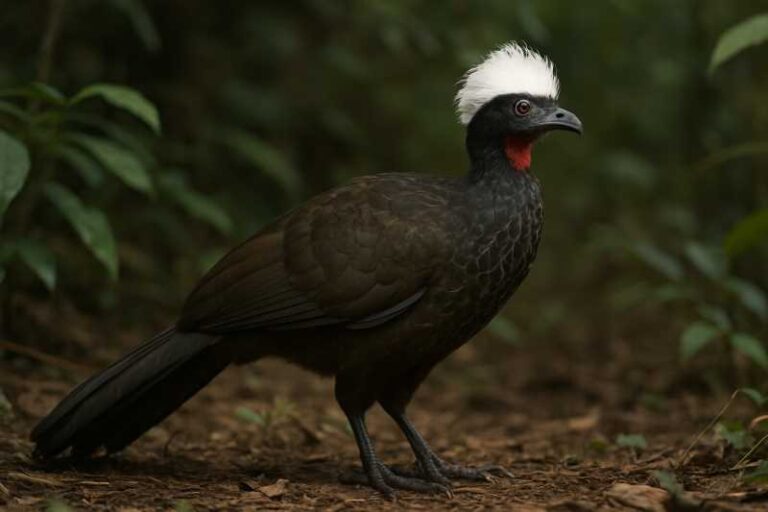
The Horned Curassow is a large bird, with adults typically measuring between 85 to 95 centimeters in length. It is known for its striking appearance, characterized by a prominent, horn-like structure on its forehead, which is a distinguishing feature among curassows. This casque, or ‘horn,’ is not just for show; it plays a role in the bird’s social behavior and identity.
The plumage of the Horned Curassow is predominantly black, with a glossy sheen that reflects a bluish tint under sunlight. The bird’s underparts are white, providing a stark contrast to its dark upper body. Its legs and feet are robust and adapted for life on the forest floor, while its beak is thick and slightly hooked, perfectly suited for its diet.
Habitat and Distribution
The Horned Curassow inhabits the lowland rainforests and subtropical or tropical moist montane forests of Bolivia and Peru. It favors dense, undisturbed regions where it can forage for its diet of fruits, seeds, and small invertebrates. The bird’s reliance on such specific habitats makes it particularly vulnerable to environmental changes and human activities.
Behavior and Ecology
Horned Curassows are largely terrestrial birds, spending much of their time on the forest floor foraging for food. They are known to be shy and elusive, often retreating into dense cover at the first sign of danger. These birds are also monogamous, typically forming long-lasting pair bonds. During the breeding season, which coincides with the rainy season, the male performs elaborate displays to attract a mate, showcasing his casque and vibrant plumage.
The nesting habits of the Horned Curassow are not well-documented, but it is believed that they nest in tree hollows or on the ground, laying a small clutch of eggs that both parents help incubate and rear. The chicks are precocial, meaning they are relatively mature and mobile from the moment of hatching.
Conservation Status and Challenges
The Horned Curassow is currently listed as Endangered on the International Union for Conservation of Nature (IUCN) Red List. Its population is estimated to be fewer than 2,500 mature individuals, and it is in a continuous decline. The primary threats to this species are habitat loss due to deforestation, agricultural expansion, and infrastructure development.
Efforts to conserve the Horned Curassow face several challenges. The bird’s elusive nature makes it difficult to study, and limited data hampers targeted conservation actions. Furthermore, the political and economic instability in the regions where it lives complicates the implementation of effective conservation strategies.
Conservation Efforts and Future Directions
Conservation organizations and local governments are working towards safeguarding the remaining habitats of the Horned Curassow. Initiatives include the establishment of protected areas, habitat restoration projects, and community-based conservation programs that involve local communities in protecting wildlife.
There is also a push for further research to better understand the ecology and behavior of the Horned Curassow. Such information is crucial for developing effective conservation plans. Additionally, raising awareness about the bird and its plight is essential to garnering support for its protection.
In conclusion, the Horned Curassow is a symbol of the unique biodiversity of the Neotropics and highlights the urgent need for conservation in these rapidly changing ecosystems. Protecting this remarkable bird requires a concerted effort from researchers, conservationists, and local communities. By understanding and appreciating the Horned Curassow, we take an important step towards ensuring its survival for future generations.
Related posts