Introduction
The White-crested Guan, Penelope pileata, is a large forest-dwelling member of the Cracidae family, which includes guans, chachalacas and curassows. It is endemic to Brazil, where it occurs in the eastern Amazon Basin. The species is especially distinctive for its long white crest, dark greenish upperparts and rich chestnut underparts. (itis.gov)
Physical Description
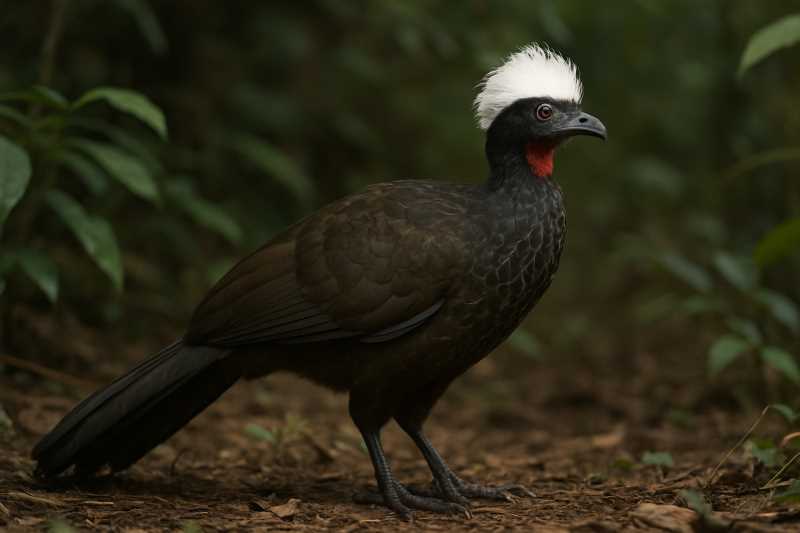
The White-crested Guan is approximately 75–82 cm long and weighs about 1.1–1.6 kg. It has a long, narrow white crest, dark slate-grey facial skin, reddish-brown to chestnut neck and underparts, and glossy dark green or blackish-green upperparts. The breast may show scattered pale feather margins, while the long tail is dark with a greenish or bluish sheen. The legs and feet are coral-red, and the bill is robust and suited to handling fruit and other plant material. (oiseaux.net)
Reliable evidence for pronounced sexual dimorphism is limited. Adult males and females are generally described as similar in overall plumage, although the iris may be darker in males. Juveniles differ from adults: newly hatched birds have more cryptic, streaked head and body plumage, and adult-like feathers begin to appear during the early growth period. (oiseaux.net)
Range and Habitat
The White-crested Guan is endemic to Brazil. Its range lies in the eastern and south-central Amazon Basin, particularly in the states of Pará, Maranhão, Tocantins and adjacent areas. It is associated mainly with humid tropical forest, including dense terra firme forest, but it may also occur in seasonally flooded forest and some forested areas near the transition with the Cerrado. It is not a migratory species. (en.wikiaves.com.br)
The species is closely dependent on forest cover. Habitat loss and fragmentation have reduced the continuity of suitable forest across parts of its range, particularly in areas affected by agricultural expansion, infrastructure development and logging. The White-crested Guan may use the forest canopy and middle levels, but it remains principally a forest bird rather than a species of open country. (fao.org)
Behaviour and Diet
White-crested Guans are diurnal and spend much of their time in trees, although they may descend to lower vegetation or the ground while feeding. Like other guans in the genus Penelope, they may occur singly, in pairs or in small social groups. Their calls are described as harsh or raucous, and vocal activity is particularly noticeable during the early part of the day. (fao.org)
The diet is based largely on fruit and other plant material, including seeds and leaves. By swallowing fruit and later passing viable seeds away from the parent plant, guans can contribute to seed dispersal and forest regeneration. The exact diet of the White-crested Guan is not as well documented as that of some more widespread guan species, so detailed claims about particular food plants should be treated cautiously.
Specific breeding information for the White-crested Guan remains limited. The original account’s claims of a fixed rainy-season breeding period, a clutch of two to three eggs and an incubation period of 24–28 days are not retained here because reliable species-specific confirmation was not found. Nests and breeding activity are expected to be associated with forest habitat, but further field study is needed to document nesting sites, clutch size, incubation and parental care.
Identification Tips
Look for a large, long-tailed forest bird with the following combination of features:
- A conspicuous white crest, often the first feature noticed.
- Dark greenish-black upperparts contrasting with chestnut or reddish-brown underparts.
- A dark face with bluish or slate-grey tones.
- Coral-red legs and feet.
- A long, broad, dark tail with a subtle greenish sheen.
The White-crested Guan is most readily separated from other Penelope guans by the combination of its bright white crest and strongly contrasting chestnut underparts. Care is needed when identifying birds in poor light, when the crest may be lowered or partly hidden. Vocalisations can assist identification, but they should be used alongside plumage, habitat and geographic range rather than as the sole field mark. (oiseaux.net)
Conservation Status
The White-crested Guan is listed as Vulnerable on the global IUCN Red List assessment used by BirdLife International. It is considered threatened primarily because of its restricted Brazilian range, continuing loss and fragmentation of forest habitat, and hunting pressure. The global population is not presented here because a reliable current population estimate was not confirmed from the sources consulted. (keybiodiversityareas.org)
Important conservation measures include protecting remaining tracts of eastern Amazonian forest, maintaining connections between fragmented reserves, reducing hunting pressure and improving monitoring of populations and habitat. Protected areas and effective land-use planning are particularly important in regions where deforestation and infrastructure development are expanding. Conservation planning should also account for the species’ dependence on mature forest and its restricted distribution. (fao.org)
Frequently Asked Questions
Where does the White-crested Guan live?
The species is endemic to Brazil and occurs mainly in the eastern and south-central Amazon Basin, especially in Pará, Maranhão and Tocantins. It inhabits humid tropical forests and some seasonally flooded forest areas. (avibase.bsc-eoc.org)
Why is the White-crested Guan called white-crested?
It is named for the long, narrow white feathers forming its prominent crest. This crest contrasts with the bird’s dark face and glossy dark upperparts.
What does the White-crested Guan eat?
It feeds mainly on fruit and other plant material, including seeds and leaves. As with other guans, it may help disperse seeds through its movements and feeding habits.
Is the White-crested Guan migratory?
No. It is regarded as a resident forest species rather than a long-distance migrant. Local movements may occur in response to food availability or habitat conditions, but regular migration is not known.
How can the White-crested Guan be identified in the field?
The most useful field marks are the white crest, dark greenish upperparts, chestnut underparts, dark face, coral-red legs and long dark tail. It is usually found in or near forest rather than open habitats.
Is the White-crested Guan threatened?
Yes. It is listed as Vulnerable globally. Habitat loss, forest fragmentation and hunting are the principal documented concerns. (keybiodiversityareas.org)
References
- BirdLife International. 2021. Penelope pileata. Species factsheet and global conservation assessment information. BirdLife DataZone, BirdLife International. Accessed 8 September 2026. https://datazone.birdlife.org/
- Costa, D. A., and M. L. Christoffersen. 2016. Comparative analysis of vocalizations of guans (Galliformes, Cracidae, Penelope) from Brazil (South America). Gaia Scientia 10(4): 173–181. https://doi.org/10.21707/gs.v10.n04a14
- Gill, F., D. Donsker, and P. Rasmussen, eds. 2026. IOC World Bird List, version 15.2. International Ornithologists’ Union. Accessed 8 September 2026. https://www.worldbirdnames.org/
- Integrated Taxonomic Information System. n.d. Penelope pileata Wagler, 1830. ITIS, Taxonomic Serial No. 175740. Accessed 8 September 2026. https://www.itis.gov/servlet/SingleRpt/SingleRpt?search_topic=TSN&search_value=175740
- Piacentini, V. Q., et al. 2015. Annotated checklist of the birds of Brazil by the Brazilian Ornithological Records Committee. Revista Brasileira de Ornitologia 23(2): 91–298. https://www.cbro.org.br/wp-content/uploads/2020/06/Piacentini-et-al-2015-RBO.pdf
- van Perlo, B. 2009. A Field Guide to the Birds of Brazil. Oxford University Press.
- World Conservation Monitoring Centre and relevant IUCN Red List assessment partners. n.d. The IUCN Red List of Threatened Species. Species assessment information for Penelope pileata. Accessed 8 September 2026. https://www.iucnredlist.org/
Related posts