Introduction
The Montezuma Quail (Cyrtonyx montezumae) is a small, secretive New World quail found in mountainous regions of Mexico and the southwestern United States. It is also known as Mearns’s Quail. Although the male has striking, intricately patterned plumage, the species is difficult to see because it remains motionless in dense grass until approached closely.
Physical Description
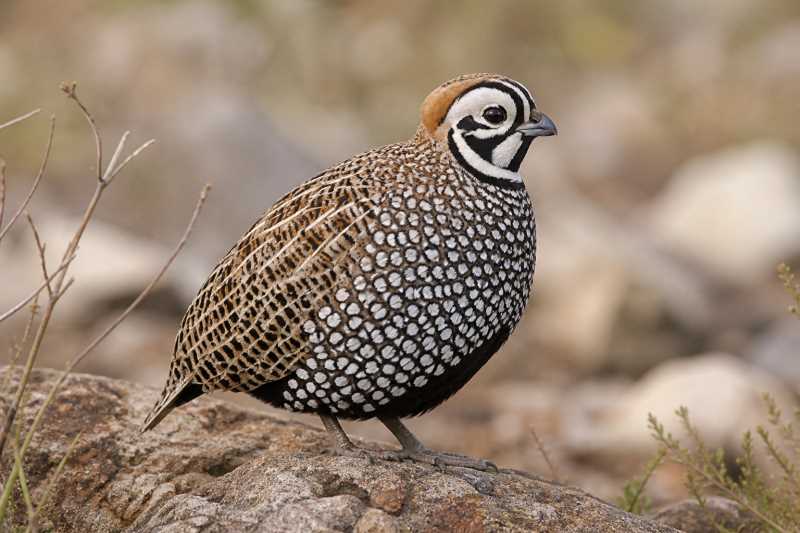
The Montezuma Quail is a compact, plump bird with a very short tail, rounded wings, a heavy bill and a small head with a slight rear crest. Adults measure approximately 20–23 centimetres in length, weigh about 122–230 grams and have a wingspan of roughly 41–43 centimetres.
Males are distinctive, with a complex black-and-white facial pattern, a pale or blond crest, a chestnut breast and dark bluish-grey flanks marked with white spots. The upperparts are finely patterned with black, brown and tan. Females are more subdued, mainly rich brown with whitish markings and a less sharply defined version of the male’s facial pattern. This sexual dimorphism helps females remain camouflaged while nesting.
Young birds are downy and mobile soon after hatching. Their early plumage is predominantly cryptic brown and becomes more adult-like as they mature.
Range and Habitat
The Montezuma Quail is a year-round resident rather than a long-distance migrant. Its range extends from the southwestern United States, including Arizona, New Mexico and parts of western Texas, south through much of the mountainous interior of Mexico.
It is most strongly associated with native perennial bunchgrass in pine-oak and evergreen oak woodland, particularly on mountain slopes, grassy hillsides, canyon margins and other areas with dense ground cover. It may also occur in stream corridors, desert grassland transitions and higher-elevation woodland. In the southwestern United States, it has been recorded from approximately 490 to 3,050 metres above sea level, although local elevation varies with climate and habitat.
The species depends on a combination of woodland cover and relatively tall native grasses. These provide shelter from predators, nesting material and access to underground food. Its distribution is patchy where grazing, land conversion, altered fire regimes or drought have reduced the quality of native grassland.
Behaviour and Diet
Montezuma Quails spend most of their time on the ground and usually walk or run through grass rather than flying. When disturbed, they may crouch motionless until an approaching person or predator is very close, then flush suddenly with rapid wingbeats. Pairs are common throughout the year, while family groups may remain together during autumn and winter. Larger coveys are less typical than in some other North American quails.
The species feeds mainly on underground plant parts, including bulbs, tubers, roots and sedge structures, as well as acorns, seeds and invertebrates. Its powerful feet and long, curved claws help it dig through soil and leaf litter. Insects such as beetles, grasshoppers and ants become more important during the wetter summer period, when they also provide food for growing young.
Breeding is commonly timed to summer rainfall in the southwestern United States, although nesting may begin earlier in parts of Mexico and the eastern portion of the range. The nest is a concealed, grass-lined structure on or near the ground, often beside a rock, tree or clump of vegetation. Clutches generally contain several eggs, with reported clutch sizes ranging from about 6 to 14 eggs in detailed North American accounts. Both parents may contribute to incubation, brooding or care of the chicks, depending on the breeding system and circumstances. The young are precocial and leave the nest soon after hatching.
Identification Tips
- Look for a very round-bodied, short-tailed quail with almost no visible neck.
- An adult male shows a bold black-and-white face, pale crest, chestnut breast, bluish-grey sides and conspicuous white spots.
- A female is mostly brown and cryptically marked, but may retain a faint impression of the male’s facial pattern.
- The species is more often detected when it flushes from dense grass than when it is seen feeding in the open.
- Strongly patterned males, the extremely short tail and the bird’s preference for mountain oak-grassland habitat help separate it from Scaled Quail and Gambel’s Quail, which are generally longer-tailed and less intricately marked.
- Its habit of holding tightly in cover is characteristic, but it should not be treated as a reliable diagnostic feature on its own.
Conservation Status
The Montezuma Quail is currently assessed as Least Concern on the IUCN Red List. This global assessment does not mean that all populations are secure. Numbers can fluctuate substantially between years in response to summer rainfall, food availability and the condition of native grass cover, and the species has become scarce or locally absent in parts of its former range.
The principal conservation concern is loss or degradation of native perennial grassland within oak woodland and mountain habitats. Heavy grazing can remove the dense cover needed for nesting and escape, even where grazing temporarily increases some food plants. Habitat clearance, roads, development, invasive grasses, altered fire regimes and increasingly hot or dry conditions may also reduce habitat quality. In the United States, conservation measures include protecting Madrean oak woodland and native grassland, managing grazing to retain adequate ground cover, restoring degraded watersheds and monitoring populations in areas affected by drought or habitat change.
Frequently Asked Questions
Where does the Montezuma Quail live?
It occurs in mountainous areas of Mexico and in parts of Arizona, New Mexico and western Texas. It is most closely associated with oak or pine-oak woodland containing native perennial bunchgrass.
Is the Montezuma Quail migratory?
No. It is generally a resident species. Local movements may occur, including movement to lower elevations during colder or less favourable periods in the northern part of its range.
What does the Montezuma Quail eat?
Its diet includes bulbs, tubers, roots, acorns, seeds and insects. It commonly scratches and digs in the soil with its strong feet and long claws to uncover food.
How can a male Montezuma Quail be identified?
The male has a striking black-and-white facial pattern, a pale crest, a chestnut breast, dark bluish-grey sides and white spots. The female is mainly brown and much less conspicuous.
When does the Montezuma Quail breed?
In the southwestern United States, breeding and nesting are often concentrated in mid to late summer after seasonal rains. The timing varies across the range and may be earlier in parts of Mexico.
Is the Montezuma Quail endangered?
The species is globally classified as Least Concern by the IUCN. Nevertheless, some local populations are affected by overgrazing, habitat loss, drought and declining native grass cover, so habitat management remains important.
References
- BirdLife International. 2021. Cyrtonyx montezumae. The IUCN Red List of Threatened Species 2021: e.T22728212A137904353. https://doi.org/10.2305/IUCN.UK.2021-3.RLTS.T22728212A137904353.en. Accessed 8 September 2026.
- Cornell Lab of Ornithology. n.d. Montezuma Quail: Identification. All About Birds. https://www.allaboutbirds.org/guide/Montezuma_Quail/id. Accessed 8 September 2026.
- Cornell Lab of Ornithology. n.d. Montezuma Quail: Life History. All About Birds. https://www.allaboutbirds.org/guide/Montezuma_Quail/lifehistory. Accessed 8 September 2026.
- Cornell Lab of Ornithology. n.d. Montezuma Quail: Range Map. All About Birds. https://www.allaboutbirds.org/guide/Montezuma_Quail/maps-range. Accessed 8 September 2026.
- Heffelfinger, J. R., and R. J. Olding. 2000. “Montezuma Quail Management in Arizona.” National Quail Symposium Proceedings 4, Article 45. https://doi.org/10.7290/nqsp04j019.
- Stromberg, M. R. 2000. “Montezuma Quail (Cyrtonyx montezumae), version 2.0.” In The Birds of North America, edited by P. G. Rodewald. Cornell Lab of Ornithology, Ithaca, New York. https://doi.org/10.2173/bna.567.
- U.S. Fish and Wildlife Service. 2022. Enhancing Habitat for Montezuma Quail. Conservation and Adaptation Resources Toolbox. https://www.fws.gov/project/enhancing-habitat-montezuma-quail. Accessed 8 September 2026.
- U.S. Forest Service, Rocky Mountain Research Station. 2025. Cyrtonyx montezumae, Montezuma Quail. Fire Effects Information System. https://research.fs.usda.gov/feis/species-reviews/cymo. Accessed 8 September 2026.
- IOC World Bird List. 2025. IOC World Bird List, version 15.2. International Ornithologists’ Committee. https://www.worldbirdnames.org/. Accessed 8 September 2026.
Related posts