Introduction
The Chestnut Wood Quail (Odontophorus hyperythrus) is a shy, ground-dwelling member of the New World quail family, Odontophoridae. It is endemic to Colombia, where it inhabits humid Andean forests and dense forest edges. Although it is more often heard than seen, its distinctive calls and chestnut plumage make it a sought-after species for birdwatchers visiting the Colombian Andes.
Physical Description
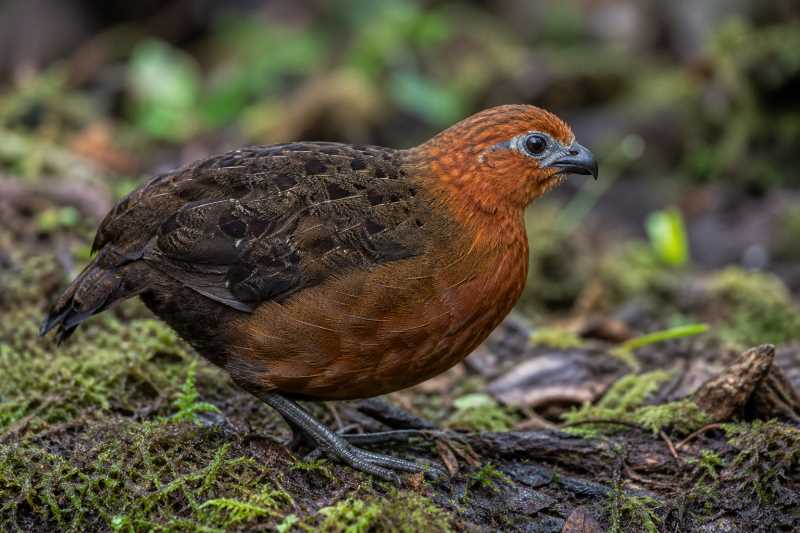
The Chestnut Wood Quail is a medium-sized quail measuring approximately 25–28 cm in length. Its back, wings and rump are brown to chestnut, with fine dark vermiculation and subtle pale markings that provide effective camouflage in leaf litter and shaded undergrowth.
Adult males have a largely chestnut head and warmer rufous-brown underparts. Females are generally duller, with a browner head and more grey-brown breast and belly. A pale line behind the eye and contrasting facial markings can be visible at close range. Juveniles resemble females but are usually less strongly marked and overall duller.
Range and Habitat
The Chestnut Wood Quail is endemic to Colombia. Its principal range covers the western and central Andes, with additional records from parts of the eastern Andes. It is generally associated with humid montane and cloud forest between about 1,600 and 2,700 metres above sea level.
The species uses mature forest, older secondary forest and some dense forest edges, particularly where thick undergrowth, leaf litter and reliable ground cover remain. It is resident rather than migratory. Habitat loss and fragmentation are important concerns because the quail depends on connected or suitably sheltered forest patches for feeding, nesting and movement.
Where to See This Species
Santuario de Fauna y Flora Otún Quimbaya, Risaralda, Colombia
This protected sanctuary in the upper Río Otún basin records the Chestnut Wood Quail among its endemic birds. Its humid sub-Andean forest, dense understorey and established ecotourism trails make it one of the more realistic public sites for searching for the species. Early morning walks are likely to be most productive, although the quail may remain concealed even when calling nearby.
Nearby accommodation: Pereira and the La Florida area provide hotels, guest houses, rural lodges and other practical accommodation for visits to the sanctuary.
Parque Nacional Natural Farallones de Cali, Valle del Cauca, Colombia
The Chestnut Wood Quail is documented from the montane forests of Farallones de Cali, including areas associated with the Pichindé and Peñas Blancas region. Visitors should concentrate on quiet trails through humid forest and dense undergrowth, listening for calls rather than expecting an open view of the bird.
Nearby accommodation: Cali and the rural Pichindé area offer hotels, guest houses, cabins and self-catering accommodation, depending on the access route.
Apía Birding Ecolodge, Risaralda, Colombia
This private birdwatching venue in the municipality of Apía has specifically documented the Chestnut Wood Quail and offers the possibility of observing it from a specialised hide. The surrounding forest lies within a biological corridor between Parque Nacional Natural Tatamá and the Distrito de Manejo Integrado Cuchilla del San Juan, providing suitable montane habitat.
Nearby accommodation: Apía has small hotels, guest houses and rural accommodation, while the surrounding countryside includes lodge-style and self-catering options.
Behaviour and Diet
The Chestnut Wood Quail is primarily terrestrial and spends most of the day moving through the forest floor, where it scratches among leaves, roots and low vegetation. Family groups commonly contain three to nine birds and may include a breeding pair with young. Groups can maintain familiar activity areas and neighbouring groups may engage in prolonged vocal exchanges.
Its diet includes fallen fruits, berries, seeds, roots and small invertebrates collected from the leaf litter and around tree roots. These feeding habits may contribute to the movement of seeds through the forest, although the species’ precise ecological role is not fully documented.
The quail is secretive and is frequently detected by its voice before it is seen. It may call in duets or group choruses, especially during the early morning. At night, individuals have been recorded roosting in trees several metres above the ground, rather than remaining entirely on the forest floor.
Breeding information is limited, but nests are built on the ground as covered, tunnel-like structures made from leaves and dry vegetation. Clutches contain about four or five eggs, and the female has been observed incubating for approximately 27–29 days. Breeding appears to coincide with wetter periods in at least parts of its range.
Identification Tips
- Look for a compact, medium-sized quail moving quietly through leaf litter and dense undergrowth.
- The chestnut head and rufous-brown underparts are useful clues to an adult male.
- Females appear duller, with more grey-brown underparts and less vivid facial colouring.
- Fine dark vermiculation on the brown back and rump helps break up the bird’s outline in shaded forest.
- A pale post-ocular line and contrasting facial markings may be visible when the bird is close.
- Listen carefully for a repeated duet or chorus, since the species is often detected vocally before it appears.
- In Colombia’s Andean forests, take care not to confuse it with other wood quails. Habitat, elevation, call and the combination of chestnut head, rufous underparts and finely patterned upperparts are more reliable than colour alone.
Conservation Status
The Chestnut Wood Quail is currently assessed as Least Concern on the IUCN Red List. This global category does not mean that the species is free from local threats. Deforestation, agricultural expansion, forest fragmentation, disturbance and hunting can reduce the quality and continuity of suitable habitat.
The species benefits from protected montane forests, restoration of connections between forest fragments and careful management of remaining secondary forest. Further monitoring is valuable because population size and long-term trends are not well quantified across its range.
Frequently Asked Questions
Where is the Chestnut Wood Quail found?
It is endemic to Colombia and occurs mainly in humid montane forests of the western and central Andes, with additional records from parts of the eastern Andes.
What habitat does the Chestnut Wood Quail prefer?
It favours humid cloud and montane forest with dense undergrowth and substantial leaf litter. It can also occur in older secondary forest and dense forest edges.
What does the Chestnut Wood Quail eat?
Its diet includes fallen fruit, berries, seeds, roots and small invertebrates gathered from the forest floor and leaf litter.
Is the Chestnut Wood Quail difficult to see?
Yes. It is secretive and usually stays in dense vegetation. Birdwatchers often hear its calls before seeing it, particularly during quiet early-morning walks.
Does the Chestnut Wood Quail migrate?
No. It is considered a resident species and does not undertake regular long-distance migration.
What is the conservation status of the Chestnut Wood Quail?
The species is currently classified as Least Concern, although habitat loss and fragmentation remain important local conservation concerns.
References
- BirdLife International
- IOC World Bird List
- Ornitología Neotropical
Related posts