Introduction
The Rufous-gaped Hillstar (Urochroa bougueri) is a localised hummingbird of the western Andes. It occurs mainly on the Pacific-facing slopes of Colombia and north-western Ecuador, where it inhabits humid montane forest, forest edges, shrubby slopes and streamside vegetation. It was formerly included within the broader concept of the White-tailed Hillstar, but is now generally treated as a separate species.
Physical Description
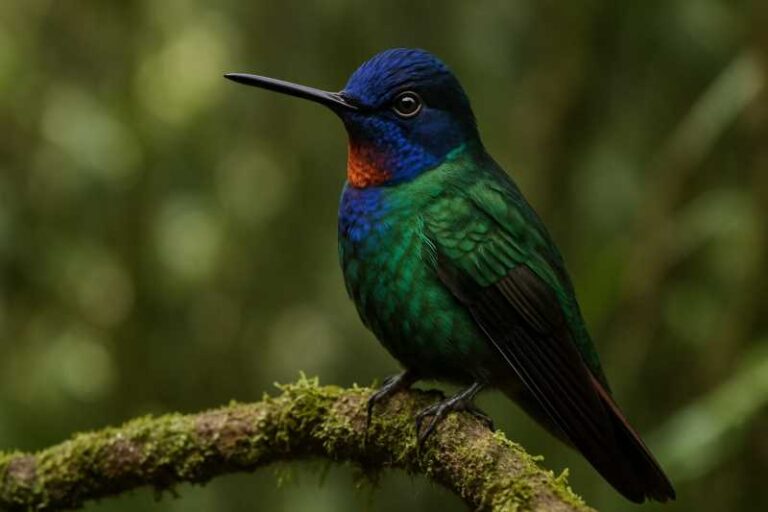
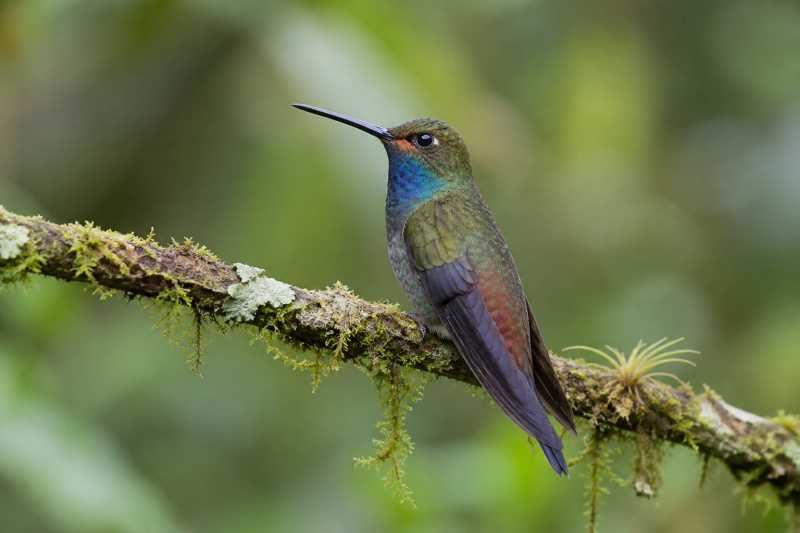
The Rufous-gaped Hillstar is a medium-sized hummingbird measuring approximately 13–14 centimetres in length and weighing about 8.5–9.2 grams. It has a long, straight, black bill and coppery-green upperparts. The face and gape area show a distinctive rufous or cinnamon colour, while the throat and upper breast are glossy blue or blue-green.
The lower breast and belly are dull greyish, contrasting with the iridescent throat. Its tail is particularly useful for identification: the central and outer tail feathers are dark, while several of the remaining feathers are white with dusky margins. The sexes are broadly similar in plumage, and reliable age-related differences are not well documented. Juveniles may show softer, buff-edged feathering than adults.
Range and Habitat
The species is distributed along the western slope of the Andes, from southern Chocó and adjoining areas of Colombia south through western Colombia to north-western Ecuador, reaching approximately Pichincha Province. It is a near-endemic of Colombia and Ecuador and is generally regarded as sedentary, although some seasonal movements to different elevations have been reported in Colombia.
The Rufous-gaped Hillstar usually occurs between about 1,100 and 2,800 metres above sea level, with many records concentrated at middle elevations. It favours humid montane forest, mature forest edges, secondary woodland, shrubby slopes and vegetation beside streams and waterfalls. It may tolerate some disturbed or agricultural landscapes where forest remnants and flowering plants remain.
Where to See This Species
Las Tángaras ProAves Reserve, Chocó, Colombia
The Las Tángaras ProAves Reserve near El Carmen de Atrato protects humid premontane and lower montane forest between roughly 1,100 and 3,300 metres. The Rufous-gaped Hillstar has been documented in the reserve and is particularly associated with the forested streams and wet habitats of the western Andes. Visitors should check current access arrangements before travelling, as some trails require local transport from the main road and advance planning.
Nearby accommodation: The reserve itself offers lodge-style accommodation, while El Carmen de Atrato provides the nearest practical town-based guest houses and basic lodging.
Bellavista Cloud Forest Reserve, Pichincha, Ecuador
Bellavista, in the Tandayapa and north-western Quito cloud-forest region, is a recognised wildlife-viewing venue where the Rufous-gaped Hillstar has been recorded. The surrounding humid forest, flowering vegetation, streams and forest edges provide suitable habitat. It is an uncommon species, so careful observation around flowering plants and watercourses is more productive than expecting frequent sightings.
Nearby accommodation: The reserve provides lodge accommodation, with additional eco-lodges, guest houses and small hotels available in the Tandayapa and Mindo areas.
Behaviour and Diet
The Rufous-gaped Hillstar is usually encountered alone and forages mainly in the lower and middle levels of forest, although it may occasionally move into the canopy. Males defend productive feeding areas, especially where flowering plants provide a dependable supply of nectar. Territorial encounters may involve rapid chases and short aerial displays.
Nectar forms the main part of its diet. Recorded or reported food plants include species of Inga, Bomarea, Psammisia and Cavendishia. The bird also captures small insects, sometimes by making short sallies from a perch or by hawking over streams and forest openings. These insects provide an important source of protein.
Breeding information is limited and is best documented from Colombia. The breeding season there extends approximately from December to March. The female builds a small cup-shaped nest, using materials such as moss and lichen, on a vertical branch several metres above the ground. A clutch normally contains two eggs. Incubation lasts about 16–18 days, and young birds leave the nest approximately 23–25 days after hatching.
Identification Tips
- Look for a fairly large, long-billed hummingbird with coppery-green upperparts and a glossy blue throat.
- The rufous facial or gape area is the feature that gives the species its common name.
- In flight, the contrasting white sections of the tail can be conspicuous, although the tail may appear mostly dark when the bird is perched.
- Search along forest streams, waterfalls, flowering shrubs and humid forest edges, particularly at middle elevations.
- The species can be confused with the Green-backed Hillstar, Urochroa leucura, which was once treated as part of the same species. The Rufous-gaped Hillstar is associated with the western Andean slope and generally has darker tail markings, a more obvious rufous facial area and a blue throat that contrasts with its duller underparts.
- The similarly dark Velvet-purple Coronet is usually smaller, has a shorter bill and shows a different distribution of blue in the plumage.
Conservation Status
The Rufous-gaped Hillstar is currently classified as Least Concern on the IUCN Red List. Its global population size and trend have not been reliably quantified. It is considered more frequent in parts of Colombia and uncommon or locally rare in Ecuador.
The main conservation concerns are the continued loss, degradation and fragmentation of humid Andean forest, especially around streams and other productive feeding habitats. Protecting remaining forest, maintaining habitat connectivity and supporting reserves within its restricted range are important conservation measures. The species may use some secondary and edge habitats, but this tolerance does not remove the need to protect mature forest and watercourses.
Frequently Asked Questions
Where does the Rufous-gaped Hillstar live?
It lives on the western slope of the Andes in Colombia and north-western Ecuador, mainly in humid montane forest, forest edges, shrubby slopes and streamside habitats.
What does the Rufous-gaped Hillstar look like?
It is a 13–14 centimetre hummingbird with coppery-green upperparts, a rufous facial or gape area, a glossy blue throat, a dull greyish belly and contrasting dark-and-white tail feathers.
What does the Rufous-gaped Hillstar eat?
It feeds mainly on nectar from flowering plants and supplements its diet with small insects captured around forest openings, perches and streams.
Is the Rufous-gaped Hillstar endangered?
No. It is currently listed as Least Concern, although habitat loss and fragmentation remain important concerns across its restricted Andean range.
Where is the best place to see a Rufous-gaped Hillstar?
Documented wildlife-viewing venues include Las Tángaras ProAves Reserve in Chocó, Colombia, and Bellavista Cloud Forest Reserve in Pichincha, Ecuador. It is an uncommon species, so sightings are not guaranteed.
References
- International Ornithologists’ Union, IOC World Bird List
- IUCN Red List of Threatened Species
- Fundación ProAves
Related posts