Introduction
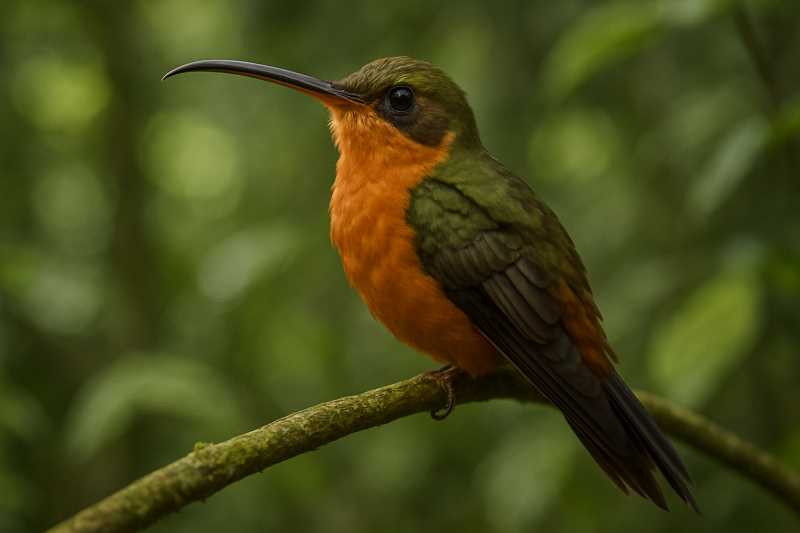
The Rufous-breasted Hermit (Glaucis hirsutus) is a medium-sized hummingbird of the Neotropics. Also known as the Hairy Hermit, it is recognised by its strongly decurved bill, bronze-green upperparts, rufous underparts and white-tipped tail feathers. It is generally resident rather than migratory and occurs in a broad range of forested habitats.
Physical Description
The Rufous-breasted Hermit is usually about 10–12 cm long and weighs approximately 7 g. Its bill is long, robust and strongly curved downwards, measuring about 3–3.5 cm. The upper mandible is dark, while the lower mandible is yellowish.
The head is dark brown, with pale streaking around the eye and base of the bill. The back and wings are bronze-green to dark brown, while the throat, breast and belly are rich rufous. The central tail feathers are greenish, and the outer feathers are more rufous, with dark bands and pale or white tips.
The sexes are broadly similar. Males may show a more noticeable yellow streak along the upper mandible, while females can appear slightly duller and generally have a somewhat shorter, more strongly curved bill. Juveniles are less well marked and may show duller, less sharply defined plumage.
Range and Habitat
The species has a wide, mainly resident distribution from Panama south through much of northern and central South America, including parts of Colombia, Venezuela, the Guianas, Brazil, Peru and Bolivia. It also occurs on Trinidad, Tobago and Grenada. The Rufous-breasted Hermit is not considered migratory, although local movements may follow flowering conditions.
It favours humid and semi-humid forest, forest edges, secondary growth, dense understorey and vegetation along streams or other watercourses. It may occur in lowlands and foothills, as well as in mid-elevation rainforest. The species is often associated with Heliconia and other flowering plants that provide suitable nectar sources.
Where to See This Species
Asa Wright Nature Centre, Northern Range, Trinidad and Tobago
The Rufous-breasted Hermit is documented at this publicly accessible nature centre and lodge in Trinidad’s forested Northern Range. Look along the trails, around flowering plants and near the centre’s viewing areas, particularly where dense forest meets open edges.
Nearby accommodation: The centre itself provides lodge accommodation. Additional guesthouses and small hotels are available around Arima and the wider Northern Range.
Gilpin Trace and Main Ridge Forest Reserve, Tobago, Trinidad and Tobago
The forest trails of Gilpin Trace and the surrounding Main Ridge Forest Reserve support suitable humid forest habitat, and the species has been recorded along the trails. Quietly check flowering plants, forest edges and shaded sections near streams.
Nearby accommodation: The practical bases are Roxborough, Speyside and Charlotteville, where visitors can find guesthouses, small hotels, lodges and self-catering accommodation.
Grand Etang National Park, Grenada
The Rufous-breasted Hermit is documented in Grand Etang National Park, where mid-elevation rainforest and abundant Heliconia provide appropriate habitat. The trails around the visitor centre and lake are suitable places to search, especially in flowering areas and along shaded forest edges.
Nearby accommodation: St George’s and the central Grenada highlands provide the widest choice of guesthouses, small hotels, lodges and self-catering accommodation.
Behaviour and Diet
Rufous-breasted Hermits are usually solitary and are not normally seen in flocks. Like other hermits, they may follow regular trap-lines, visiting a sequence of flowering plants in a predictable circuit. They feed while hovering or by clinging to a flower, extending the tongue deep into long, curved corollas.
Nectar forms the main part of the diet. Important food plants include Heliconia, Costus and other tropical species with suitably shaped flowers. Small insects and spiders are also taken, providing protein and other nutrients that are particularly important when adults are feeding young.
The species can contribute to pollination as pollen is transferred between flowers during repeated visits. It is also capable of defending favoured feeding routes or flower-rich areas from other hummingbirds.
Breeding information varies geographically, but the female is responsible for nest construction, incubation and care of the young. The nest is a small, flexible, hammock-like cup attached to the underside of a leaf, often near a stream. It is made from fine plant fibres, rootlets and soft materials bound together with spider silk. A clutch usually contains two white eggs, and incubation lasts about 17 days.
Identification Tips
- Look for a medium-sized hermit with a long, strongly downcurved bill.
- The combination of bronze-green upperparts and rich rufous underparts is distinctive.
- White-tipped outer tail feathers are useful when the bird moves through shaded vegetation.
- The species often forages low in the forest understorey or along forest edges rather than remaining high in the canopy.
- It may be confused with other hermits at a distance, but the rufous breast, robust curved bill and lack of a prominent long pale central tail stripe are useful field marks.
- Listen and watch patiently near Heliconia and other long-tubed flowers, where regular trap-line activity may reveal a bird that is otherwise difficult to locate.
Conservation Status
The Rufous-breasted Hermit is currently assessed as Least Concern. Its extensive distribution and use of a range of forest and secondary habitats reduce its immediate global extinction risk. Nevertheless, local populations may be affected by deforestation, agricultural expansion, habitat fragmentation and the loss of flowering plants and streamside vegetation.
Protecting remaining forest, maintaining connected habitat and conserving flowering plants in reserves and other wooded landscapes are important measures for the species. Local monitoring remains useful because a broad global assessment can conceal declines in particular regions or islands.
Frequently Asked Questions
Where can the Rufous-breasted Hermit be found?
It occurs from Panama through northern and central South America, including Brazil, Colombia, Venezuela, the Guianas, Peru and Bolivia. It is also found on Trinidad, Tobago and Grenada.
Is the Rufous-breasted Hermit migratory?
No. It is generally considered a resident species, although individuals may make local movements in response to flowering conditions and food availability.
What does the Rufous-breasted Hermit eat?
It feeds mainly on nectar from tubular tropical flowers, especially plants such as Heliconia and Costus. It also catches small insects and spiders.
How can the Rufous-breasted Hermit be identified?
Look for its long, strongly curved bill, bronze-green back, rufous throat and underparts, and white-tipped outer tail feathers. It is often seen alone in dense understorey or along forest edges.
Where does the Rufous-breasted Hermit nest?
The female usually attaches a small, flexible nest to the underside of a leaf, often near a stream. The nest is made from plant fibres and other soft material held together with spider silk.
What is the conservation status of this species?
The Rufous-breasted Hermit is assessed as Least Concern. Habitat loss and fragmentation remain important local threats despite the species’ broad range.
References
- BirdLife International
- IOC World Bird List
- Cornell Lab of Ornithology
Related posts