Introduction
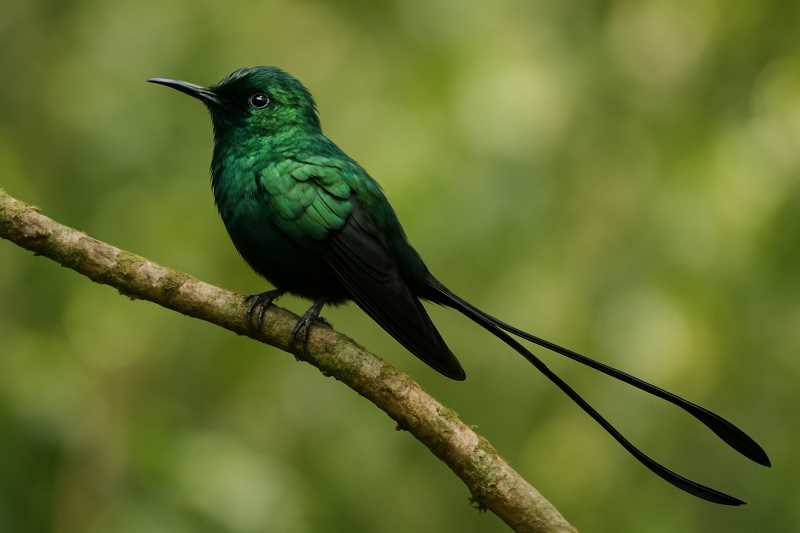
The Black-billed Streamertail (Trochilus scitulus) is a hummingbird endemic to eastern Jamaica. It is one of two streamertail species in the genus Trochilus, although some taxonomic authorities continue to treat it as the eastern form of the Streamertail, Trochilus polytmus. The species is best known for the male’s elongated tail streamers, emerald plumage and entirely black bill.
Physical Description
The Black-billed Streamertail is a small, slender hummingbird with a striking difference in appearance between the sexes.
Adult males have bright green upperparts and metallic green underparts, with a dark to velvety black crown and a black bill. The tail is dark with a greenish or bronzy sheen. The second pair of outer tail feathers is greatly elongated, forming the characteristic streamers. Including the tail streamers, males measure approximately 22–35 centimetres in total length, although the body itself is much smaller.
Females are about 10.5 centimetres long. They lack the male’s elongated streamers and are generally duller, with green to bronze-green upperparts, whitish underparts and metallic green spotting on the breast and flanks. The tail is shorter, with pale or white tips on the outer feathers.
Immature males resemble females at first and develop the adult male’s long tail streamers as they mature. The black bill in both sexes is the most useful feature separating this species from the Red-billed Streamertail where their ranges approach one another.
Range and Habitat
The Black-billed Streamertail is endemic to Jamaica and occurs mainly in the eastern part of the island. Its range includes the Blue Mountains and John Crow Mountains, eastern Portland Parish and parts of the northern slopes of Saint Thomas. It is particularly associated with humid forested landscapes, but also uses secondary woodland, forest edges, clearings, gardens and other areas where flowering plants are available.
The species has been recorded from near sea level to approximately 1,500 metres. It is most closely associated with moist evergreen and montane forest, and generally avoids arid uplands and mangrove habitats. Its range overlaps with that of the Red-billed Streamertail in parts of eastern Jamaica, and the two forms hybridise in a narrow contact zone.
Where to See This Species
Blue and John Crow Mountains National Park, Portland and Saint Thomas, Jamaica
The national park protects extensive humid forest in the eastern Jamaican mountains and is one of the most important protected areas for the species. The Black-billed Streamertail is documented from the park, particularly in forested areas and along suitable mountain roads and trails. Early mornings are generally the most productive time for observing hummingbirds, especially near flowering plants and forest edges.
Nearby accommodation: Kingston, the Blue Mountains communities and Port Antonio provide practical bases with guest houses, lodges, cabins and other small-scale accommodation.
Ecclesdown Road, Portland Parish, Jamaica
Ecclesdown Road runs through the wet forest of the Drivers River Valley in the foothills of the John Crow Mountains. It is a recognised birdwatching site for the Black-billed Streamertail and offers suitable forest, roadside vegetation and flowering plants. The bird can occur along the road and in nearby forest margins, although careful observation is needed because hummingbirds move quickly and defend feeding areas aggressively.
Nearby accommodation: Port Antonio and the San San area are the most practical bases, with hotels, guest houses, lodges and self-catering accommodation available.
Behaviour and Diet
The Black-billed Streamertail is active during the day and spends much of its time flying rapidly between flowers, perches and defended feeding areas. Males are strongly territorial and may chase other hummingbirds from productive feeding sites. Outside courtship, individuals are generally solitary.
The diet consists mainly of nectar from a wide range of native and introduced flowering plants. The bird forages at different levels, from low vegetation to the forest canopy. It also takes small insects and spiders, either by catching them in flight or by gleaning them from foliage and spider webs. These animal foods provide important protein, particularly during breeding.
The species is considered an elevational migrant, moving up or down the mountains in response to changing food availability. Breeding can occur throughout the year, with activity reported most often between January and May. Males perform aerial courtship displays in which they fly repeatedly in front of females and spread or swing their elongated tail streamers.
The female builds the nest and cares for the young. The nest is a small cup made from fine plant fibres and bound with spider silk, often with lichens attached to the outside for camouflage. It is usually placed on a slender branch or other narrow support. The female typically lays two eggs and undertakes incubation and chick-rearing alone.
Identification Tips
- Look for a small, fast-moving hummingbird with a black bill in eastern Jamaica.
- Adult males have bright green plumage, a dark crown and very long tail streamers.
- Females lack the streamers and show paler, whitish underparts with green spotting.
- The Red-billed Streamertail is the main comparison species. Its bill is red rather than black, and it is generally more widespread across Jamaica.
- The Black-billed Streamertail is typically smaller, darker and proportionately longer-tailed than the Red-billed Streamertail.
- In the contact zone between the two forms, bill colour and other features may be variable because hybridisation occurs.
Conservation Status
The Black-billed Streamertail is assessed as Least Concern. Its population trend is not well established, and its restricted distribution makes it locally vulnerable to changes in habitat even though the species remains locally common in suitable areas.
The principal conservation concern is the degradation and loss of humid forest through deforestation, agricultural expansion, development and other land-use changes. Changes in rainfall patterns and the availability of flowering plants may also affect feeding and breeding conditions. Protection of the Blue and John Crow Mountains, maintenance of forest corridors and continued population monitoring are important conservation measures.
Frequently Asked Questions
Where does the Black-billed Streamertail live?
It is endemic to eastern Jamaica, especially the Blue Mountains, John Crow Mountains, eastern Portland Parish and parts of northern Saint Thomas.
How can the Black-billed Streamertail be identified?
The most reliable features are the entirely black bill, green plumage and, in adult males, very long tail streamers. Females lack the streamers and have paler underparts.
Is the Black-billed Streamertail the same bird as Jamaica’s Doctor Bird?
Jamaica’s national bird, commonly called the Doctor Bird, is the Red-billed Streamertail. The Black-billed Streamertail is its close eastern Jamaican relative and is recognised as a separate species by the IOC, although some authorities treat it as a subspecies.
What does the Black-billed Streamertail eat?
It feeds mainly on flower nectar and supplements this diet with small insects and spiders caught in flight or taken from vegetation and webs.
When is the best time to see this species?
Early morning is generally the most productive period for birdwatching. Forest edges, flowering plants and quiet roads in eastern Jamaica are good places to watch for feeding or territorial hummingbirds.
Is the Black-billed Streamertail endangered?
No. It is currently assessed as Least Concern, but its limited range means that continued protection of eastern Jamaica’s humid forests remains important.
References
- IOC World Bird List
- IUCN Red List of Threatened Species
- Journal of Caribbean Ornithology
Related posts