Introduction
The Black-tailed Trainbearer (Lesbia victoriae) is a high-Andean hummingbird recognised for its elongated dark tail, green plumage and agile flight. It occurs in Colombia, Ecuador and Peru, where it uses natural and modified habitats ranging from montane shrubland to gardens and urban parks.
Physical Description
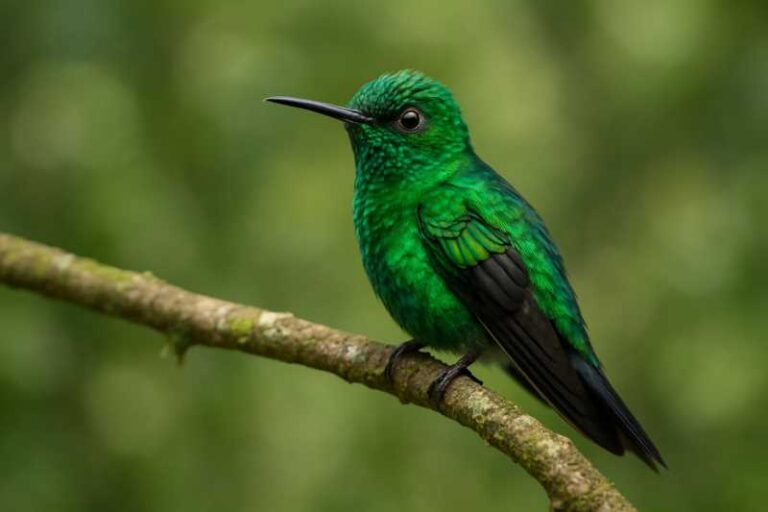
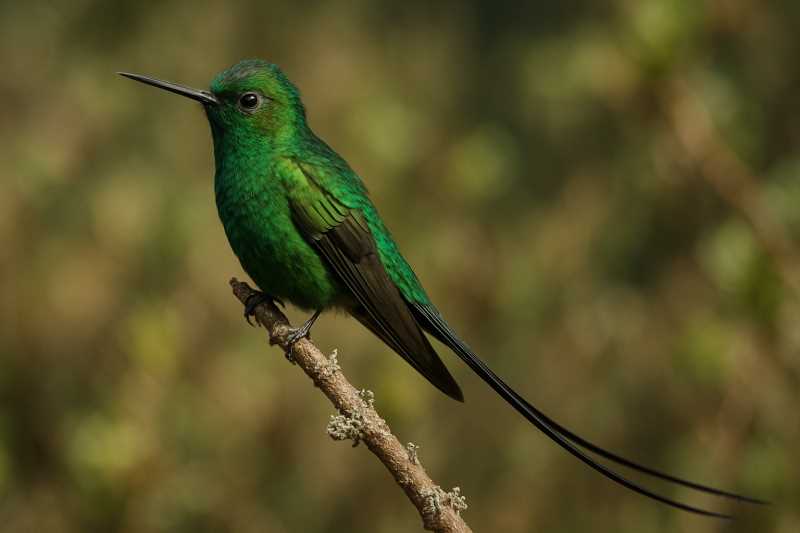
The Black-tailed Trainbearer is a slender hummingbird with a relatively long, slightly decurved bill and a distinctive extended tail. Adult males are mainly green, with an iridescent green throat and chest, darker wings and a long black tail. The tail is especially conspicuous when the bird is perched or displaying.
Males are larger and have much longer tails than females. Adult females are less brightly coloured, with a shorter tail and pale underparts marked with green spotting. Young birds are generally duller, and juveniles do not show the full contrast or tail development of adult males.
Reported total lengths are approximately 21–24 cm for males, including the tail, and about 13.5–14.5 cm for females. Much of this difference is caused by the male’s elongated tail feathers.
Range and Habitat
The species is distributed through the central and northern Andes of Colombia, Ecuador and Peru. It is generally found at elevations of approximately 2,500–3,800 metres, although local records may vary according to geography and habitat conditions.
Its habitats include montane forest edges, high-altitude shrubland, open woodland, agricultural landscapes, flowering gardens and urban parks. The Black-tailed Trainbearer can tolerate considerable habitat modification when flowering plants and suitable perches remain available. It is regarded as a resident species rather than a long-distance migrant, although local movements may occur in response to food availability and seasonal conditions.
Where to See This Species
Parque Metropolitano Guangüiltagua, Pichincha, Ecuador
The wooded slopes and flowering areas of this large urban park in Quito provide suitable habitat for the species. Museum and biodiversity records document Black-tailed Trainbearers at elevations of roughly 2,700–2,965 metres, making the park a realistic location for observing the bird in a readily accessible Andean setting. Check flowering shrubs, forest edges and open clearings, particularly during the cooler morning hours.
Nearby accommodation: Quito offers a broad choice of hotels, guest houses, serviced apartments and self-catering accommodation.
Parque Arqueológico y Ecológico Rumipamba, Pichincha, Ecuador
This protected archaeological and ecological park in Quito contains native vegetation, open areas and woodland edges used by a range of urban Andean birds. Local ornithological monitoring has recorded the Black-tailed Trainbearer among the park’s most frequently noted species. Look around flowering plants, scrub and vegetated boundaries.
Nearby accommodation: Quito is the practical base, with hotels, guest houses, hostels and apartments available across the city.
Jardín Botánico de Quito, Pichincha, Ecuador
The botanical garden within Parque La Carolina has documented records of Black-tailed Trainbearers, including both males and females. Its cultivated flowering plants, planted trees and sheltered garden habitats can attract the species, especially when nectar sources are in bloom. The site is particularly suitable for observers who want to combine urban birding with access to managed botanical habitats.
Nearby accommodation: Central and northern Quito provide hotels, guest houses, hostels and self-catering accommodation close to the garden and surrounding parks.
Behaviour and Diet
The Black-tailed Trainbearer feeds mainly on nectar from flowering plants. It also takes small insects and spiders, which provide protein and other nutrients, particularly during breeding. Its hovering flight allows it to feed from tubular flowers, while its rapid manoeuvring helps it move between scattered nectar sources.
Individuals may defend productive flowers or feeding areas from other hummingbirds. Males can perform aerial displays during courtship, using their long tails and iridescent plumage as visual signals. The species is often seen alone, although several birds may gather where flowering plants are abundant.
The female builds the nest and provides the main care for the young. The nest is a small cup made from plant material and bound with spider silk, usually placed on a branch or shrub. Observations in Quito recorded two eggs, an incubation period of approximately 18–19 days and a nestling period of about 13–15 days. Young birds were ready to fledge after approximately 25–27 days in that study.
Identification Tips
- Look for a slender, high-elevation hummingbird with an exceptionally long, dark tail, especially in adult males.
- Adult males are mostly green with an iridescent throat and chest, whereas females have paler, spotted underparts and a much shorter tail.
- The bird often perches on exposed twigs or shrubs between short, rapid feeding flights.
- The Black-tailed Trainbearer can be confused with the Green-tailed Trainbearer, but the Black-tailed species has a predominantly dark tail rather than a clearly green one.
- Compare the tail shape and bill carefully. The Black-tailed Trainbearer generally has a longer, more strongly curved tail and a relatively longer, more decurved bill than the Green-tailed Trainbearer.
Conservation Status
The Black-tailed Trainbearer is currently classified as Least Concern. Its broad Andean distribution and ability to use gardens, open woodland and other modified habitats reduce its immediate extinction risk.
Nevertheless, local populations may be affected by deforestation, agricultural expansion, urban development and the loss of native flowering plants. Changes in temperature and rainfall could also alter the distribution of suitable high-elevation habitat and the timing or availability of nectar resources. Protecting montane vegetation, maintaining connected habitat and planting native flowering species can benefit this and other Andean hummingbirds.
Frequently Asked Questions
Where can the Black-tailed Trainbearer be found?
It is found in the Andes of Colombia, Ecuador and Peru, mainly at elevations between approximately 2,500 and 3,800 metres.
What does the Black-tailed Trainbearer eat?
Its diet consists mainly of nectar, supplemented by small insects and spiders. Nectar provides energy, while arthropods supply protein and other nutrients.
How can the Black-tailed Trainbearer be identified?
The most useful field mark is the adult male’s very long black tail combined with green plumage and an iridescent throat. Females have shorter tails and pale, green-spotted underparts.
Does the Black-tailed Trainbearer migrate?
It is generally considered resident across its range. Local movements may occur when birds follow flowering plants or respond to changing food availability.
Where is the best place to see this species near Quito?
Parque Metropolitano Guangüiltagua, Parque Arqueológico y Ecológico Rumipamba and Jardín Botánico de Quito all have documented records and provide accessible habitat within the Quito area.
How does the Black-tailed Trainbearer nest?
The female builds a small cup-shaped nest, usually on a branch or shrub. A study in Quito recorded two eggs, incubation lasting about 18–19 days and fledging after approximately 25–27 days.
References
- BirdLife International
- Instituto Nacional de Biodiversidad, Ecuador
- Revista Ecuatoriana de Ornitología
Related posts