Stryker’s Snub-nosed Monkey: A Rare Mammalian Treasure
Introduction
Stryker’s Snub-nosed Monkey, scientifically known as Rhinopithecus strykeri, is a captivating and rare primate species that has captured the attention of conservationists and wildlife enthusiasts alike. Discovered as recently as 2010, this elusive species has quickly become a symbol of the rich biodiversity found within Southeast Asia. This article delves into the unique characteristics and life of Stryker’s Snub-nosed Monkey, exploring its physical description, habitat, behavior, diet, and conservation status.
Physical Description
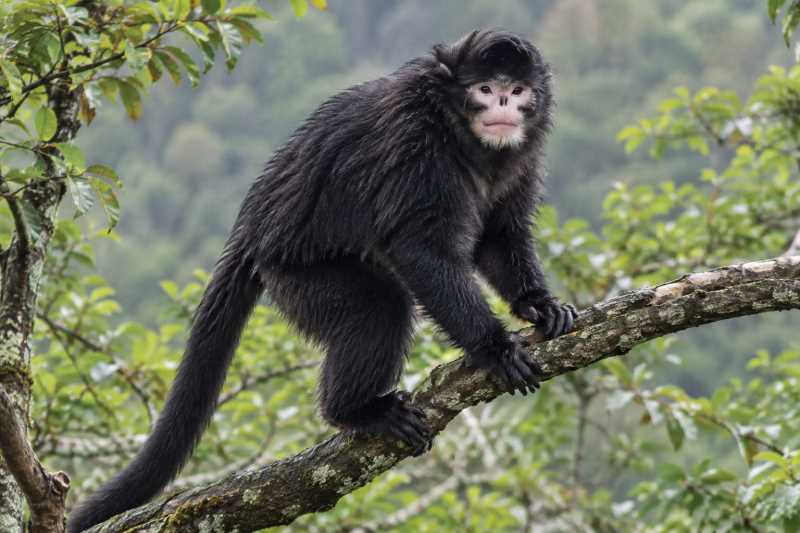
Stryker’s Snub-nosed Monkey is notable for its striking appearance, featuring a distinctive upturned nose, which is a signature trait among its relatives in the genus Rhinopithecus. This species exhibits a soft, dense coat of fur that ranges from black to dark brown, with a contrasting white fur patch on its chin and perineum. Adults typically weigh between 8 to 20 kilograms, with males being significantly larger than females. The tail of this monkey is long and robust, aiding in balance and mobility among the treetops.
The facial features of Stryker’s Snub-nosed Monkey are particularly noteworthy. It has a flat face with a short, snub nose, giving it an expression that some describe as almost human-like. Its nostrils are turned upwards, a feature that may have evolved to adapt to its cold, mountainous habitat.
Range and Habitat
Stryker’s Snub-nosed Monkey is endemic to the temperate forests of northern Myanmar. These forests are characterized by steep, mountainous terrain and dense vegetation. The species is found at elevations ranging from 1,700 to 3,700 meters, where the climate is cool and the environment is often shrouded in mist.
The monkey’s habitat is predominantly composed of mixed deciduous and evergreen forests, which provide ample food resources and shelter. The region’s isolation contributes to the species’ rarity and limited range, making it particularly vulnerable to environmental changes and human activities.
Behavior and Diet
Stryker’s Snub-nosed Monkeys are social creatures that live in groups, which can range from small family units to larger troops of up to 100 individuals. These groups are typically led by a dominant male, with numerous females and their offspring. The species exhibits a fission-fusion social structure, where group size and composition can change throughout the year based on environmental conditions and resource availability.
Their diet is primarily herbivorous, consisting of leaves, fruits, seeds, and flowers. During the colder months, when food is scarce, they may rely more heavily on tree bark and lichens. The monkeys spend much of their time in the canopy, foraging and moving through the trees with agility and grace.
Identification Tips (Field Recognition Cues)
Identifying Stryker’s Snub-nosed Monkey in the wild can be challenging due to its elusive nature and remote habitat. However, there are several key features to look for:
- Facial Features: Look for the distinctive upturned nose and the flat, human-like face.
- Coloration: Note the dark fur with white patches on the chin and perineum.
- Tail: Observe the long, bushy tail that aids in balance.
- Behavior: Watch for their agile movement through the trees and their social interactions in groups.
Conservation Status (With Threats and Protections)
Stryker’s Snub-nosed Monkey is classified as Critically Endangered by the International Union for Conservation of Nature (IUCN). The primary threats to its survival include habitat loss due to logging and agriculture, as well as hunting for meat and traditional medicine.
Conservation efforts are underway to protect this rare species. These include establishing protected areas within its natural habitat and enforcing anti-poaching laws. In addition, local communities are being engaged in conservation initiatives to promote sustainable practices and reduce human-wildlife conflict.
Frequently Asked Questions
How was Stryker’s Snub-nosed Monkey discovered?
Stryker’s Snub-nosed Monkey was first described in 2010 after a team of researchers, led by Dr. Thomas Geissmann, conducted field surveys in northern Myanmar. The discovery was based on both local knowledge and scientific observations.
What makes Stryker’s Snub-nosed Monkey unique?
This species is unique due to its distinctive upturned nose and striking facial features, as well as its adaptation to the cool, mountainous forests of Myanmar. Its recent discovery and limited range add to its intrigue.
How can I help in the conservation of Stryker’s Snub-nosed Monkey?
Supporting organizations that focus on wildlife conservation in Southeast Asia, raising awareness about the species, and promoting sustainable practices in regions where they live are effective ways to contribute to their conservation.
What adaptations help Stryker’s Snub-nosed Monkey survive in its environment?
The monkey’s dense fur provides insulation against cold temperatures, while its agile movements in the treetops and social structure help it efficiently forage for food and avoid predators.
Are there any cultural significances associated with Stryker’s Snub-nosed Monkey?
In some local cultures, the monkey is considered a symbol of wilderness and natural beauty. However, it is also hunted for its fur and for use in traditional medicine, which poses a threat to its population.
Related posts