Introduction
Peters’s Duiker, scientifically known as Cephalophorus callipygus, is a small, elusive mammal that belongs to the Bovidae family. Endemic to the dense forests of Central and West Africa, this species is often overshadowed by its larger and more well-known relatives. Despite its small size, Peters’s Duiker plays a crucial role in its ecosystem, acting as both prey and seed disperser. Understanding the characteristics, habits, and conservation status of this fascinating creature can provide insights into the complex dynamics of tropical forest ecosystems.
Physical Description
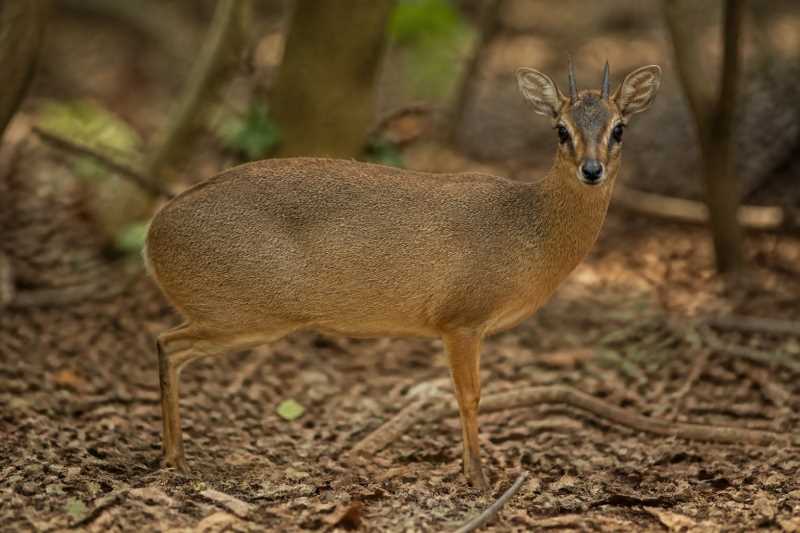
Peters’s Duiker is a small antelope, characterized by its compact and robust body. Adults typically weigh between 12 to 20 kilograms and stand about 45 to 55 centimeters at the shoulder. The species exhibits sexual dimorphism, with males being slightly larger than females. Their short, dense fur is generally a reddish-brown color, providing excellent camouflage in their natural forest habitat. A distinctive feature of Peters’s Duiker is its pointed face and large, dark eyes, which enhance its nocturnal vision.
The duiker’s horns, present in both sexes, are small and spike-like, measuring approximately 5 to 10 centimeters. These horns are used primarily for defense against predators and for intraspecific competition among males. Their legs are short but strong, enabling swift movements through dense underbrush.
Range and Habitat
Peters’s Duiker is native to the humid tropical forests of Central and West Africa. Its range extends from southeastern Nigeria through Cameroon, Equatorial Guinea, Gabon, and into the Congo Basin. This species prefers primary and secondary forests, where it can find ample cover and food resources. However, it can also be found in forest-savanna mosaics and occasionally in abandoned agricultural areas that offer sufficient vegetation cover.
The duiker’s habitat preference for dense understory vegetation provides both food and protection from predators. These environments also facilitate their crepuscular and nocturnal activities, helping them avoid the heat of the day and human disturbances.
Behavior and Diet
Peters’s Duiker is primarily solitary, although pairs or small family groups are occasionally observed. Their behavior is secretive, making them difficult to study in the wild. They are most active during the early morning and late afternoon, exhibiting crepuscular habits.
The diet of Peters’s Duiker is diverse, comprising mainly fruits, leaves, and shoots. They are known to feed on fallen fruits, which they find by foraging through the forest floor. This feeding behavior plays a vital role in seed dispersal, contributing to the maintenance of forest biodiversity. Occasionally, they may consume small insects or carrion, which provide additional protein.
Vocal communication is minimal, but they can produce a variety of sounds, such as whistles and grunts, to signal alarm or distress. Olfactory communication is essential in marking territories and identifying individuals, with scent glands located near their eyes used for this purpose.
Identification Tips (Field Recognition Cues)
Identifying Peters’s Duiker in the field requires attention to several key characteristics:
- Size and Build: Look for a small, robust antelope with a stocky build and short legs.
- Coloration: Note the reddish-brown fur, which is uniform in color without significant markings.
- Horns: Both males and females have small, spike-like horns, usually less than 10 centimeters long.
- Behavior: Observe their solitary or paired behavior, and their preference for moving quickly through dense vegetation.
- Sound: Listen for low grunts or whistles, especially during dawn and dusk.
Conservation Status (With Threats and Protections)
Peters’s Duiker is currently listed as Near Threatened on the IUCN Red List. The primary threats to this species include habitat loss due to logging and agricultural expansion, as well as hunting for bushmeat. The increasing human population in Central and West Africa intensifies these pressures, leading to rapid habitat degradation.
Conservation efforts for Peters’s Duiker focus on habitat preservation and anti-poaching initiatives. Protected areas, such as national parks and reserves, offer some refuge from human activities. However, effective conservation requires a multi-faceted approach, including community education and sustainable land management practices.
Frequently Asked Questions
1. What is the primary diet of Peters’s Duiker?
Peters’s Duiker predominantly feeds on fruits, leaves, and shoots found on the forest floor. Occasionally, they may consume small insects or carrion, supplementing their diet with additional protein.
2. How does Peters’s Duiker contribute to its ecosystem?
As a seed disperser, Peters’s Duiker plays a crucial role in maintaining forest biodiversity. By consuming and excreting seeds, they facilitate the growth of various plant species, contributing to the regeneration of their habitat.
3. What are the main threats to Peters’s Duiker?
The primary threats to Peters’s Duiker include habitat loss due to logging and agricultural expansion, as well as hunting for bushmeat. These factors are exacerbated by the growing human population in their range.
4. Where can Peters’s Duiker be found in the wild?
Peters’s Duiker is native to the dense forests of Central and West Africa, including countries like Nigeria, Cameroon, Gabon, and the Congo Basin.
5. How can one identify Peters’s Duiker in its natural habitat?
Look for a small, reddish-brown antelope with a stocky build and short legs, possessing small, spike-like horns. They are often observed alone or in pairs, moving quickly through dense vegetation.
Related posts