Introduction
The Guanaco (Lama guanicoe) is a wild camelid species native to the mountainous regions of South America. Renowned for its adaptability to diverse environments, the Guanaco is one of the most important herbivores in its native range, contributing significantly to the ecosystems it inhabits. As a close relative of the domesticated llama, the Guanaco shares many physical and behavioral characteristics with its better-known cousin. This article delves into the fascinating world of the Guanaco, exploring its physical traits, habitat, behavior, and the conservation efforts aimed at ensuring its survival.
Physical Description
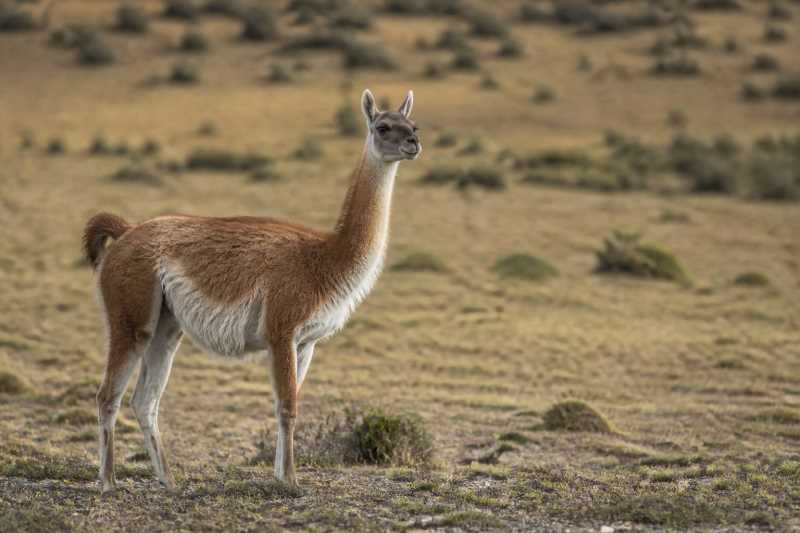
Guanacos are medium-sized camelids, typically measuring about 1.0 to 1.2 meters (3.3 to 3.9 feet) at the shoulder and weighing between 90 to 140 kilograms (198 to 309 pounds). They are characterized by their slender bodies, long necks, and large eyes. Their coats are thick and predominantly a light brown color, with a white underbelly and a grayish face. The fur is particularly dense and insulating, which helps them survive in the cold climates of the Andes.
The Guanaco’s head is small and well-proportioned, with large, expressive eyes that provide excellent vision, crucial for spotting predators. Their ears are long and pointed, often moving independently to pick up sounds from different directions. Adapted to their environment, Guanacos have padded feet, which allow them to move swiftly and nimbly across rocky and uneven terrains.
Range and Habitat
Guanacos inhabit a wide range of environments, from the arid plains of Patagonia to the high-altitude steppes of the Andes. Their range extends through Argentina, Chile, Peru, Paraguay, and Bolivia. The diverse nature of their habitat is a testament to their adaptability, thriving in regions that vary significantly in climate and topography.
These camelids are most commonly found in open habitats, such as grasslands, shrublands, and mountainous regions where they can graze freely. In Patagonia, they are particularly abundant, playing a crucial role in the local ecosystem by influencing vegetation patterns and serving as prey for native predators like the puma.
Behavior and Diet
Guanacos are social animals, typically forming small family groups consisting of a dominant male, several females, and their young. Bachelor males often form separate groups, living together until they are able to establish their own territories and families. The social structure of Guanacos is dynamic, with individuals frequently moving between groups.
Their diet primarily consists of grasses, shrubs, and lichens, which they graze on throughout the day. Guanacos are well-adapted to their often sparse environments, capable of surviving on the limited vegetation available in the arid and semi-arid regions they inhabit. Their ability to obtain moisture from the plants they consume allows them to endure long periods without water.
Identification Tips (field recognition cues)
Identifying Guanacos in the field involves recognizing their distinctive features and behaviors. Here are some tips for successful Guanaco spotting:
- Look for their characteristic coat color: Guanacos have a light brown coat with a white underbelly and a grayish face, which can help distinguish them from other camelids.
- Observe their movement: Guanacos are agile and swift, often seen bounding across the terrain with their characteristic gait.
- Listen for vocalizations: They communicate using a series of clicks, hums, and bleats, which can be helpful in locating them.
- Spot their groups: Look for small family groups or larger bachelor herds in open areas, as Guanacos are social animals.
Conservation Status (with threats and protections)
The current conservation status of the Guanaco is classified as "Least Concern" by the IUCN, although certain local populations may face threats. The primary threats to Guanacos include habitat loss due to agricultural expansion, competition with livestock for resources, and illegal hunting.
Conservation efforts are in place to protect Guanacos, particularly in Argentina and Chile, where national parks and reserves have been established to safeguard their habitats. Regulations on hunting and efforts to promote sustainable land use are also crucial in ensuring the survival of this species. Continued research and monitoring are necessary to address the challenges faced by Guanacos and to develop effective conservation strategies.
Frequently Asked Questions
What is the main predator of the Guanaco?
The primary predator of the Guanaco is the puma, which hunts them in the open grasslands and mountainous regions they inhabit. Guanacos rely on their keen senses and agility to avoid predation, often using their speed to escape danger.
How do Guanacos adapt to high-altitude environments?
Guanacos have several adaptations that allow them to thrive in high-altitude environments, such as efficient respiratory systems that enable them to extract oxygen from thin air, and a diet that allows them to survive on sparse vegetation.
Are Guanacos and llamas the same species?
No, Guanacos and llamas are closely related but distinct species. Guanacos are wild camelids, while llamas are domesticated descendants of the wild guanaco. They share similar physical characteristics but differ in behavior and domestication status.
Can Guanacos be domesticated?
While Guanacos are not typically domesticated like llamas and alpacas, they have been known to be kept in semi-captive conditions for conservation and research purposes. However, they retain their wild instincts and behaviors.
What role do Guanacos play in their ecosystem?
Guanacos are essential herbivores in their ecosystems, influencing vegetation patterns through grazing and serving as prey for native predators. Their presence helps maintain ecological balance in their habitats.
Related posts