Introduction
The False Killer Whale, scientifically known as Pseudorca crassidens, is a fascinating marine mammal belonging to the oceanic dolphin family. Despite its name, it bears no close relation to the well-known killer whale, or orca, but shares some superficial similarities that have intrigued marine biologists and enthusiasts alike. Known for their social behavior and intelligence, false killer whales are found in oceans around the world, yet remain lesser-known than their more famous relatives. This article delves into the various aspects of the false killer whale, from its physical appearance to its behaviors, and the conservation challenges it faces.
Physical Description
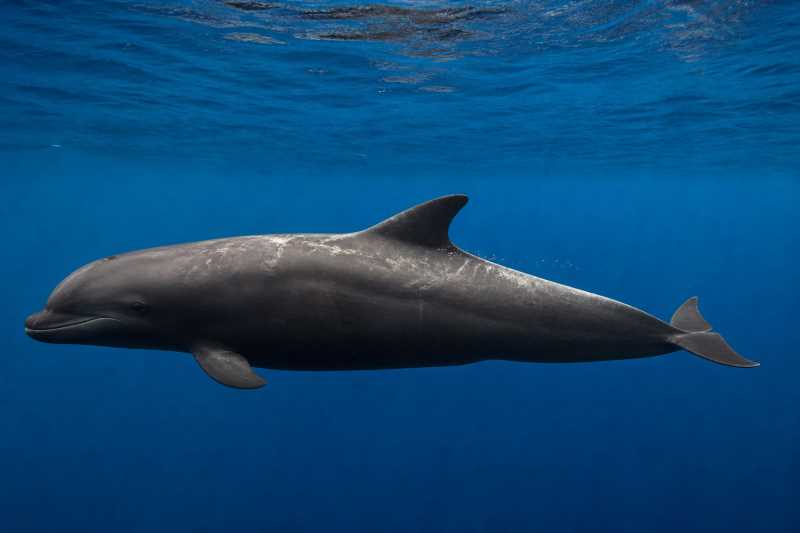
False killer whales are large dolphins, characterized by their sleek, black or dark gray bodies, occasionally with lighter patches on their undersides or around the head. They can grow up to 20 feet in length and weigh between 1,500 and 2,600 pounds. Their bodies are streamlined, adapted for fast swimming, with a narrow, pointed head and a distinctively bulbous forehead. Unlike true killer whales, false killer whales lack the striking black-and-white coloration, opting instead for a more uniform dark appearance. Their dorsal fins are tall and slender, often falcate, and their pectoral fins are long and tapered.
Range and Habitat
False killer whales are found in tropical and subtropical oceans worldwide. They inhabit deep offshore waters but can occasionally be observed closer to coastlines, particularly around oceanic islands and archipelagos such as Hawaii and New Zealand. These dolphins display a preference for warmer waters, typically found in areas with surface temperatures ranging from 15°C to 25°C. As highly social animals, they are often seen in large groups, known as pods, which can range from a few individuals to over 100 members. Their extensive range and tendency to inhabit open waters make them less frequently encountered than other dolphin species.
Behavior and Diet
False killer whales are known for their complex social structures and behaviors. They are highly social animals, often forming strong bonds within their pods. These pods are sometimes composed of multiple generations, with a mix of both males and females. False killer whales are also known to associate with other dolphin species, such as bottlenose dolphins, which may provide mutual benefits such as increased foraging success or protection from predators.
Their diet primarily consists of fish and squid, but they are also known to hunt other marine mammals, such as small cetaceans and seals, though this is less common. False killer whales employ cooperative hunting techniques, coordinating with other pod members to encircle and capture their prey. This cooperative behavior is indicative of their advanced cognitive abilities and social complexity.
Identification Tips (Field Recognition Cues)
Identifying false killer whales in the wild can be challenging due to their preference for deep waters and their dark coloration, which can blend into the ocean’s depths. However, certain characteristics can aid in their identification:
- Size and Shape: Look for a large, sleek body with a narrow, pointed head and a bulbous forehead.
- Coloration: Uniform dark gray or black coloration, sometimes with lighter patches.
- Dorsal Fin: Tall, slender, and slightly curved dorsal fin.
- Behavior: Often seen in large pods, sometimes leaping or breaching.
- Location: Typically found in deeper offshore waters.
Conservation Status (With Threats and Protections)
The conservation status of the false killer whale is currently listed as "Near Threatened" by the International Union for Conservation of Nature (IUCN). Despite their wide distribution, several threats have contributed to their declining numbers. Key threats include:
- Bycatch: False killer whales are often accidentally caught in fishing gear, particularly in longline fisheries, which can lead to injury or death.
- Pollution: Chemical pollutants and marine debris pose significant threats, as they can accumulate in the whales’ bodies and impact their health.
- Habitat Degradation: Human activities such as shipping, oil exploration, and coastal development can degrade their natural habitats.
Efforts to protect false killer whales include:
- Regulation of Fisheries: Implementing measures to reduce bycatch, such as modifying fishing gear and practices.
- Marine Protected Areas: Establishing protected zones where human activity is limited to safeguard critical habitats.
- Research and Monitoring: Ongoing studies to better understand their population dynamics and threats, aiding in conservation strategies.
Frequently Asked Questions
1. What is the difference between a false killer whale and a killer whale?
Despite their similar names, false killer whales (Pseudorca crassidens) and killer whales (Orcinus orca) belong to different genera. False killer whales are smaller, with a more uniform dark coloration and lack the striking black-and-white patterns of killer whales. Additionally, killer whales have a more robust body shape and are known for their distinct, tall dorsal fins.
2. Where can I see false killer whales in the wild?
False killer whales are typically found in tropical and subtropical oceans around the world. Popular locations for observing them include the waters around Hawaii, New Zealand, and the Indian Ocean. They prefer deep offshore waters but can occasionally be seen near coastlines.
3. Why are false killer whales endangered?
False killer whales are considered "Near Threatened" due to several factors, including bycatch in fishing operations, pollution, and habitat degradation. These threats have contributed to a decline in their population, highlighting the need for effective conservation measures.
4. How do false killer whales hunt their prey?
False killer whales employ cooperative hunting techniques, working together within their pods to encircle and capture prey. This behavior demonstrates their advanced social structures and cognitive abilities.
5. What do false killer whales eat?
Their diet primarily consists of fish and squid, but they are also known to hunt marine mammals on occasion. False killer whales are opportunistic feeders, adapting their foraging strategies to available prey.
Related posts