Introduction
Du Chaillu’s Rope Squirrel, scientifically known as Funisciurus duchaillui, is a captivating member of the Sciuridae family. Named after the French-American explorer Paul Du Chaillu, who was renowned for his explorations of Central Africa, this species is a testament to the rich biodiversity of the African continent. Known for its agile movements and unique adaptations, the Du Chaillu’s Rope Squirrel is an intriguing subject for naturalists and wildlife enthusiasts alike.
In this article, we delve deep into the life and characteristics of this fascinating creature, exploring everything from its physical description to its behavior, habitat, and conservation status. We aim to provide a comprehensive guide that will not only satisfy your curiosity but also enhance your understanding of this remarkable species.
Physical Description
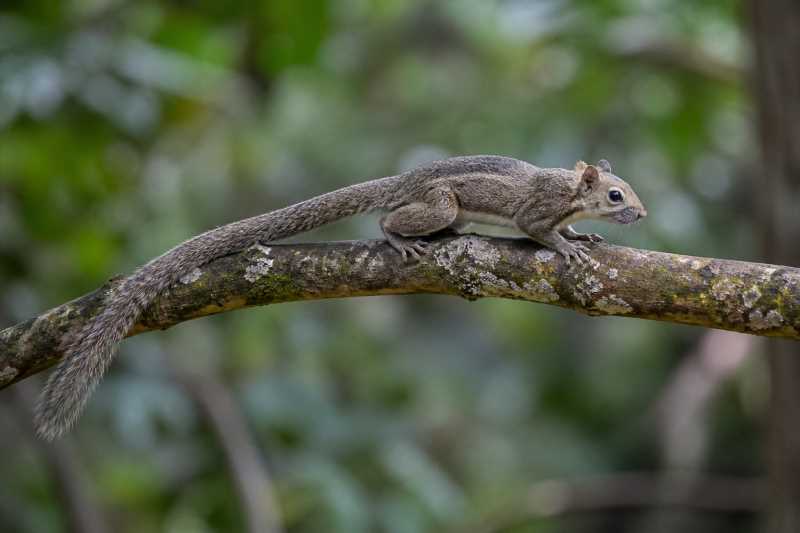
Du Chaillu’s Rope Squirrel is a small to medium-sized rodent, distinguished by its sleek and agile form. Typically, it measures around 20 to 30 centimeters in body length, with an additional tail length that often equals or surpasses the body. This gives the squirrel an elongated appearance, which is well-suited to its arboreal lifestyle.
The coat of the Du Chaillu’s Rope Squirrel is a blend of earthy tones, primarily brown with subtle variations that include grayish or reddish hues. This coloration provides excellent camouflage against the bark of trees and the forest floor, protecting it from predators. The underbelly is usually lighter, often a pale gray or creamy white, which can sometimes help with identification in the wild.
One of the most striking features of this squirrel is its bushy tail. The tail is not only an essential tool for balance but also serves as a communication device and a means of thermoregulation. The fur on the tail is particularly dense, aiding in its various functions.
Range and Habitat
The natural habitat of Du Chaillu’s Rope Squirrel spans across the tropical rainforests of Central and West Africa. Countries such as Gabon, Cameroon, and the Republic of Congo host significant populations of this squirrel, where it thrives in dense forests.
These forests provide an abundance of food resources and shelter, essential for the squirrel’s survival. The high canopy of these forests offers an ideal environment for their arboreal lifestyle. Du Chaillu’s Rope Squirrel is well adapted to life in these towering trees, where it can move swiftly and efficiently to escape predators and find food.
Behavior and Diet
Du Chaillu’s Rope Squirrel is predominantly diurnal, meaning it is most active during the day. Its behavior is characterized by agility and alertness, often seen darting through tree branches or foraging on the forest floor. This species is known for its solitary nature, although it may occasionally be observed in pairs or small family groups.
The diet of Du Chaillu’s Rope Squirrel is diverse and primarily herbivorous. It feeds on a variety of fruits, seeds, and nuts, which it forages from both the ground and the tree canopy. Occasionally, it may also consume insects and small invertebrates, especially during the dry season when plant-based food is scarcer.
Identification Tips
Identifying Du Chaillu’s Rope Squirrel in the wild can be challenging due to its elusive nature and the dense habitats it occupies. However, there are several field recognition cues that can aid in its identification:
- Coloration: Look for the distinctive brown fur with variations of gray and red. The lighter underbelly can also be a helpful feature.
- Tail: Note the bushy tail, which is often held in an upright position and used for balance as the squirrel moves through the trees.
- Behavior: Observe the agile movements and tendency to forage during daylight hours. Its alert and swift reactions are indicative of this species.
- Vocalizations: Listen for the squirrel’s calls, which are sharp and can serve as a warning to other squirrels or a signal of its presence.
Conservation Status
As of the latest assessments, Du Chaillu’s Rope Squirrel is not classified as endangered. However, it faces several threats that could impact its populations in the future. The primary threat to this species is habitat loss due to logging and agricultural expansion. These activities are reducing the size of its natural habitat, making it more difficult for the squirrels to find food and shelter.
Conservation efforts are in place in several regions to protect the natural habitats of Du Chaillu’s Rope Squirrel. Protected areas and national parks play a critical role in preserving the forests these squirrels call home. Additionally, some organizations are working towards sustainable logging practices and reforestation projects that could mitigate habitat destruction.
Frequently Asked Questions
1. What is the best time to observe Du Chaillu’s Rope Squirrel in the wild?
The best time to observe Du Chaillu’s Rope Squirrel is during the early morning or late afternoon when it is most active. During these times, the squirrel is often foraging for food or moving between trees.
2. How does Du Chaillu’s Rope Squirrel communicate with others?
Du Chaillu’s Rope Squirrel uses a variety of vocalizations to communicate. These include sharp calls that can signal alarm or territorial claims. The bushy tail is also used for visual communication, especially during interactions with other squirrels.
3. Are Du Chaillu’s Rope Squirrels solitary animals?
Yes, Du Chaillu’s Rope Squirrels are generally solitary, though they may be observed in pairs or small family groups, especially during mating season or when raising offspring.
4. What are the key threats to the survival of Du Chaillu’s Rope Squirrel?
The key threats to the survival of Du Chaillu’s Rope Squirrel include habitat loss due to deforestation and agricultural expansion. Conservation efforts are critical to mitigate these threats and preserve their natural habitats.
5. Can Du Chaillu’s Rope Squirrel adapt to changes in its environment?
While Du Chaillu’s Rope Squirrel has some adaptability, it is highly dependent on forest environments. Significant habitat changes pose a substantial threat to its survival, emphasizing the importance of conservation efforts.
Related posts