Introduction
The Domestic Ass, scientifically known as Equus asinus, is a member of the Equidae family and is commonly referred to as the donkey. This species has been instrumental in human civilization, serving as a robust and reliable working animal for thousands of years. Originating from the African Wild Ass, the domestic donkey has spread across the globe, adapting to varied climatic conditions and environments. This article delves into the intricate details of the Domestic Ass, including its physical description, habitat, behavior, and conservation status, providing a comprehensive overview for enthusiasts and animal lovers alike.
Physical Description
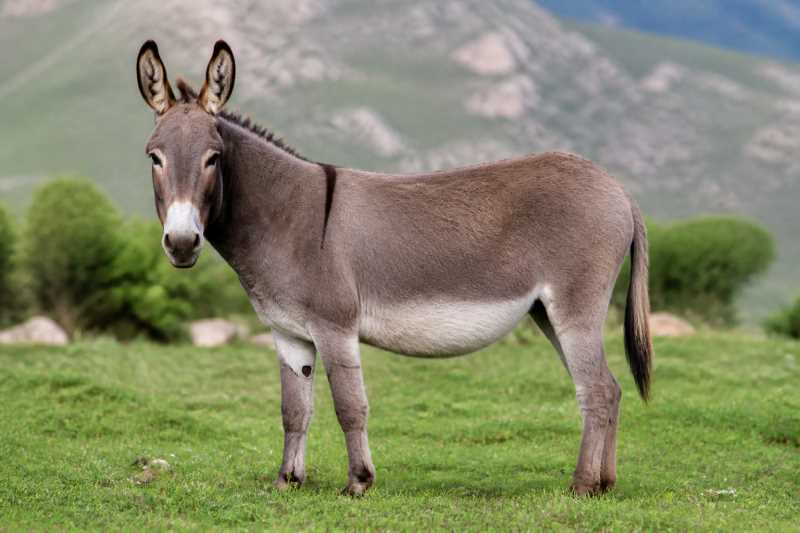
The Domestic Ass is a medium-sized mammal characterized by its sturdy build, long ears, and a distinctive bray that sets it apart from its equine relatives. Adult donkeys typically weigh between 180 to 430 kilograms (400 to 950 pounds) and stand about 90 to 160 centimeters (3 to 5.2 feet) at the shoulder. Their coat can vary significantly in color, ranging from gray and brown to black and white, often with a dorsal stripe running from the mane to the tail.
Donkeys have short, upright manes and a tail similar to that of a cow, with a tuft of fur at the end. Their hooves are smaller and more upright compared to those of horses, which allows them to navigate rocky and uneven terrain with ease. The eyes of a donkey are placed on the sides of their head, providing a wide field of vision, which is crucial for detecting predators.
Range and Habitat
Historically, the ancestors of the Domestic Ass roamed the arid and semi-arid regions of North Africa and the Middle East. Today, domestic donkeys are found worldwide, inhabiting a diverse range of environments from deserts to mountainous regions. They are particularly prevalent in developing countries where they continue to play a vital role in agriculture and transportation.
Donkeys are highly adaptable animals that can thrive in harsh environments where other domesticated animals might struggle. Their ability to consume a wide variety of plant materials allows them to inhabit areas with sparse vegetation. In rural settings, they are often found in pastures, grasslands, and agricultural fields.
Behavior and Diet
The Domestic Ass is a social animal that thrives in groups known as herds. These herds are typically composed of a dominant male, several females, and their offspring. Donkeys communicate with each other through vocalizations, such as braying, as well as through body language and scent marking.
Donkeys are herbivorous animals that primarily feed on grasses, shrubs, and low-lying vegetation. They are known for their efficient digestive system, which allows them to extract maximum nutrients from fibrous plant material. In arid regions, donkeys can survive on minimal water intake by deriving moisture from the plants they consume.
Identification Tips (Field Recognition Cues)
Identifying a Domestic Ass in the field involves observing several key characteristics. Here are some tips to help you recognize this species:
- Ears: Donkeys have long, upright ears that are more prominent than those of horses and zebras.
- Size: They are generally smaller than horses, with a more robust and stocky build.
- Coat Color: Look for a variety of coat colors, often with a distinctive dorsal stripe.
- Tail: Their tails are similar to a cow’s, with a tuft of fur at the end.
- Bray: Listen for their characteristic bray, a loud and distinctive call.
Conservation Status (with Threats and Protections)
While the Domestic Ass is not considered endangered, its wild ancestors, the African Wild Ass, are listed as critically endangered by the International Union for Conservation of Nature (IUCN). The primary threats to wild populations include habitat loss, competition with livestock, and hunting.
In contrast, domestic donkeys are abundant and widely distributed due to their value to human societies. However, they face challenges such as neglect, overwork, and inadequate veterinary care in some regions.
Conservation efforts for the African Wild Ass involve habitat protection, anti-poaching measures, and community education to reduce human-wildlife conflict. Organizations dedicated to equine welfare also work to improve the conditions for domestic donkeys around the world.
Frequently Asked Questions
1. What are the differences between a donkey and a mule?
A mule is a hybrid animal resulting from the crossbreeding of a male donkey (jack) and a female horse (mare). Mules inherit traits from both parents, such as the donkey’s endurance and the horse’s size. Unlike donkeys, mules are usually sterile and cannot reproduce.
2. How do donkeys communicate with each other?
Donkeys communicate through vocalizations, such as braying, as well as through body language. They also use scent marking to establish territory and convey information about reproductive status.
3. What is the lifespan of a domestic donkey?
Domestic donkeys have a lifespan of 25 to 30 years on average, although some can live up to 50 years with proper care and management.
4. Why do donkeys have long ears?
The long ears of donkeys serve multiple purposes, including enhancing their hearing ability and helping to dissipate heat in hot climates. Their ears also play a role in communication and expressing emotions.
5. How are donkeys used in agriculture?
Donkeys are used in agriculture for various tasks, such as plowing fields, transporting goods, and providing manure for fertilizer. Their strength and endurance make them valuable assets in regions where modern machinery is unavailable or impractical.
Related posts