Introduction
The Borneo Black-banded Squirrel (Callosciurus orestes) is a fascinating rodent species that inhabits the lush forests of Borneo. Known for its distinctive black banding, this squirrel is a member of the Sciuridae family, which encompasses a variety of tree-dwelling and ground squirrels. Despite its relatively elusive nature, the Borneo Black-banded Squirrel plays a vital role in its ecosystem, contributing to seed dispersal and forest regeneration. This article provides an in-depth look at the physical characteristics, habitat, behavior, and conservation status of this unique species.
Physical Description
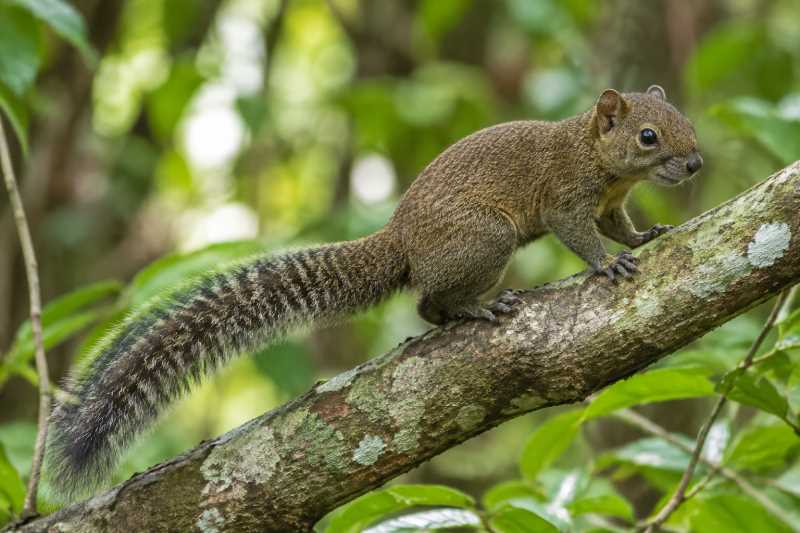
The Borneo Black-banded Squirrel is a small to medium-sized rodent, with a body length ranging from 18 to 22 centimeters, excluding its bushy tail, which adds another 18 to 22 centimeters. The most striking feature of this squirrel is its coloration. The dorsal fur is predominantly grayish-brown, adorned with distinctive black bands that run horizontally along the body. These bands set it apart from other squirrels in the region. The ventral side is typically a lighter shade, ranging from pale gray to almost white.
The head is characterized by a pointed snout, small rounded ears, and large, expressive eyes, which are well-adapted for spotting predators and foraging for food in the dense forest canopy. The limbs are strong and agile, with sharp claws that facilitate climbing and gripping onto tree bark. The tail, bushy and long, aids in balance and acts as a rudder during arboreal navigation.
Range and Habitat
The Borneo Black-banded Squirrel is endemic to the island of Borneo, which is divided among three countries: Malaysia, Indonesia, and Brunei. This species predominantly inhabits the montane and submontane forests of Borneo, thriving at elevations ranging from 900 to 3,000 meters. These squirrels prefer dense, primary forests where they can find abundant food and shelter.
Their habitat is characterized by high humidity and a complex structure, with multiple canopy layers providing ample opportunities for foraging and nesting. The dense foliage offers protection from predators and harsh weather conditions. Unfortunately, the pristine habitats of the Borneo Black-banded Squirrel are under threat due to deforestation and land conversion for agriculture and palm oil plantations.
Behavior and Diet
The Borneo Black-banded Squirrel is diurnal, meaning it is active during the day. It exhibits arboreal behavior, spending most of its time in the trees. This squirrel is solitary by nature, although individuals can sometimes be observed feeding in loose groups when food resources are abundant.
Its diet is omnivorous, consisting mainly of fruits, seeds, and nuts, which it forages from the forest canopy. Additionally, it may consume insects and small invertebrates, providing it with essential proteins. The squirrel plays a crucial ecological role as a seed disperser, aiding in the regeneration of its forest habitat.
During the breeding season, which typically coincides with periods of fruit abundance, the female constructs a nest, or drey, out of leaves and twigs high in the trees. After a gestation period of about 40 to 45 days, she gives birth to a litter of two to three young. The juveniles are weaned after approximately two months and become independent shortly thereafter.
Identification Tips (Field Recognition Cues)
Field identification of the Borneo Black-banded Squirrel can be accomplished by noting several key characteristics:
- Distinctive Black Bands: The most notable feature is the series of black bands across its back, which are easily visible against the squirrel’s grayish-brown fur.
- Size and Tail: Its medium size and long, bushy tail are characteristic of the species.
- Behavior: Observing its diurnal and arboreal behavior can help distinguish it from other rodents and nocturnal squirrels.
- Vocalizations: Listen for its sharp, chattering calls, which are often used to communicate with others and warn of potential threats.
Conservation Status (with Threats and Protections)
The International Union for Conservation of Nature (IUCN) currently classifies the Borneo Black-banded Squirrel as a species of Least Concern. However, this classification does not mean the species is free from threats. The primary threat to its survival is habitat loss due to deforestation and land conversion for agriculture, particularly the expansion of palm oil plantations.
Conservation efforts are crucial to preserving the natural habitats of the Borneo Black-banded Squirrel. Protected areas and national parks in Borneo, such as Kinabalu Park and Gunung Mulu National Park, offer refuge for this and other endemic species. Furthermore, international organizations and local governments are working towards sustainable land-use practices that balance economic development with conservation.
Frequently Asked Questions
What is the Borneo Black-banded Squirrel’s primary habitat?
The Borneo Black-banded Squirrel primarily inhabits montane and submontane forests in Borneo, thriving at elevations of 900 to 3,000 meters.
How does the Borneo Black-banded Squirrel contribute to its ecosystem?
This squirrel plays a vital role as a seed disperser, aiding in forest regeneration and supporting biodiversity in its habitat.
What are the main threats to the Borneo Black-banded Squirrel?
The main threats include habitat loss due to deforestation and agricultural expansion, particularly for palm oil plantations.
How can I identify a Borneo Black-banded Squirrel in the wild?
Look for its distinctive black bands on a grayish-brown body, long bushy tail, and listen for its sharp, chattering calls.
Are there any conservation efforts in place to protect the Borneo Black-banded Squirrel?
Yes, there are ongoing conservation efforts, including protected areas and initiatives promoting sustainable land-use practices.
Related posts