The Enigmatic Rufous-banded Owl: An Ornithological Gem
The Rufous-banded Owl (Strix albitarsis), a captivating avian species, is a member of the Strigidae family, which encompasses true owls. This elusive bird is primarily found in the montane forests of the Andes, spreading across countries such as Colombia, Ecuador, Peru, and Bolivia. With its distinctive rufous-banded appearance, this owl has been a subject of interest for ornithologists and bird enthusiasts alike.
A Distinctive Appearance
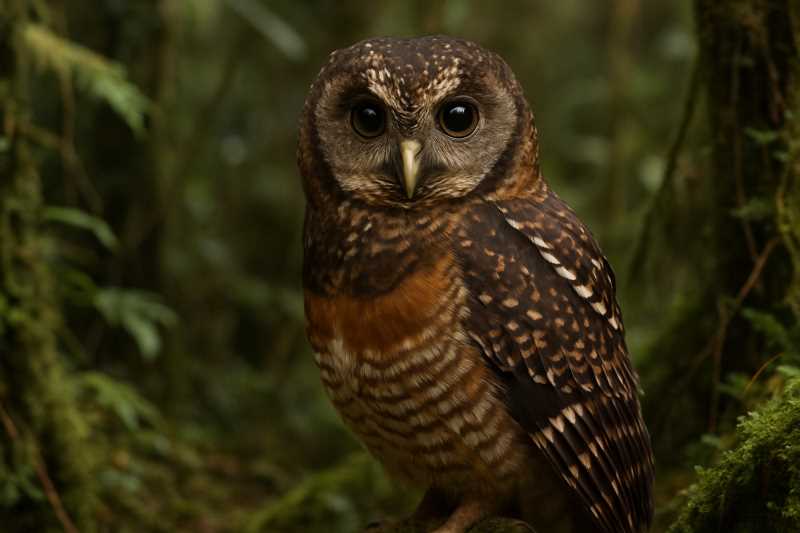
The Rufous-banded Owl is renowned for its striking plumage. As its name suggests, it is characterized by prominent rufous bands across its body, particularly visible on its wings and tail. Its facial disk is typically pale, accentuated by dark concentric rings that frame its expressive yellow eyes. The bird’s underparts are predominantly white, with streaks of rufous and brown that add to its camouflage within the dense forest canopy.
Measuring approximately 33-38 centimeters in length, the Rufous-banded Owl exhibits sexual dimorphism, with females generally being larger than males. Its wingspan can reach up to 90 centimeters, allowing for agile flight through the forested habitats it calls home.
Habitat and Distribution
The natural habitat of the Rufous-banded Owl is the subtropical and tropical moist montane forests of the Andes. It thrives at altitudes ranging from 1,500 to 3,000 meters, favoring areas with dense undergrowth and ample tree cover. These ecosystems not only provide the owl with shelter but also a rich food supply composed of small mammals, birds, and insects.
The owl’s distribution extends along the Andean mountain range, with sightings reported in Colombia, Ecuador, Peru, and Bolivia. However, due to its elusive nature and the inaccessibility of its habitat, the Rufous-banded Owl is often difficult to study in the wild.
Behavior and Ecology
As a nocturnal predator, the Rufous-banded Owl is most active during the night. It employs a sit-and-wait strategy to capture its prey, using its acute hearing and keen eyesight to detect movements in the darkness. Its diet primarily consists of small mammals, such as rodents, but it also preys on birds and large insects.
The Rufous-banded Owl is known for its distinctive call, a series of deep hoots that resonate through its forested habitat. These vocalizations play a crucial role in communication between individuals, particularly during the breeding season.
Breeding typically occurs during the dry season when food is more abundant. The species is believed to be monogamous, with pairs often returning to the same nesting sites year after year. Nests are usually located in tree cavities or on ledges, where the female lays a clutch of 1-2 eggs. Both parents participate in caring for the young, ensuring a high survival rate for the offspring.
Conservation Status
The Rufous-banded Owl is currently classified as a species of Least Concern by the International Union for Conservation of Nature (IUCN). However, its population is suspected to be declining due to habitat loss and fragmentation. Deforestation for agriculture and urban development poses significant threats to its montane forest habitat.
Conservation efforts are crucial to ensure the survival of this species. Protecting large tracts of montane forests and establishing conservation areas are vital strategies in preserving the Rufous-banded Owl’s natural habitat. Additionally, further research is needed to better understand its ecology and population dynamics, which will aid in developing effective conservation plans.
The Importance of the Rufous-banded Owl
The Rufous-banded Owl plays a vital role in its ecosystem as a predator, helping to maintain balanced populations of small mammals and insects. Its presence is an indicator of healthy forest ecosystems, highlighting the importance of preserving these habitats.
Furthermore, this owl is of significant interest to the scientific community and birdwatchers. Its elusive nature and striking appearance make it a sought-after species for birdwatching tours in the Andean region, contributing to local ecotourism initiatives.
In conclusion, the Rufous-banded Owl remains a mysterious yet integral component of the Andean montane forests. Its conservation is not only essential for maintaining biodiversity but also for ensuring that future generations can continue to marvel at this remarkable bird. As efforts to protect its habitat continue, the Rufous-banded Owl stands as a symbol of the natural beauty and ecological richness of the Andes.
Related posts