Introduction
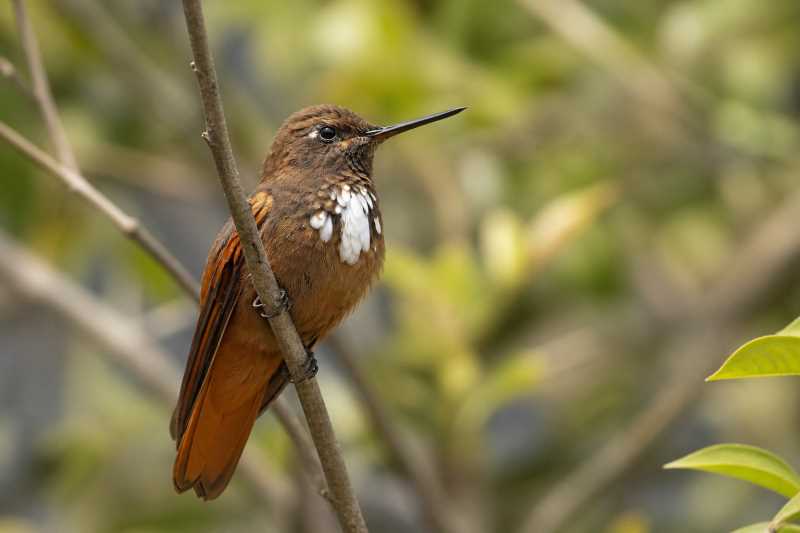
The White-tufted Sunbeam (Aglaeactis castelnaudii) is a high-elevation hummingbird endemic to Peru. It is recognised by its dark brown plumage, iridescent lavender rump and lower back, rufous tail, and conspicuous white breast tuft. The species occurs in isolated areas of the central and southern Peruvian Andes.
Physical Description
The White-tufted Sunbeam is a medium-sized hummingbird measuring approximately 11–12 cm in length. It has a short, straight, black bill measuring about 1.8–2 cm.
Adults are mainly dark brown or bronzy-brown, with a dark cinnamon abdomen and a rufous tail. The lower back and rump show an iridescent lavender or purplish sheen, which is most noticeable when the bird turns in good light or flies. A small white mark behind the eye and a prominent white, scale-like tuft on the centre of the breast are important identification features.
Males and females are broadly similar, although females and immature birds are generally less iridescent. Young birds are browner overall and may show a less developed breast tuft and less obvious colour on the rump.
Range and Habitat
The White-tufted Sunbeam is endemic to Peru. Its distribution is divided between two main Andean regions: a northern population in parts of Huánuco, Pasco and Junín, and a southern population in Huancavelica, Ayacucho, Apurímac and Cusco.
It inhabits humid montane forest, evergreen scrub, forest edges and high-elevation shrubland. It is particularly associated with flowering vegetation, including Escallonia and Polylepis woodland, as well as patches of shrubs and small trees in inter-Andean valleys. The species is usually found between about 2,500 and 4,300 metres, with some records from higher elevations.
The White-tufted Sunbeam is resident rather than a long-distance migrant, although local or seasonal movements may occur in response to flowering conditions and changes in food availability. Its range is small and fragmented, making the protection of remaining high-Andean forest and scrub especially important.
Where to See This Species
Ampay National Sanctuary, Apurímac, Peru
Ampay National Sanctuary is one of the best documented protected areas for the species. The White-tufted Sunbeam is recorded along the trail from the entrance checkpoint towards the high-altitude lakes, where humid forest, scrub and flowering plants provide suitable habitat. The species can be looked for throughout the year, although local weather and trail conditions vary considerably.
Nearby accommodation: Abancay is the nearest practical base, with hotels, guest houses and other town-based accommodation. Camping is also available within the sanctuary area where permitted.
Machu Picchu Historic Sanctuary, Cusco, Peru
The White-tufted Sunbeam has been recorded within the wider Machu Picchu and Choquequirao biodiversity area. Higher trails, Polylepis patches and upper cloud-forest habitats are more suitable than the warmest forest around the town of Machu Picchu. Birding records and regional species lists include the species among the sanctuary’s range-restricted birds.
Nearby accommodation: Machu Picchu Pueblo is the most practical base, with hotels, guest houses and hostels. Ollantaytambo and Cusco provide additional accommodation for visitors exploring the wider region.
Abra Málaga, Cusco Region, Peru
Abra Málaga is a publicly accessible high-elevation road and mountain-pass area on the route between Cusco and Machu Picchu. The surrounding Polylepis woodland, open slopes and patches of flowering shrubland are known habitat for the White-tufted Sunbeam. The species has also been studied at this site, including observations of its nest and nesting habitat.
Nearby accommodation: Ollantaytambo is a useful gateway settlement, with hotels, guest houses and lodges. Visitors may also stay in Cusco or in accommodation around the Sacred Valley.
Behaviour and Diet
The White-tufted Sunbeam is an agile hummingbird that hovers while feeding and may also cling to flowers when extracting nectar. It is often seen perched quietly on exposed branches or the tops of shrubs between feeding flights.
Its diet consists mainly of nectar from flowering shrubs and herbs. It also takes small insects and other arthropods, either by making short aerial sallies or by picking prey from vegetation. These animal foods provide protein and other nutrients that nectar alone cannot supply.
The species is generally solitary outside the breeding period. Details of courtship and territorial behaviour remain poorly documented. A compact cup-shaped nest has been recorded on a Polylepis branch at Abra Málaga, constructed from soft plant material, moss, cobwebs, bark, leaves and lichens. The limited available observations suggest that much remains to be learned about its breeding biology.
Identification Tips
- Look for a dark brown hummingbird with a rufous tail and a purple or lavender sheen on the lower back and rump.
- The white breast tuft is the most distinctive feature and can appear scale-like when the bird is perched.
- A small white mark behind the eye may be visible at close range.
- The straight black bill is relatively short compared with the bills of many Andean hummingbirds.
- The White-tufted Sunbeam can resemble the Shining Sunbeam (Aglaeactis cupripennis) where their ranges overlap. The White-tufted Sunbeam is distinguished by its obvious white breast tuft, whereas the Shining Sunbeam lacks this prominent white feature.
- In dull light, the iridescent rump may be difficult to see, so the breast tuft, rufous tail and dark overall plumage are usually the most useful field marks.
Conservation Status
The White-tufted Sunbeam is currently assessed as Near Threatened on the IUCN Red List. It has a small, fragmented range and is affected by the continuing loss and degradation of montane forest, Polylepis woodland and high-elevation scrub. Agricultural expansion, burning, wood collection and other changes in land use may reduce suitable habitat, while climate change could alter flowering patterns and the distribution of high-Andean vegetation.
The species occurs in protected areas including Ampay National Sanctuary and the Machu Picchu–Choquequirao biodiversity area. Maintaining native forest and scrub, protecting Polylepis stands, reducing habitat fragmentation and improving monitoring are important conservation measures.
Frequently Asked Questions
Where is the White-tufted Sunbeam found?
It is endemic to Peru, where it occurs in isolated areas of the central and southern Andes, including parts of Huánuco, Pasco, Junín, Huancavelica, Ayacucho, Apurímac and Cusco.
What habitat does the White-tufted Sunbeam prefer?
It prefers humid montane forest, evergreen scrub, forest edges and high-elevation shrubland, especially areas containing Polylepis, Escallonia and other flowering plants.
How large is the White-tufted Sunbeam?
Adults are approximately 11–12 cm long, with a straight bill measuring about 1.8–2 cm.
What does the White-tufted Sunbeam eat?
It feeds mainly on flower nectar and supplements this diet with small insects and other arthropods.
How can the White-tufted Sunbeam be identified?
The combination of dark brown plumage, a rufous tail, an iridescent lavender rump and a conspicuous white tuft on the centre of the breast is diagnostic. The straight black bill and white mark behind the eye are additional useful features.
Is the White-tufted Sunbeam threatened?
It is assessed as Near Threatened. Its restricted and fragmented range is vulnerable to habitat loss and degradation, particularly in high-Andean forest, Polylepis woodland and shrubland.
References
- IUCN Red List of Threatened Species
- Birdwatching Guide for Protected Natural Areas, PROMPERÚ and SERNANP
- Journal of Natural History
Related posts