Introduction
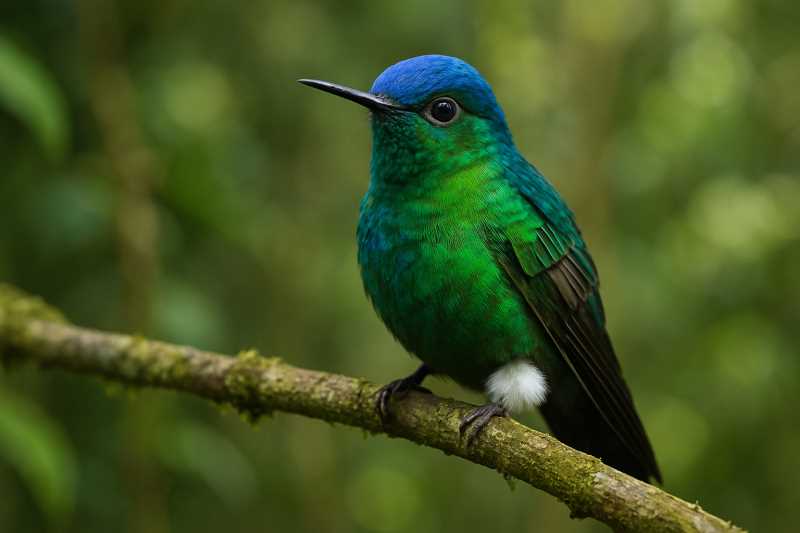
The Blue-capped Puffleg (Eriocnemis glaucopoides) is a small Andean hummingbird found in southern Bolivia and north-western Argentina. It is recognised by the male’s iridescent blue forehead, green plumage and conspicuous white leg puffs.
Physical Description
The Blue-capped Puffleg is a small hummingbird measuring approximately 9–11 cm in length. Both sexes have a straight, slender black bill, dark wings, a dark blue-black tail and dense white feather tufts around the thighs, the feature that gives pufflegs their common name.
The adult male has dark green upperparts, a glittering blue forehead and mainly golden-green underparts. The lower breast may show a bluish-green sheen, while the undertail coverts are shining purplish blue. The tail is moderately to deeply forked.
The female lacks the blue forehead and is less brightly coloured overall. Her throat, breast and belly are generally cinnamon-buff to ochraceous, sometimes with greenish markings on the sides, and the tail is less deeply forked. Juvenile males resemble females until the blue forehead develops with maturity.
Range and Habitat
The species occurs along the eastern Andes from southern and central Bolivia, including the departments of La Paz and Cochabamba, south through north-western Argentina. In Argentina, documented records include Jujuy, Salta, Tucumán and Catamarca.
It inhabits humid montane environments, including cloud-forest edges, dense shrubland, elfin woodland and open, flower-rich slopes. It may occur across more than one vegetation belt, particularly where flowering plants and sheltered vegetation are available. The Blue-capped Puffleg is not a long-distance migrant, although local or altitudinal movements may occur in response to food availability and seasonal conditions.
Where to See This Species
Calilegua National Park, Jujuy, Argentina
The Blue-capped Puffleg has been documented in Calilegua National Park, which protects extensive Yungas forest on the eastern slopes of the Calilegua Range. Look along humid forest edges, flowering clearings and dense vegetation at suitable elevations. The park is publicly accessible, although road and weather conditions should be checked before travelling.
Nearby accommodation: The town of Calilegua and the larger gateway of Libertador General San Martín offer hotels, guest houses and other practical accommodation. Camping is also available in or near the park where authorised.
El Rey National Park, Salta, Argentina
El Rey National Park is a documented locality for the species and protects a large tract of Yungas forest and adjoining Chaco habitats. The best prospects are likely to be in humid forest and flowering vegetation rather than the drier lowland sections. Access can be demanding, and four-wheel-drive transport may be appropriate on some routes.
Nearby accommodation: Visitors commonly use hotels, guest houses and campsites in Salta, Metán, Güemes or Las Lajitas, with camping also available within the park when authorised.
Aconquija National Park, Tucumán, Argentina
The Blue-capped Puffleg has been recorded in Aconquija National Park, which protects a major altitudinal gradient from Yungas forest to high mountain environments. Forest edges, montane clearings and shrub-rich areas around the park’s accessible portals provide suitable places to search for hummingbirds.
Nearby accommodation: Alpachiri is the nearest practical settlement, with cabins, guest houses and camping options. Concepción and Aguilares provide additional hotels and family accommodation.
Behaviour and Diet
The Blue-capped Puffleg feeds mainly on flower nectar and is an important pollinator of montane plants. It supplements this energy-rich diet with small insects and spiders, which provide protein and other nutrients.
It may hover while feeding or perch briefly near a flower before moving to another source. Like many hummingbirds, it is generally solitary outside the breeding context and may defend productive flowers or feeding areas from other hummingbirds.
Species-specific information about breeding remains limited. Males may use aerial displays and their iridescent plumage during courtship. The female is responsible for nest construction, incubation and care of the young, as is typical of hummingbirds.
Identification Tips
- Look for the small size, straight black bill and white feather puffs around the thighs.
- An adult male is distinctive because of its glittering blue forehead, dark green body, blue-black forked tail and purplish-blue undertail coverts.
- Females are more difficult to identify because they lack the blue forehead and have cinnamon-buff underparts.
- The white leg puffs are often the quickest clue when the bird is perched or hovering close to vegetation.
- In the known range, the adult male is unlikely to be confused with another puffleg. Female identification requires closer attention to the combination of cinnamon underparts, green upperparts, white leg puffs and the shape and colour of the tail.
Conservation Status
The Blue-capped Puffleg is classified globally as Least Concern on the IUCN Red List. A reliable global population estimate is not available, and the species is not regarded as globally threatened at present.
Habitat loss and fragmentation remain relevant local concerns because the species depends on humid montane vegetation, forest edges and flowering habitats. Agricultural expansion, logging, road development and changes in land use can reduce or isolate suitable habitat, particularly in the Yungas. Protection of remaining forest, maintenance of habitat connectivity and responsible management of national parks and other reserves are important conservation measures.
In Argentina, the species has also been assigned a more precautionary regional category, reflecting the importance of protecting its restricted national distribution.
Frequently Asked Questions
Where is the Blue-capped Puffleg found?
It occurs in the eastern Andes of southern Bolivia and north-western Argentina, including the Argentine provinces of Jujuy, Salta, Tucumán and Catamarca.
What does the Blue-capped Puffleg look like?
The male has dark green plumage, a brilliant blue forehead, a dark forked tail, blue-purple undertail coverts and white leg puffs. The female lacks the blue forehead and has cinnamon-buff underparts.
What does the Blue-capped Puffleg eat?
It feeds mainly on nectar from flowering plants and also takes small insects and spiders.
Is the Blue-capped Puffleg migratory?
It is not considered a long-distance migrant. Local or altitudinal movements may occur, but detailed movement patterns are not well documented.
Where can I see a Blue-capped Puffleg in Argentina?
Documented protected-area localities include Calilegua National Park in Jujuy, El Rey National Park in Salta and Aconquija National Park in Tucumán.
Is the Blue-capped Puffleg endangered?
The species is currently classified as Least Concern globally. Nevertheless, habitat loss and fragmentation remain potential local pressures, so the protection of Yungas forest and associated montane vegetation is important.
References
- IUCN Red List of Threatened Species
- Sistema de Información de Biodiversidad, Argentina
- Administración de Parques Nacionales, Argentina
Related posts