Introduction
The White-rumped Swift (Apus caffer) is a small, highly aerial swift of sub-Saharan Africa, with additional breeding populations in Morocco, Spain and Portugal. It spends much of its life in flight, feeding on insects above open country, woodland, cliffs and settlements.
Physical Description
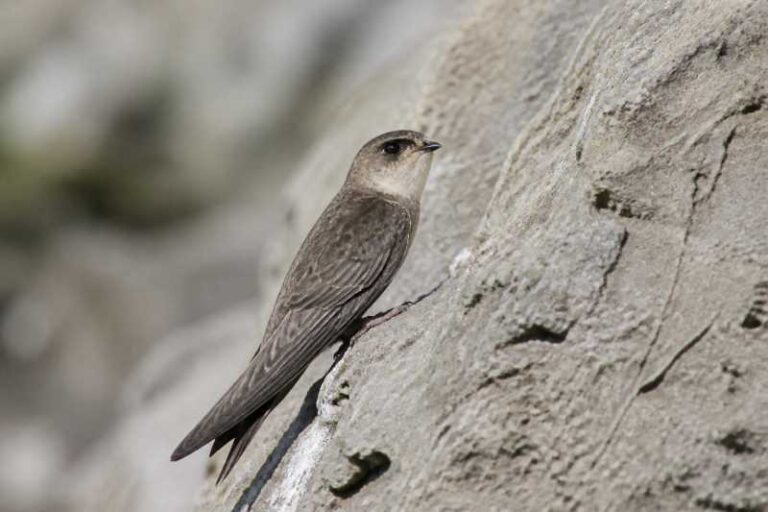
The White-rumped Swift is approximately 14–16 centimetres long, with a wingspan of about 42–48 centimetres. It has a slim, streamlined body, long pointed wings and a distinctly forked tail.
The plumage is predominantly dark brown to blackish, often showing a subtle sheen in good light. The most important field mark is the contrasting white rump, accompanied by a small pale throat patch. The white rump is usually narrower and less extensive than that of some similar swifts.
Males and females appear alike. Juveniles may have slightly fresher, paler feather edges, but age-related differences are subtle and rarely useful when birds are seen in flight.
Range and Habitat
The species occurs widely across sub-Saharan Africa, from West and East Africa through central Africa and southwards to South Africa. Smaller breeding populations occur in Morocco, Spain and Portugal. The northern and southern parts of its range are partly migratory, while many birds in tropical Africa are resident or move locally in response to rainfall and food availability.
White-rumped Swifts use open savanna, dry woodland, shrubland, Mediterranean-type habitats, forest edges and cultivated landscapes. They may also forage over villages, towns and urban areas where suitable nesting structures and abundant flying insects are available. The species is usually seen in open airspace above plains, valleys, cliffs, buildings and woodland edges.
For nesting, it often takes over old nests made by Little Swifts or swallows. Nest sites may be found on cliffs, bridges, buildings and other vertical structures rather than in trees alone.
Where to See This Species
Kruger National Park, Limpopo and Mpumalanga, South Africa
The White-rumped Swift is included on the official Kruger National Park bird checklist. Scan open skies over savanna, river courses, woodland clearings and areas around the park camps, especially during periods of strong insect activity.
Nearby accommodation: SANParks rest camps provide accommodation within the park, while Hazyview and Phalaborwa offer additional hotels, lodges and guest houses near park access points.
Kgalagadi Transfrontier Park, Northern Cape, South Africa and Botswana
SANParks notes that White-rumped Swifts may pass through the park during the rainy season. The best opportunities are likely to be over the open dry riverbeds, watercourse margins and other areas where rainfall produces temporary increases in flying insects.
Nearby accommodation: The park’s main camps provide basic campsites, chalets and self-catering accommodation. Askham is a practical gateway settlement for additional guest houses and self-catering options.
Table Mountain National Park, Western Cape, South Africa
The White-rumped Swift is recorded on the official Table Mountain National Park bird checklist. Look above open fynbos slopes, cliffs, valleys and coastal edges, particularly where warm air and insect activity bring swifts into view.
Nearby accommodation: Cape Town provides the widest choice of hotels, guest houses, lodges and self-catering accommodation, with access to several parts of the park.
Behaviour and Diet
White-rumped Swifts are active, agile fliers and are often seen singly, in pairs or in small to large groups. Their flight is fast and buoyant, with rapid wingbeats interspersed with glides. They may gather over areas with concentrated insect activity and can mix with other swift and swallow species.
The diet consists mainly of small flying insects, including flies, beetles, ants and other aerial invertebrates. Prey is caught in flight, usually high above the ground, although birds may fly lower over grassland, watercourses or woodland edges when insects are abundant.
Breeding times vary across the range and are often associated with local rainy seasons or periods of high insect availability. The species commonly uses existing nests made by Little Swifts and swallows, sometimes taking over a nest site and lining it with feathers and plant material bound with saliva. One to three eggs may be laid, and both parents contribute to incubation and feeding the young.
Identification Tips
- Look for a small, slender, dark swift with long pointed wings and a clearly forked tail.
- The narrow white rump is the key feature, but it may be difficult to see in poor light or during fast flight.
- A small pale throat patch can be visible when the bird banks or turns.
- The flight is generally more streamlined and deeply forked-tailed than that of the broader-looking Little Swift.
- Horus Swift can also create confusion in parts of Africa. Compare overall structure, tail shape, rump pattern and flight style rather than relying on the white rump alone.
- Swifts have very short legs and are poorly adapted to take-off from level ground. A bird found grounded should be assessed by a qualified wildlife rehabilitator.
Conservation Status
The White-rumped Swift is currently listed as Least Concern on the IUCN Red List. The 2018 global assessment recorded the population trend as increasing, although the total number of mature individuals was not estimated.
The species is relatively widespread and uses a variety of habitats, but local populations may be affected by the loss of nesting structures, changes in insect abundance, habitat clearance and extreme weather. Protecting natural landscapes, retaining suitable older buildings and bridges, and maintaining healthy insect populations can all support the species.
Frequently Asked Questions
Where can the White-rumped Swift be found?
It is found mainly across sub-Saharan Africa, with smaller breeding populations in Morocco, Spain and Portugal. Some populations are resident, while others migrate seasonally.
What does a White-rumped Swift look like?
It is a slim, dark swift with long pointed wings, a deeply forked tail, a narrow white rump and a small pale throat patch. Males and females look alike.
What does the White-rumped Swift eat?
It feeds mainly on small flying insects, including flies, beetles, ants and other aerial invertebrates caught during flight.
Where does the White-rumped Swift nest?
It often occupies old nests made by Little Swifts or swallows. Nest sites may occur on cliffs, bridges, buildings and other vertical structures.
Is the White-rumped Swift migratory?
Movement varies geographically. The northernmost and southernmost populations are partly migratory, while many tropical African populations remain resident or move locally with rainfall and food availability.
How can it be distinguished from a Little Swift?
The White-rumped Swift is generally slimmer, with a more deeply forked tail and a narrower white rump. Care is needed because both species are fast-moving and may occur together.
References
- IUCN Red List of Threatened Species
- IOC World Bird List
- South African National Parks
Related posts