Introduction
The Feline Owlet-nightjar (Aegotheles insignis) is a nocturnal bird of montane New Guinea. It belongs to the owlet-nightjar family, Aegothelidae, and is recognised by its cryptic brown plumage, large eyes and secretive behaviour. The species is resident rather than migratory and is most often encountered in forested mountain regions. (birdsoftheworld.org)
Physical Description
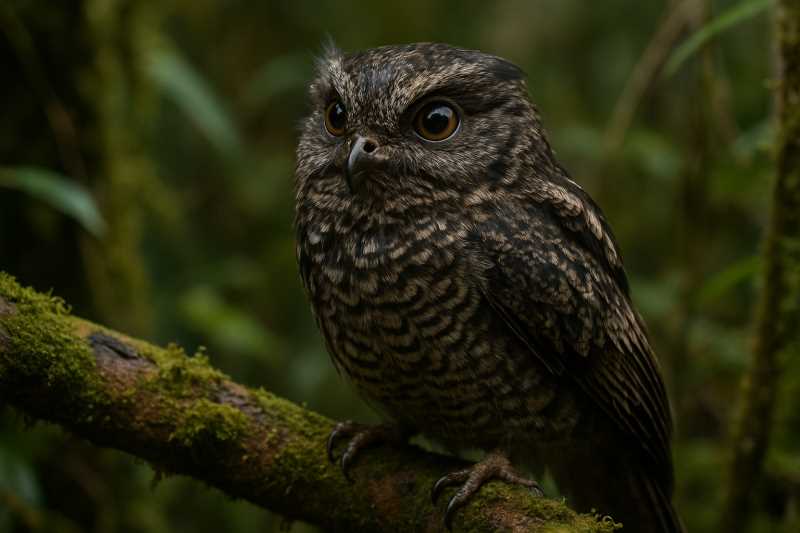
The Feline Owlet-nightjar is a medium-sized owlet-nightjar with mottled brown, grey and warm rufous plumage that blends closely with bark, moss and shadowed forest vegetation. Pale streaking and vermiculated markings on the underparts help break up its outline when it is perched.
Its large eyes are adapted to low-light activity, while the short bill is surrounded by fine facial bristles. These bristles, known as rictal bristles, are characteristic of owlet-nightjars and may help detect or handle flying insects during nocturnal foraging. The combination of a broad head, short bill, prominent eyes and soft, cryptic plumage contributes to the species’ somewhat feline appearance.
Reliable evidence for strong sexual dimorphism is lacking, and males and females are generally difficult to distinguish in the field. Young birds can differ from adults in plumage. Research on the species has identified a rufous, less heavily vermiculated juvenile plumage, so age-related variation should be considered when identifying unusual-looking individuals. (sora.unm.edu)
Range and Habitat
The Feline Owlet-nightjar is endemic to New Guinea, where it occurs in the island’s main mountain ranges and several outlying ranges. It is associated primarily with montane forest, including primary and secondary forest. Records also exist from forest edges, fallow areas and other partly modified habitats, although the species remains dependent on tree cover.
Published specimen data place the nominate form mainly between about 1,140 and 2,800 metres above sea level, with some records possibly approaching the upper forest limit. This is more restricted than broad estimates sometimes given for the species and reflects the better-supported evidence for its montane distribution. The habitat includes cool, humid forest with mature trees, mossy growth and suitable daytime roosting sites. (researchgate.net)
Taxonomic treatment has changed over time. The lowland Starry Owlet-nightjar, formerly included within a broader concept of the Feline Owlet-nightjar, is now treated as a separate species by major modern checklists. The Feline Owlet-nightjar should therefore be understood as the montane New Guinea species Aegotheles insignis. (worldbirdnames.org)
Where to See This Species
Pegunungan Arfak Nature Reserve, West Papua, Indonesia
The Arfak Mountains are one of the most realistic places to look for the Feline Owlet-nightjar. The species has been documented in the reserve and along birding routes through the Arfak Mountains, including records from forest roads and day-roost sites. Local guides familiar with the area may know traditional roost locations, but sightings are never guaranteed because the bird is well camouflaged and active mainly at night. (ebird.org)
Nearby accommodation: Mokwam and nearby Arfak villages provide basic guesthouses, homestays and camps. Manokwari is the main gateway for visitors seeking a wider choice of hotels and other practical accommodation.
Behaviour and Diet
The Feline Owlet-nightjar is primarily nocturnal. During daylight it usually remains motionless at a concealed roost, often on a branch or against a tree trunk where its plumage makes it difficult to detect. Observers have recorded individuals at day roosts along forest trails in the Arfak Mountains.
At dusk and during the night, it becomes active and hunts flying insects. Beetles, moths and other small invertebrates are consistent with the feeding ecology of owlet-nightjars, although detailed, species-specific dietary studies remain limited. The bird is thought to make short flights from a perch to intercept prey, then return to another perch or the original lookout.
The species is usually encountered alone, and little is known about its social organisation outside the breeding period. Breeding observations are scarce. Tree hollows, cavities or other sheltered sites are considered plausible nesting locations, but the available evidence is insufficient to describe clutch size, incubation or parental care with confidence. Bioacoustic monitoring and carefully documented nocturnal surveys could improve knowledge of its calls, distribution and breeding biology.
Identification Tips
- Look for a medium-sized, broad-headed nocturnal bird with mottled brown, grey and rufous plumage.
- Focus on the large eyes, short bill, rounded head and fine facial bristles.
- A bird sitting motionless against a mossy trunk or branch during the day may be easier to locate than one in flight.
- At night, listen around mature montane forest edges, trails and known roosting areas, particularly near dusk.
- Do not rely on the name alone. The facial appearance is suggestive rather than genuinely cat-like, and the species is more likely to be identified by its shape, plumage and habitat than by a single feature.
- In New Guinea, take care not to confuse it with other owlet-nightjars, especially the Mountain Owlet-nightjar and the separately recognised Starry Owlet-nightjar. Elevation, geographic location, body proportions, plumage pattern and vocalisations are all important. (worldbirdnames.org)
Conservation Status
The Feline Owlet-nightjar is currently assessed as Least Concern. This category does not mean that the species is unaffected by habitat loss. BirdLife International identifies forest clearance and the continuing reduction of tree cover as important concerns, while the population is suspected to be declining. Exact population estimates are not available, reflecting the difficulty of surveying a nocturnal bird in remote mountain forests. (datazone.birdlife.org)
The principal conservation priority is the retention of intact montane and submontane forest across New Guinea. Logging, agricultural expansion, mining and associated infrastructure can reduce suitable habitat or fragment forest. Protected areas such as the Pegunungan Arfak Nature Reserve provide an important framework for habitat protection, but effective conservation also depends on sustainable land use, local participation and improved field research.
Frequently Asked Questions
Where is the Feline Owlet-nightjar found?
It is endemic to New Guinea, where it occurs mainly in montane forests across the island’s central and outlying mountain ranges. It is not a naturally occurring bird of mainland Australia.
Is the Feline Owlet-nightjar nocturnal?
Yes. It is mainly active after dark and usually spends the day concealed at a roost. It may sometimes be located during daylight if a bird is sitting at a known roost site.
What does the Feline Owlet-nightjar eat?
It is believed to feed mainly on flying insects and other small invertebrates, including moths, beetles and spiders. Detailed studies of its diet are limited.
How high does the Feline Owlet-nightjar live?
The best-supported specimen records place it mainly at approximately 1,140 to 2,800 metres above sea level, although local records and taxonomic treatments may vary.
Is the Feline Owlet-nightjar endangered?
No. It is currently listed as Least Concern, but its population is suspected to be declining because it depends on forest and is exposed to habitat loss.
Where is the best place to look for this species?
The Arfak Mountains of West Papua, Indonesia, are among the most reliable publicly accessible areas for searching. Visitors should use local guides, concentrate on mature forest and forest trails, and expect that most encounters will require careful nocturnal listening or knowledge of daytime roosts.
References
- BirdLife International
- IOC World Bird List
- U.S. Geological Survey
Related posts