
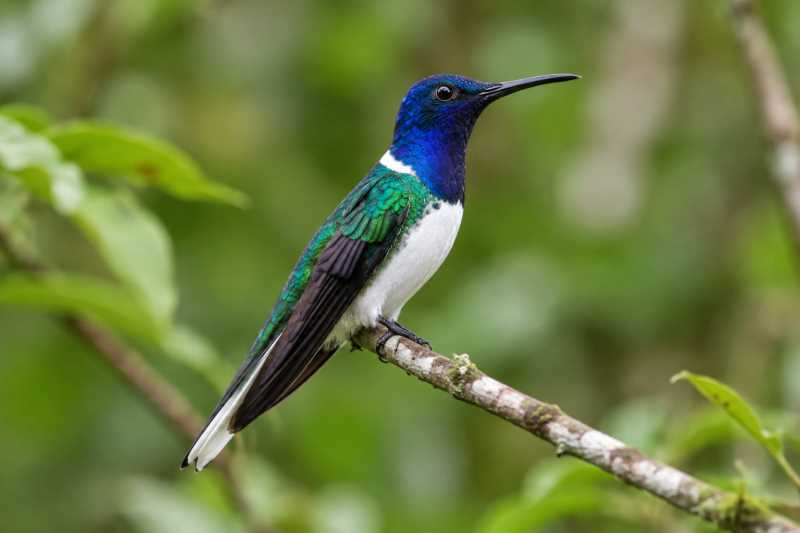
The White-necked Jacobin (Florisuga mellivora) is a captivating species of hummingbird that enchants birdwatchers and ornithologists alike with its dazzling appearance and intriguing behavior. Found primarily in the neotropical regions of Central and South America, this avian jewel is a testament to the richness of biodiversity in these ecosystems. In this article, we delve into the life, habitat, and unique characteristics of the White-necked Jacobin, shedding light on why it has become a symbol of beauty and ecological importance.
Appearance and Physical Characteristics The White-necked Jacobin is immediately recognizable due to its striking plumage and distinctive markings. Adult males boast a brilliant blue head and upper breast, contrasted by a bright white lower breast and belly. Their back and wings are an iridescent green, which, depending on the light, can shimmer with hues of emerald and teal. The namesake white neck collar is complemented by a long, straight bill designed for optimal nectar feeding. Females, while less vibrant, are equally fascinating, displaying a range of plumage variations from a duller blue to more muted greens and whites. This sexual dimorphism not only adds to their charm but also plays a role in their mating rituals and social dynamics.
Habitat and Distribution White-necked Jacobins inhabit a range of environments, from lowland rainforests and forest edges to gardens and plantations. Their distribution spans from southern Mexico through Central America and into the northern regions of South America, including countries like Colombia, Venezuela, and Ecuador. These birds are often found at elevations up to 1,200 meters but are most abundant in lowland tropical forests, where flowering plants are plentiful.
Ecological Role and Feeding Behavior As a nectarivorous species, the White-necked Jacobin plays a crucial role in pollination. Their feeding habits involve visiting a wide variety of flowers, which they pollinate as they feed. This mutualistic relationship is vital for the reproductive success of many plant species and highlights the hummingbird’s ecological importance.
In addition to nectar, Jacobins also consume small insects and spiders, which provide essential proteins and nutrients necessary for their high-energy lifestyle. Their feeding behavior is characterized by rapid, agile flight patterns as they hover in front of flowers or catch insects mid-air, showcasing their incredible maneuverability and speed.
Reproduction and Social Behavior The breeding season for the White-necked Jacobin varies depending on the region, but it generally occurs during the wet season when food resources are abundant. Males are known for their elaborate courtship displays, which include acrobatic flight maneuvers and vocalizations designed to attract females.
Females are responsible for nest building and chick rearing. They construct small cup-shaped nests using plant fibers and spider silk, often positioning them on the undersides of leaves or small branches for protection. The female lays two eggs, which she incubates alone, while the male continues to display and defend his territory.
Socially, White-necked Jacobins are known to be both solitary feeders and participants in mixed-species foraging flocks. This adaptability in social behavior allows them to exploit a wide range of food resources and avoid competition with other hummingbird species.
Conservation Status and Threats Currently, the White-necked Jacobin is classified as a species of Least Concern by the International Union for Conservation of Nature (IUCN). However, like many other species that inhabit tropical regions, they face threats from habitat destruction and climate change. Deforestation for agriculture and urban development reduces the availability of suitable habitats and food sources, posing a long-term threat to their populations.
Conservation efforts focusing on habitat preservation and restoration are essential to ensure the survival of the White-necked Jacobin and other species within these biodiverse ecosystems. Raising awareness about the ecological roles of such species and the threats they face can help garner support for conservation initiatives.
Conclusion The White-necked Jacobin is more than just a visually stunning bird; it is an integral part of the ecosystems it inhabits. Its role as a pollinator and its adaptability to various habitats make it a key species for maintaining the health and diversity of tropical environments. By understanding and appreciating the unique characteristics of the White-necked Jacobin, we can better advocate for the preservation of the natural world and the myriad species that enrich it.
Related posts


